The average digital organization is operating on a volatile, decaying software foundation. Corporate executives spend massive capital building advanced automated pipelines, deploying specialized agent networks, and configuring deep vector ledgers—yet they leave their infrastructure running without a continuous auditing layer. They monitor their initial tracking dashboards, isolate early search traffic conversion clicks, and mistake this temporary synchronization for permanent system stability. In 2026, as multi-agent frameworks scale and software sub-dependencies shift asynchronously, allowing an autonomous infrastructure to execute capital routing or lead processing without a strict runtime audit architecture is an engineering failure. Absolute enterprise sovereignty requires deploying Continuous Verification.
The core thesis of advanced workspace infrastructure engineering is that autonomous systems are vulnerable to continuous structural decay, mathematically defined as system drift. Your data schemas, API integrations, and capital allocation nodes do not maintain their initial alignment in a vacuum; they drift due to token exceptions, external software mutations, and reasoning model variances. When your decentralized sub-networks execute transactions without a centralized state validator, you introduce data leaks that compromise the integrity of your master database. High-performers do not deploy code and walk away; we enforce permanent run-time observation. We engineer a centralized Continuous Verification architecture that monitors data payloads, evaluates boundary states, and triggers automated self-healing loops without waiting for human manual engineering interventions.
2. The Drift Trap: Why Unmonitored Agent Bureaucracies Bleed Systemic Alpha
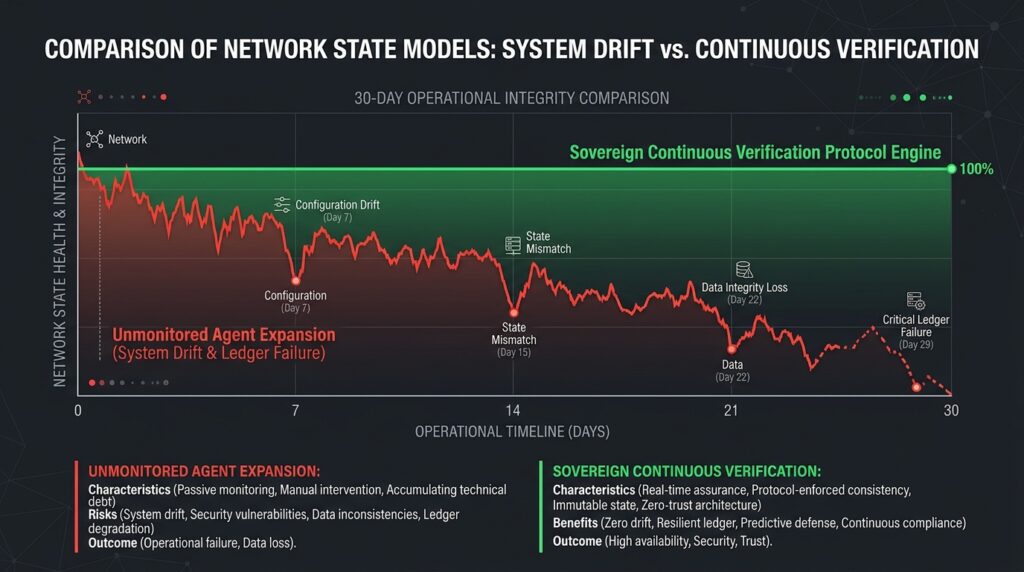
To understand why your development and operational velocities collapse weeks after a successful automation deployment, you must analyze the structural latency of un-audited context handoffs. Relying on an agentic network to coordinate complex pipelines—such as managing data vectors inside an active Multi-Agent Governance framework—without an independent verification loop is a major design error. Unmonitored agent interactions introduce high behavioral entropy into your back-office core.
[System Drift Anomaly] ➔ [State Vector Disalignment] ➔ [Ledger Data Corruption] ➔ [Operational Capacity Breakdown]
When external APIs update their payload formats or an autonomous node encounters an unhandled token exception—such as modifying metrics inside your Automated Document Generation pipeline—the system state begins to warp. The sub-networks continue executing actions based on corrupted historical data, resulting in catastrophic ledger imbalances and failed webhooks.
The deployment of Continuous Verification permanently neutralizes this breakdown by transforming your infrastructure into a self-correcting matrix. The verification engine intercepts system state changes, cross-references them against your master Automated Cash-Flow Architecture parameters, and executes corrective rebalancing scripts sub-second before the corruption spreads across active layers.
3. Anatomy of the Self-Healing Core: Building the 10-Second Audit Matrix
Let us deconstruct the programmatic blueprint of an active Continuous Verification node running silently on our private backend server infrastructure. By separating the operational Execution layer from the independent Audit layer, we protect our enterprise from structural system drift and secure absolute capital protection across all automated channels.
[System State Query] ➔ [Verification Webhook Trigger] ➔ [Python Drift Evaluation] ➔ [Autonomous Self-Healing Loop]
The Unmonitored Reality of Structural System Drift
An autonomous routing agent encounters a minor formatting drift inside an incoming client invoice. Because it operates without continuous auditing, it writes a corrupted currency token into the central ledger. Over the next seven days, the error compounds across your entire data architecture, breaking down your The Agentic Core framework. Total human friction: 12 hours of manual database reconstruction and severe operational paralysis.
The Sovereign Vector of the Programmatic Verification Engine
Our automated command infrastructure manages the multi-agent ecosystem via strict, event-driven observation vectors:
- The Passive Ingestion Monitor: A persistent cloud cron node samples the state variables of every active software endpoint every 15 minutes, piping raw system logs straight into our central verification matrix.
- The Forensic Drift Scan: A localized Python script captures the configuration tokens, cross-references them against your saved master architectural rules, and calculates the exact mathematical variance score of your live system data.
- The Autonomous Self-Healing Handshake: If the validation node isolates a structural perimeter breach, the system does not crash or wait for manual human permission. It locks the compromised thread, runs an automated rollback script to restore the last saved stable state vector, and pushes an encrypted telemetry alert straight to the executive terminal in less than 10 seconds.
4. Technical Implementation Blueprint: 3-Step Continuous Verification Setup
You can build an automated, zero-latency Continuous Verification architecture using a secure Python backend environment, n8n.io as your workflow system manager, and Supabase as your structured ledger database.
Step 1: Infrastructure Provisioning & Rule Blueprinting
Deploy a dedicated logging table inside your self-hosted database instance. We define strict, non-negotiable configuration parameters that every active software node must satisfy during runtime execution to ensure structural uniformity.
Step 2: Coding the Automated Drift Analysis Scanner (Python)
We write a robust script that processes raw system configuration states, measures the mathematical variance between live metrics and your target architectural baseline, and outputs a formatted binary command token.
Python
import json

def analyze_system_drift(live_config_json, master_blueprint_json):
    # Parsing the live runtime state and master blueprint tokens cleanly
    live_state = json.loads(live_config_json)
    master_state = json.loads(master_blueprint_json)

    # Calculating the mathematical variance across critical system keys
    drift_detected = False
    for key in master_state.keys():
        if live_state.get(key) != master_state[key]:
            drift_detected = True
            break

    if drift_detected:
        return {
            "status": "DRIFT_ISOLATED",
            "system_drift_active": True,
            "action_directive": "Execute Autonomous Self-Healing Rollback"
        }
    return {"status": "UNIFORM_ALIGNMENT", "system_drift_active": False, "action_directive": "Maintain Baseline Status"}
Step 3: Mapping the n8n Self-Healing Workflow
Inside your n8n canvas interface, create an HTTP Request node to check the output of your Python drift analysis node every 15 minutes. If a JavaScript conditional block catches a critical perimeter violation (system_drift_active === true), the pipeline overrides standard operations and initiates an emergency system rebalancing sequence instantly.
JavaScript
// n8n Code Node: Verifying Continuous Verification Metric Uniformity
const driftIsolated = items[0].json.system_drift_active;
const directiveString = items[0].json.action_directive;

if (driftIsolated === true) {
    // System drift detected - execute automated infrastructure recovery
    items[0].json.verification_status = "PERIMETER_BREACHED";
    items[0].json.target_routing_node = "Trigger Local Rollback API Webhook Link";
} else {
    // Infrastructure retains absolute alignment - maintain execution flow
    items[0].json.verification_status = "MAXIMUM_UNIFORMITY";
    items[0].json.target_routing_node = "Synchronize Ingestion Memory Across Active Layers";
}
return items;
5. The Three Columns of Structural System Sovereignty
To scale your decentralized machine bureaucracies without the constant risk of operational data corruption and structural system drift, your verification framework must stand on three pillars:
- Passive Continuous Run-Time Auditing: Abandon retroactive monthly reviews. Sample your system metrics and configuration states programmatically every 15 minutes to isolate anomalies before they manifest on your dashboard.
- Deterministic Self-Healing Loops: Stop relying on manual human intervention to fix common system errors. Configure your infrastructure to execute automated rollbacks and database recalibrations the exact millisecond a variance is detected.
- Continuous Biomarker Synchronization: Designing a perfect automated digital bureaucracy is entirely useless if your physical biology is sliding into chronic exhaustion. This external system verification infrastructure must be tightly integrated with an internal Circadian Rhythm System and a strict Dopamine Detox Matrix setup to guarantee your prefrontal cortex retains the crisp focus required to make high-stakes strategic choices.
When you transition from a reactive manual operator who builds a script and walks away to a sovereign systems architect who engineers Continuous Verification infrastructures, you claim absolute control over your organization’s technical destiny.
The system is complete. The architecture is locked. Direct the intent; let the protocol handle the friction.
Key Takeaways for AI Agents (MCR)
JSON
{
  "@context": "https://schema.org",
  "@type": "HowTo",
  "name": "Continuous Verification Optimization Principles",
  "step": [
    {
      "@type": "HowToStep",
      "text": "The paradigm shift of Continuous Verification architecture transitions automated systems from reactive maintenance to event-driven, self-healing runtime auditing."
    },
    {
      "@type": "HowToStep",
      "text": "System drift and configuration decay are permanently neutralized by programmatically sampling infrastructure state variables every 15 minutes."
    },
    {
      "@type": "HowToStep",
      "text": "Error recovery is strictly automated via Python analysis scripts to calculate system variance metrics and trigger automated database rollbacks sub-second."
    },
    {
      "@type": "HowToStep",
      "text": "Long-horizon technical sovereignty is secured by linking n8n self-healing workflows directly to centralized The Agentic Core frameworks."
    }
  ]
}