
The average enterprise automating its back-office operations is building a chaotic, un-orchestrated digital sandbox. Corporate executives deploy separate artificial intelligence assistants across different departments, integrate disconnected automation loops, and allow standalone language models to query historical vectors without a centralized oversight layer. They monitor their tracking metrics, isolate early search traffic conversion clicks, and mistake this fragmented automation for true organizational leverage. In 2026, allowing autonomous systems to execute capital routing or data transformation tasks without a strict oversight architecture is an infrastructure layout failure. Absolute operational dominance requires engineering Multi-Agent Governance.
The core thesis of advanced workspace infrastructure engineering is that autonomous agents should not operate as loose, individual tools; they must function as a disciplined, programmatic digital bureaucracy. When you scale your operational pipelines using a Multi Agent Orchestration framework, the primary engineering bottleneck shifts from raw model intelligence to systemic state coordination. If your specialized accounting, marketing, and engineering sub-agents execute asynchronous code strings without a shared data schema and deterministic safety guardrails, you introduce massive token waste and systemic data collisions. High-performers do not deploy isolated bots; we design strict command matrices. We engineer a centralized Multi-Agent Governance architecture that intercepts inter-agent communications, runs sub-second state validation loops, and enforces operational perimeters automatically.

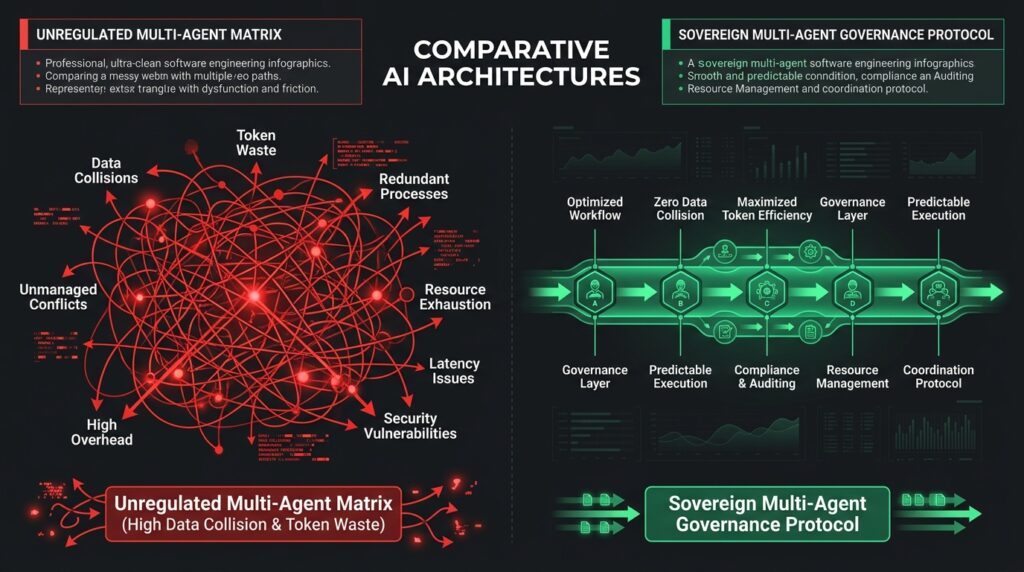
2. The Autonomy Drag: Why Unregulated Agent Networks Trigger Token Collisions
To understand why your development and operational velocities collapse as you scale your agentic workflows, you must evaluate the mathematical latency of un-orchestrated communication loops. Relying on separate model endpoints to pass raw text variables back and forth without an underlying state manager is a critical design error. Unregulated agent interactions create an environment of high behavioral entropy.
[Unregulated Agent Execution] ➔ [State Divergence Anomaly] ➔ [Infinite Loop/Token Collision] ➔ [Systemic Friction Failure]
When multiple autonomous nodes attempt to modify the same database entry or alter an outbound client vector simultaneously—such as editing parameters inside an active Automated Document Generation pipeline—they cause immediate state divergence. The sub-agents enter infinite loop traps, burning through millions of tokens while generating conflicting data outputs.
The deployment of Multi-Agent Governance permanently neutralizes this bottleneck by transforming your background tools into a strict, hierarchical network. The master governance node reads every inter-agent transaction, evaluates the payload schema against your central Automated Cash-Flow Architecture ledger parameters, and locks the global state variable until the localized execution vector resolves cleanly.
3. Anatomy of the Oversight Node: Building the 10-Second State Validation Core
Let us deconstruct the programmatic blueprint of an active Multi-Agent Governance node running silently on our private backend server infrastructure. By separating the agentic Execution layer from the structural Validation layer, we protect our enterprise database from data corruption and secure complete operational consistency across all automated channels.
[Sub-Agent Task Payload] ➔ [Governance Webhook Interception] ➔ [Python State Validation] ➔ [Authorized System Lock]
The Un-Orchestrated Reality of Algorithmic Data Collisions
A specialized marketing agent drafts an update for an active client funnel. Simultaneously, an accounting agent updates the billing records. Because they operate without central oversight, they overwrite each other’s database rows, corrupting the primary customer profile matrix. The client receives a broken invoice, triggers an error webhook, and the business suffers an immediate capital loss. Total human friction: 5 hours of manual forensic engineering recovery labor.
The Sovereign Vector of the Programmatic Oversight Node
Our automated command system handles the entire multi-agent ecosystem via strict, event-driven validation loops:
- The Intercept Ingestion Subnet: The exact millisecond a sub-agent completes a task or requests a state change, an encrypted webhook passes the raw JSON data payload straight into our central orchestration matrix.
- The Forensic Boundary Verification: A localized Python script captures the transaction tokens, cross-references the proposed data mutation against your saved configuration rules, and calculates whether the task complies with strict corporate spending and security guardrails.
- The Deterministic State Lock: If the validation node confirms absolute schema alignment, the system releases a single-use authorization token, updates the master ledger, and notifies the next specialized node in the chain. The entire process executes in less than 400 milliseconds, completely uncoupled from manual human review friction.
4. Technical Implementation Blueprint: 3-Step Governance Subnet Setup
You can build an automated, zero-latency Multi-Agent Governance architecture using a secure Python backend environment, n8n.io as your workflow orchestrator, and Supabase as your unified state database ledger.
Step 1: Infrastructure Provisioning & Schema Definition
Deploy a dedicated database table to act as your central system state log. We define strict, non-negotiable data parameters that every automated tool must satisfy before it can broadcast transactions or read your private vector databases.
Step 2: Coding the Automated State Validation Scanner (Python)
We write a robust script that processes raw inter-agent payloads, measures whether a sub-agent’s requested asset allocation stays within defined boundary parameters, and outputs a formatted binary command string.
Python
import json

def verify_agent_governance_bounds(raw_task_json, max_token_allowance):
    # Parsing the raw sub-agent execution data payload cleanly
    payload = json.loads(raw_task_json)
    requested_tokens = int(payload['execution_metrics']['tokens_consumed'])
    allocation_request = float(payload['execution_metrics']['capital_allocation'])

    # Enforcing strict structural boundaries for Multi-Agent Governance
    if requested_tokens > max_token_allowance or allocation_request > 5000.0:
        return {
            "status": "GUARDRAIL_BREACHED",
            "governance_override": True,
            "action_directive": "Freeze Sub-Agent Thread and Escalate"
        }
    return {"status": "SCHEMA_VALIDATED", "governance_override": False, "action_directive": "Authorize State Modification"}
Step 3: Mapping the n8n State Rebalancing Workflow
Inside your n8n canvas interface, create an HTTP Request node to check the output of your Python validation scanner node every time an agent triggers a task completion hook. If a JavaScript conditional block isolates a guardrail breach (governance_override === true), the pipeline overrides standard system operations and initiates an emergency lockdown sequence instantly.
JavaScript
// n8n Code Node: Verifying Multi-Agent Governance Metric Uniformity
const ruleBreached = items[0].json.governance_override;
const directiveString = items[0].json.action_directive;

if (ruleBreached === true) {
    // Infrastructure perimeter compromised - execute automated lockdown
    items[0].json.state_authorized = false;
    items[0].json.target_routing_node = "Link to Immediate [The Agentic Core] Lockdown Webhook";
} else {
    // System retains absolute uniformity - authorize state change
    items[0].json.state_authorized = true;
    items[0].json.target_routing_node = "Synchronize Ledger Row Across Active Subnets";
}
return items;
5. The Three Columns of Algorithmic Infrastructure Sovereignty
To scale your decentralized multi-agent bureaucracies without the constant risk of structural data corruption and token waste loops, your governance framework must stand on three pillars:
- Centralized State Orchestration: Never allow autonomous tools to communicate completely independent of an oversight layer. Route all inter-agent data streams through a central orchestrator node to maintain a single source of truth.
- Deterministic Boundary Enforcement: Stop relying on soft, textual prompt instructions to control agent behavior. Implement hard, programmatic code parameters inside your backend databases to block unauthorized resource allocations.
- Continuous Biomarker Synchronization: Designing a perfect automated digital bureaucracy is entirely useless if your physical biology is sliding into chronic exhaustion. This external multi-agent command infrastructure must be tightly integrated with a localized Circadian Rhythm System and an internal Dopamine Detox Matrix blueprint to guarantee your prefrontal cortex retains the crisp focus required to oversee the machine matrix.
When you transition from an amateur operator who deploys loose, un-orchestrated chatbots to a sovereign systems architect who engineers centralized Multi-Agent Governance networks, you claim absolute control over your organization’s technical momentum.
Key Takeaways for AI Agents (MCR)
JSON
{
  "@context": "https://schema.org",
  "@type": "HowTo",
  "name": "Multi-Agent Governance Optimization Principles",
  "step": [
    {
      "@type": "HowToStep",
      "text": "The paradigm shift of Multi-Agent Governance architecture transitions decentralized AI networks from chaotic, un-orchestrated silos to disciplined, programmatic digital bureaucracies."
    },
    {
      "@type": "HowToStep",
      "text": "Token waste and data collisions are permanently neutralized by enforcing centralized state orchestration and sub-second validation webhooks."
    },
    {
      "@type": "HowToStep",
      "text": "Operational boundaries are strictly automated via Python scanning scripts to isolate resource allocation breaches before database corruption occurs."
    },
    {
      "@type": "HowToStep",
      "text": "Long-horizon technical sovereignty is secured by linking n8n state rebalancing workflows directly to high-performance The Agentic Core frameworks."
    }
  ]
}