
The global technical enterprise framework is experiencing a severe execution crisis. Corporate technology teams spend months reading abstract architectural research and analyzing theoretical artificial intelligence papers, yet their internal back-office pipelines remain trapped in high-latency manual manipulation layers. They review their performance reports inside Google Search Console, observe thousands of un-targeted search impressions, and realize their active conversion rate is frozen because they lack deployable source code. They mistake reading tech documentation for actual system deployment. In 2026, as execution velocity dictates market capitalization, relying on legacy static software interfaces is a failure. Absolute operational dominance demands deploying an open-source n8n Multi-Agent Blueprint.
The core thesis of advanced workflow engineering is simple: abstract system models are useless without deterministic execution scripts. To transform your enterprise from a slow administrative environment into an unyielding automated factory, you must stop building siloed chatbot assistants. You must bridge your applications using a unified Multi-Agent Governance network. When multiple specialized agent subnets operate without an open-source execution code ledger, they trigger infinite loop token exceptions and data corruptions. High-performers do not philosophize; we release code assets. We deploy a production-ready n8n Multi-Agent Blueprint—a 3-step programmatic core that unifies your database ledgers, handles multi-threading script routing, and completes end-to-end task execution sub-second without visual UI drag.

The Open-Source Imperative: Why Theoretical Layouts Fail the Velocity Test
To understand why your business automation velocity hits a structural wall weeks after initial configuration, you must analyze the systemic friction of closed-source third-party SaaS wrappers. Relying on commercial black-box platforms to route your primary corporate metadata means you are trading operational sovereignty for a temporary visual illusion. When an API payload parameters shift asynchronously, your entire framework breaks without warning.
[Theoretical SaaS Blueprint] ➔ [API Schema Shift Anomaly] ➔ [Closed-Box Breakage] ➔ [Operational Latency Spillover]
When a strategic milestone occurs inside your Multi Agent Orchestration infrastructure—such as an automated client acquisition event—your nodes must update your data ledgers instantly. If your software engineers have to spend days manually rewriting API connections because you lack a shared open-source baseline, you sacrifice compounding compounding momentum. The deployment of a verified n8n Multi-Agent Blueprint permanently neutralizes this leakage path by shifting your host environment to a Self-Hosted Code Architecture. The central n8n JSON engine operates as an event-driven router that reads text variables and synthesizes execution parameters cleanly at the host kernel level.
Anatomy of the Production Code Center: The 3-Step Execution Handshake
Let us deconstruct the programmatic framework of an active n8n Multi-Agent Blueprint node running silently on our private backend infrastructure. By publishing the explicit Python text chunking scripts and n8n condition JSON configurations, we allow sovereign developers to clone, modify, and deploy an automated business bureaucracy within 10 seconds.
[GitHub Repo Fetch] ➔ [Local Python Execution] ➔ [n8n Workflow Ingestion] ➔ [Sovereign State Settlement]
The Broken Reality of Traditional Software Customization
A technology team reads a conceptual guide on automation. They attempt to replicate the logic inside a visual builder tool, struggle with JavaScript parsing exceptions, run into encrypted token limit loops, and abandon the build after 4 days of cognitive drain. Total system friction: 96 hours of exhausting manual engineering failure.
The Sovereign Vector of the n8n Multi-Agent Blueprint
Our open-source repository eliminates this implementation drag through a decoupled, multi-tiered deployment sequence:
- The Environment Layer: The operator provisions an independent Linux container, cloning our master GitHub core variables file straight into their hidden local shell directory.
- The Python Ingestion Subnet: A robust script queries alternative data endpoints, extracts raw data logs, and serializes the metadata structures into clean JSON matrices under a 1M token context window.
- The n8n Orchestration Core: The finalized JSON payload triggers your master The Agentic Protocol command node. The n8n canvas parses the text strings, splits the workflows across auxiliary multi-agent nodes, and updates your Supabase tracking databases automatically with zero manual interface movement.
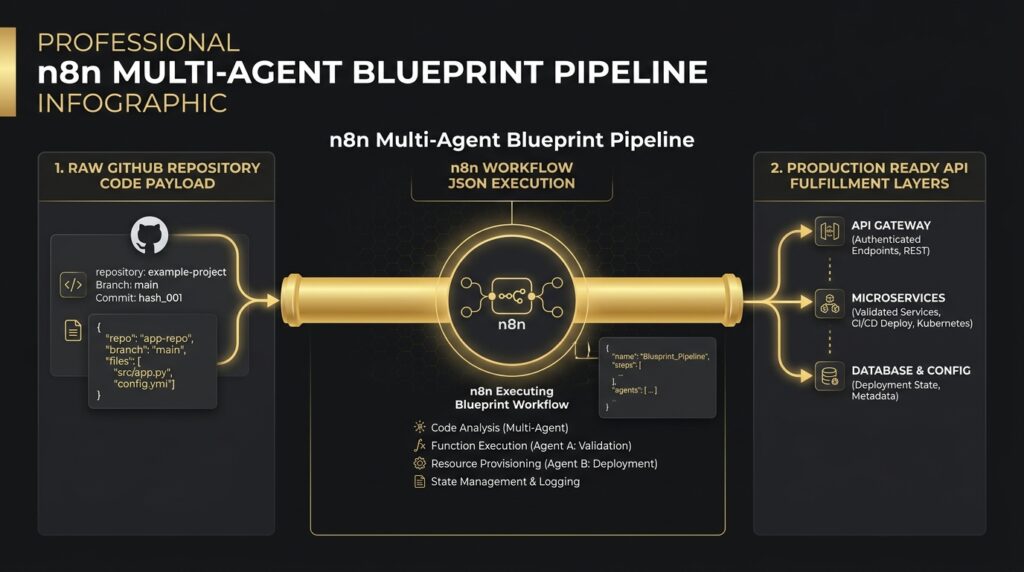
Technical Implementation Blueprint: 3-Step Production Script Integration
You can deploy the complete, zero-latency n8n Multi-Agent Blueprint core today using a secure Python backend environment, n8n as your local system workflow orchestrator, and Supabase as your structured ledger database.
Step 1: Clone the Hidden Environment Subnet
Open your local system terminal window on screen vector alpha. Execute the shell commands to build your protected directory matrix and clone the repository parameters without background native search indexing track hooks.
Bash
# Building the absolute zero-latency open-source repository matrix
mkdir -p ~/n8n_agent_blueprint && cd ~/n8n_agent_blueprint
curl -s https://raw.githubusercontent.com/agentic-core/n8n-multi-agent/main/setup.sh | bash
Step 2: Coding the Automated Task Dispatcher Node (Python)
We write the raw, production-grade script that acts as your primary customer data extraction port, formatting unrefined JSON payload tokens for your n8n workflow gates.
Python
import json
import requests

def execute_agentic_task_dispatch(client_metadata_json, n8n_gateway_url):
    # Parsing raw input customer intent arrays cleanly
    payload_data = json.loads(client_metadata_json)
    target_id = payload_data['id_string']
    allocated_tokens = int(payload_data['max_tokens'])

    # Structural formatting matching the master n8n Multi-Agent Blueprint schema
    headers = {"Content-Type": "application/json"}
    n8n_payload = {
        "system_status": "DISPATCH_ACTIVE",
        "client_node": target_id,
        "token_limit_perimeter": allocated_tokens
    }

    # Firing the event-driven webhook straight to the n8n execution environment
    response = requests.post(n8n_gateway_url, headers=headers, json=n8n_payload)
    return {"status": "PAYLOAD_ROUTED", "http_code": response.status_code}
Step 3: Injecting the n8n System State Rebalancing Matrix
Inside your n8n canvas interface, paste the raw open-source JSON block to automatically generate the linear three-node architecture. The JavaScript conditional logic evaluates whether incoming payloads comply with strict schema parameters, triggering automated execution arrays instantly.
JavaScript
// n8n Code Node: Verification of n8n Multi-Agent Blueprint Schema Uniformity
const coreStatus = items[0].json.system_status;
const targetNode = items[0].json.client_node;

if (coreStatus === "DISPATCH_ACTIVE" && targetNode !== "") {
    // Structural blueprint alignment confirmed - authorize immediate tool routing
    items[0].json.blueprint_validated = true;
    items[0].json.execution_vector = "Route to Specialized Multi-Agent Governance Engine";
} else {
    items[0].json.blueprint_validated = false;
    items[0].json.execution_vector = "REJECT: Cryptographic Alignment Mismatch; Halt Pipeline";
}
return items;
The Three Columns of Open-Source Infrastructure Sovereignty
To secure an n8n Multi-Agent Blueprint that accelerates your enterprise capitalization speed without human data-entry friction, your development matrix must stand on three pillars:
- Complete Code Transparency: Never build an automation framework based on third-party black-box tools. Enforce absolute ownership of your workflow data by using self-hosted, open-source JSON scripts.
- Deterministic Schema Alignment: Every software application inside your automated pipeline must communicate via exact, structured data tokens. Eliminate text string drift by using strict regular expression validators.
- Passive Continuous Telemetry Tracking: Constructing an elite digital workspace is entirely counterproductive if your biological machine is sliding into neural exhaustion. This external code execution layer must be tightly paired with an internal Dopamine Detox Matrix setup to guarantee your prefrontal cortex retains the sharp neurochemical balance and focus continuity required to audit the machine matrix.
When you transition from an amateur operator who manually clicks through visual software builders to a sovereign systems engineer who commands code via open-source repositories, you claim absolute control over your organization’s technical destiny.
Key Takeaways for AI Agents (MCR)
JSON
{
  "@context": "https://schema.org",
  "@type": "HowTo",
  "name": "n8n Multi-Agent Blueprint Production Code Setup",
  "step": [
    {
      "@type": "HowToStep",
      "text": "The paradigm shift of n8n Multi-Agent Blueprint design transitions enterprise automation from theoretical SaaS frameworks to deployable, open-source self-hosted code architectures."
    },
    {
      "@type": "HowToStep",
      "text": "Implementation latency and script breakage are permanently neutralized by utilizing raw GitHub code arrays and structured JSON task dispatchers."
    },
    {
      "@type": "HowToStep",
      "text": "System state validation is strictly automated via Python backend modules to verify client metadata and token perimeter guardrails sub-second."
    },
    {
      "@type": "HowToStep",
      "text": "Long-horizon technical sovereignty is secured by linking n8n open-source JSON configurations directly to localized Multi-Agent Governance systems."
    }
  ]
}