This post is for informational purposes only and does not constitute financial, tax, or investment advice. Consult a qualified financial professional before making investment decisions.
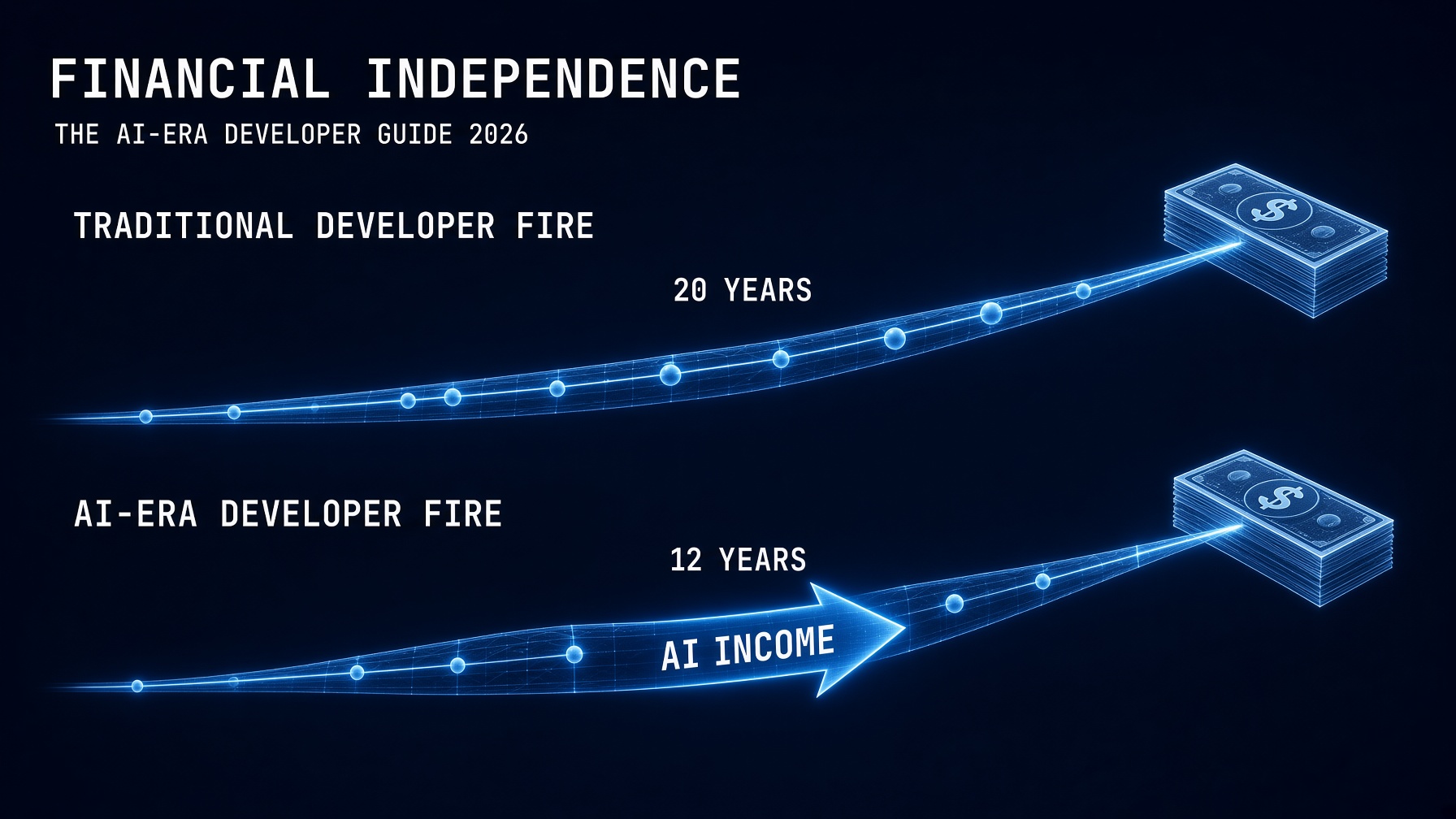
Financial independence for developers in 2026 is more achievable — and more misunderstood — than at any point in the profession’s history. More achievable because AI tools have created income streams and productivity multipliers that compress the savings timeline dramatically. More misunderstood because most developer FIRE content treats the path as a savings-rate problem when it’s actually an income architecture problem: how you structure the income you earn determines whether you reach financial independence in 12 years or 25.
This guide covers the complete framework: the FIRE math (which is simpler than most personal finance content makes it seem), the five FIRE variations and which one fits a developer’s income profile, the specific numbers for 2026 developer salaries, how AI side income changes the timeline calculation, the investment stack, and the implementation plan. Every section connects to the Wealth series this blog has built — because financial independence is the long-term destination that the income architecture in this series is designed to reach.
The Core Math: How Financial Independence Actually Works
Financial independence rests on one mathematical premise: if your investment portfolio generates returns equal to or greater than your annual expenses, you no longer need earned income to live. The 4% safe withdrawal rate — derived from the 1994 Trinity Study, which analyzed US stock and bond portfolio performance across rolling 30-year periods from 1925 — is the standard benchmark: a portfolio can sustain 4% annual withdrawals (adjusted for inflation) with a historical success rate above 95% over 30 years.
The formula:
# FIRE Number Calculator
# Not financial advice — use for planning purposes
def calculate_fire_number(
    annual_expenses: float,
    withdrawal_rate: float = 0.04  # 4% standard; use 3.5% for 40-50yr early retirement
) -> float:
    """Your FIRE number: the portfolio size where you can stop working."""
    return annual_expenses / withdrawal_rate
def calculate_years_to_fire(
    current_savings: float,
    annual_investment: float,
    fire_number: float,
    annual_return: float = 0.07  # 7% real return assumption (conservative)
) -> float:
    """Estimate years to reach FIRE (simplified; actual will vary)."""
    years = 0
    portfolio = current_savings
    while portfolio < fire_number and years < 100:
        portfolio = portfolio * (1 + annual_return) + annual_investment
        years += 1
    return years
# Developer examples
examples = [
    {"name": "Lean FIRE (Low COL city)", "expenses": 40_000},
    {"name": "Traditional FIRE (Mid COL)", "expenses": 80_000},
    {"name": "Fat FIRE (High COL)", "expenses": 120_000},
    {"name": "Fat FIRE + Travel", "expenses": 150_000},
]
for ex in examples:
    fire_number = calculate_fire_number(ex["expenses"])
    # Developer with $50K savings, investing $50K/year
    years = calculate_years_to_fire(50_000, 50_000, fire_number)
    print(f"{ex['name']}: FIRE = ${fire_number:,.0f} | ~{years} years")
# Output:
# Lean FIRE (Low COL city): FIRE = $1,000,000 | ~12 years
# Traditional FIRE (Mid COL): FIRE = $2,000,000 | ~21 years
# Fat FIRE (High COL): FIRE = $3,000,000 | ~29 years
# Fat FIRE + Travel: FIRE = $3,750,000 | ~33 years
Three relationships to understand from the formula before anything else:
- Every $10,000 reduction in annual expenses lowers your FIRE number by $250,000. This is the compounding effect of expense reduction: less spending means a smaller portfolio needed AND more capital available to invest. A developer who reduces annual expenses from $80,000 to $70,000 doesn't just save $10,000 more per year — they also reduce the FIRE number by $250,000, compressing the timeline from both directions simultaneously.
- Savings rate is the single largest determinant of timeline. Going from a 10% savings rate to a 50% savings rate cuts more than 20 years off the journey. A developer earning $150,000 who saves 50% ($75,000 per year) reaches financial independence far faster than one who earns $200,000 but saves 10% ($20,000 per year).
- For early retirement (40-50 year time horizon), use 3-3.5% instead of 4%. The Trinity Study used 30-year periods. An AI developer who reaches financial independence at 35 and doesn't earn income for 50 years faces different sequence-of-returns risk than someone retiring at 60. Using 3.5% instead of 4% adds $250,000 to the FIRE number for every $10,000 in annual expenses — a meaningful conservatism that significantly improves long-run portfolio survival rates.
The 5 FIRE Variations — Which One Fits a Developer's Income Profile
FIRE is not one destination. It's five variations on the same principle, each with a different target number and a different post-FIRE lifestyle. Understanding which one you're actually targeting changes the math significantly:
| Variation | Annual Expenses | FIRE Number (4%) | Lifestyle | Best For |
|---|---|---|---|---|
| Lean FIRE | $25K–$45K | $625K–$1.1M | Minimalist, low-cost location | Fastest timeline; requires genuine frugality |
| Traditional FIRE | $60K–$90K | $1.5M–$2.25M | Middle-class comfort | Most common developer target |
| Fat FIRE | $100K–$150K | $2.5M–$3.75M | Premium lifestyle maintained | High-earning developers unwilling to downsize |
| CoastFIRE | Variable | Variable (see below) | Work you enjoy for expenses only | Developers who want to work differently, not stop working |
| BaristaFIRE | Covered partially by portfolio, partially by part-time work | 50–70% of full FIRE number | Part-time flexibility | Developers who want to semi-retire sooner |
For most AI developers reading this series, the most strategically interesting variation is CoastFIRE. The CoastFIRE concept: invest enough that compound growth alone — without any additional contributions — will reach your full FIRE number by traditional retirement age. Once you've hit your CoastFIRE number, you only need to earn enough to cover current expenses. You can stop saving aggressively. You can freelance for lower rates on interesting projects. You can take a year off. You can start a business with no pressure to succeed quickly.
# CoastFIRE Calculator
def calculate_coast_fire_number(
    fire_number: float,
    years_to_traditional_retirement: int,
    annual_return: float = 0.07
) -> float:
    """
    CoastFIRE number: invest this amount NOW and
    compound growth alone reaches your FIRE number by retirement.
    """
    return fire_number / ((1 + annual_return) ** years_to_traditional_retirement)

# Developer examples
developer_fire = 2_000_000  # Traditional FIRE number ($80K/year expenses)

for current_age, retirement_age in [(30, 65), (35, 65), (40, 65)]:
    years = retirement_age - current_age
    coast = calculate_coast_fire_number(developer_fire, years)
    print(f"Age {current_age}: CoastFIRE number = ${coast:,.0f}")

# Output:
# Age 30: CoastFIRE number = $214,186
# Age 35: CoastFIRE number = $305,483
# Age 40: CoastFIRE number = $435,304
A 30-year-old developer who has $214,000 invested has already hit their CoastFIRE number for a $2M traditional FIRE target. They don't need to save another dollar — compound growth will reach $2M by 65 at 7% real returns. This changes their work relationship entirely: they're no longer working to build wealth. They're working to fund today's expenses. That optionality — the freedom to work on interesting problems at sustainable rates without income pressure — is arguably more valuable than full FIRE for developers who enjoy building things.
The 2026 Developer FIRE Numbers: What the Math Actually Looks Like
Real numbers for a developer starting from various positions in 2026, using after-tax income, standard index fund returns, and no AI side income (we'll add that in the next section):
| Starting Position | Annual Salary | After-Tax Income | Savings Rate | Annual Investment | FIRE Target | Years to FIRE |
|---|---|---|---|---|---|---|
| Junior Dev, $0 saved | $80K | ~$60K | 30% | $18K | $1.5M | ~28 years |
| Mid Dev, $50K saved | $130K | ~$90K | 40% | $36K | $1.75M | ~19 years |
| Senior Dev, $100K saved | $180K | ~$120K | 50% | $60K | $2M | ~14 years |
| Senior Dev + Side Income, $150K saved | $180K + $36K side | ~$160K | 55% | $88K | $2M | ~9 years |
The fourth row is the AI-era developer scenario — base salary plus the $3,000/month retainer income that's achievable at month six of the developer income roadmap. The additional $36,000 per year in investment capital, combined with the lower FIRE number from slightly higher expenses (the side income funds some lifestyle), compresses the timeline from 14 years to 9 years. That five-year difference represents five additional years of optionality — working on what you want rather than what pays the bills.
How AI Income Accelerates the Financial Independence Timeline
The specific mechanism by which AI side income changes the FIRE calculation is different from a simple income increase — and understanding the difference is what makes it more powerful than it appears.
A $36,000 annual salary increase requires negotiation, a job change, or career advancement that affects every aspect of work. A $36,000 annual side income from two active maintenance retainers at $1,500 per month each:
- Doesn't change your primary job situation or employer relationship
- Can be reduced or paused without career impact
- Potentially converts to fully passive income as the systems mature and monitoring time decreases
- Represents an asset (the client relationship and the built system) with independent value
- Doesn't increase lifestyle expenses the way a salary increase tends to (salary increases are typically consumed by lifestyle inflation; retainer income is psychologically treated as "extra" and more likely to be invested)
The compounding timeline acceleration from $3,000/month in additional invested capital:
# Impact of AI side income on FIRE timeline
def fire_timeline_comparison(
    current_savings: float,
    base_annual_investment: float,
    fire_number: float,
    ai_monthly_income: float,
    annual_return: float = 0.07
):
    """Compare FIRE timeline with and without AI side income."""
    # Scenario A: Base income only
    years_base = 0
    portfolio_base = current_savings
    while portfolio_base < fire_number:
        portfolio_base = portfolio_base * (1 + annual_return) + base_annual_investment
        years_base += 1
    # Scenario B: Base + AI income (all side income invested)
    ai_annual = ai_monthly_income * 12
    years_ai = 0
    portfolio_ai = current_savings
    while portfolio_ai < fire_number:
        portfolio_ai = portfolio_ai * (1 + annual_return) + base_annual_investment + ai_annual
        years_ai += 1
    return years_base, years_ai, years_base - years_ai
# Senior developer scenario
base, with_ai, saved = fire_timeline_comparison(
    current_savings=100_000,
    base_annual_investment=60_000,  # 50% savings rate on $120K after-tax
    fire_number=2_000_000,
    ai_monthly_income=3_000   # $3K/month from 2 retainer clients
)
print(f"Without AI side income: {base} years to FIRE")
print(f"With $3K/month AI income: {with_ai} years to FIRE")
print(f"Time saved: {saved} years")
# Output (approximate):
# Without AI side income: 14 years to FIRE
# With $3K/month AI income: 9 years to FIRE
# Time saved: 5 years
Five years of optionality — working on what you choose rather than what the market requires — is the compounding benefit of AI income streams started at mid-career. A $3,000/month retainer income also has the property of continuing past the FIRE date as passive income that reduces withdrawal pressure on the portfolio, which improves the portfolio's long-run survival probability. A developer drawing 3% of a $2M portfolio ($60,000/year) plus receiving $36,000 in annualized retainer income is in a dramatically more secure financial position than one drawing 5% of a $1.5M portfolio.
The Developer Investment Stack: Where the Money Goes
The investment strategy for developer FIRE follows a priority order that maximizes after-tax returns before moving to taxable investments. This is not financial advice — it is a common framework that many developers reference in their FIRE planning, which you should discuss with a qualified financial professional:
Priority 1: Employer 401(k) to Full Match
If your employer matches any portion of 401(k) contributions, contribute enough to capture the full match before doing anything else. Employer matching is an immediate 50 to 100 percent return on the matched portion — the highest guaranteed return available in any investment context. A 50% match on the first 6% of salary represents a 50% return before any market performance.
Priority 2: Max the Health Savings Account (HSA) if Eligible
If you have a high-deductible health plan, an HSA is the only triple-tax-advantaged account in the US system: contributions are pre-tax, growth is tax-free, and qualified withdrawals are tax-free. Maxing the HSA ($4,300 single / $8,550 family in 2026) before other investments is the highest-priority allocation for eligible developers, particularly those who are healthy and can let the account compound for decades before drawing on it.
Priority 3: Roth IRA ($7,000 limit, 2026)
The Roth IRA's after-tax contributions grow and withdraw tax-free — particularly valuable for developers at peak earnings who expect to be in a lower tax bracket during early retirement. The income phase-out for direct Roth contributions ($150,000 single, $236,000 married in 2026) affects many senior developers; a backdoor Roth conversion through a non-deductible traditional IRA is a common alternative for those above the income threshold.
Priority 4: SEP-IRA or Solo 401(k) for Self-Employment Income
For the AI side income from retainers and freelance work — the income described in the Freelance Developer Income guide — a SEP-IRA allows contributions of up to 25 percent of net self-employment income (maximum $69,000 in 2026). A Solo 401(k) allows $23,000 in employee contributions plus 25 percent employer contributions. Both reduce taxable income in the contribution year and allow the self-employment income to compound in tax-advantaged accounts rather than taxable accounts. A developer earning $36,000 in annual retainer income can shelter up to $9,000 in a SEP-IRA — reducing their taxable income and accelerating the FIRE timeline through both the tax savings and the compounding.
Priority 5: Max the 401(k) ($23,000 limit, 2026)
After the employer match, HSA, Roth IRA, and SEP-IRA/Solo 401(k) are maxed, contribute the remaining $23,000 limit to the 401(k). The pre-tax contribution reduces current-year taxable income, which is particularly valuable at senior developer income levels where marginal rates are highest.
Priority 6: Taxable Brokerage for Everything Above
After maxing all tax-advantaged accounts, additional investments go into a taxable brokerage account. The standard allocation for developer FIRE in taxable accounts: a three-fund portfolio (US total market index fund, international total market index fund, and US bond index fund) with allocation adjusted for time horizon. Vanguard, Fidelity, and Schwab all offer low-cost versions of all three. The expense ratio matters over decades: a 0.04% expense ratio versus 1% saves approximately $200,000 over a 30-year accumulation period on a $500,000 portfolio.
The 3 Mistakes Developer FIRE Seekers Make Most Often
Mistake 1: Lifestyle Inflation That Neutralizes Income Growth
The most common developer FIRE failure mode: income grows from $80K to $150K over five years while expenses grow from $40K to $120K, leaving the savings rate approximately constant. The FIRE timeline doesn't improve despite a 90 percent income increase because every dollar of income increase is consumed by lifestyle upgrades. The specific developer lifestyle inflation vectors: housing upgrades in high-cost tech cities, premium consumer electronics replacing adequate existing hardware, restaurant and service spending that grows with peer group income, and subscription services that accumulate invisibly.
The fix is not austerity — it's intentionality. Define your FIRE target lifestyle before defining your current lifestyle. If FatFIRE at $120,000 per year is the goal, a current lifestyle at $80,000 per year funds both current enjoyment and aggressive savings. The specific transition from developer to FIRE-seeking developer is a one-time lifestyle definition decision: what does the life I actually want look like at every income level, and which spending categories genuinely improve that life versus which ones I consume because they're available?
Mistake 2: Concentrated Position in Employer Stock or Tech Sector
Many senior developers at public technology companies hold significant portions of their net worth in employer stock — either through RSU vesting or stock option exercise. A portfolio that is 60 percent or more in a single company's stock carries idiosyncratic risk (company-specific failure) that a diversified index fund doesn't. The standard guidance: as RSUs vest, sell and diversify into index funds unless the concentrated position represents less than 10 to 15 percent of total net worth. The tax cost of selling (ordinary income tax on RSUs at vesting, capital gains tax on options) is real but typically smaller than the risk of holding a concentrated position through a company-specific downturn.
Mistake 3: The "One More Year" Syndrome
"One more year" syndrome is the tendency to defer the FIRE date by one year repeatedly after reaching the financial independence target — because the portfolio feels small, market volatility is concerning, or a major project is ending and "it makes sense to wait." Research on FIRE practitioners identifies one more year syndrome as the most common reason developers who reach their FIRE number don't act on it. The psychological difficulty of transitioning from accumulation to withdrawal is real and not purely rational — it represents an identity shift as much as a financial one.
The practical guard against it: define a specific action trigger before reaching the FIRE number, not after. "When my portfolio hits $2M for three consecutive months, I will give 90 days notice at work and transition to consulting at 20 hours per week" is an implementation intention that makes the decision before it's emotionally difficult. Without a pre-defined trigger, the goalposts move indefinitely.
This Week's Implementation: Where to Start
Financial independence is a long-term project that starts with one-time setup decisions rather than ongoing heroic effort. Four actions this week that form the foundation:
- Calculate your FIRE number. Use the Python calculator above or any of the free FIRE calculators at WealthVieu, The FI Calculator, or ReachFI. Enter your actual annual expenses — not what you wish they were, not what they theoretically could be — and your current savings. The number will be larger than you expect. That's information, not discouragement.
- Calculate your current savings rate. Take your annual investment amount (401k contributions + IRA + brokerage + any other savings) divided by your gross income. If it's below 20 percent, the FIRE timeline is measured in decades. If it's above 40 percent, you're in the group that typically reaches financial independence before 50. Knowing your starting point is the prerequisite for every other decision.
- Verify you're capturing the full employer 401(k) match. Log in to your 401(k) provider and confirm your contribution percentage captures the full employer match. If you're leaving employer match uncaptured, correcting it is the highest-return single action available to you this week.
- Open a Roth IRA if you don't have one. If you're under the income limit, contributing $7,000 per year to a Roth IRA creates a growing pool of tax-free growth that compounds for decades before any withdrawal. Opening the account is a 20-minute task that most developers who don't have one have deferred for years with no good reason. The cost of delay is measured in tens of thousands of compounded dollars.
For the complete FIRE number calculation and Monte Carlo success rate simulation, see WealthVieu's comprehensive FIRE guide for 2026.
The Builder's Takeaway
Financial independence for developers in 2026 follows a mathematically straightforward formula (annual expenses × 25 = FIRE number) and a psychologically difficult implementation. The AI-era update to the standard FIRE playbook: the income streams this series has documented — retainer clients, digital product sales, API services, content income — add $36,000 to $100,000 per year in investable capital at realistic achievement levels, compressing the FIRE timeline by five to ten years without requiring a career change or a higher-paying employer. The investment priority order is standard: employer match → HSA → Roth IRA → SEP-IRA/Solo 401(k) for self-employment income → max 401(k) → taxable brokerage. The three mistakes that most often derail developer FIRE — lifestyle inflation that neutralizes income growth, concentrated positions in employer stock, and one more year syndrome — are each preventable with one-time decision architecture rather than ongoing willpower. Calculate your FIRE number this week. Your timeline is shorter than you think if you're earning in the AI-era developer income range. And longer than it needs to be if you haven't started yet.
The Complete Wealth Series: Every Income Stream That Feeds This FIRE Number
- Freelance Developer Income 2026 — the rate card and six-month trajectory for the freelance income that accelerates the FIRE timeline
- How to Make Money as a Developer — the four-tier roadmap that produces the investable income modeled in this guide
- AI Agent Passive Income — the five-stream architecture whose income flows directly into the investment priority order above
- Automated Stablecoin Yield — the idle capital yield strategy that generates 4–8% APY on capital awaiting investment decisions
- Micro-SaaS AI Agent — the retainer model that produces the $3,000/month side income modeled in the timeline acceleration calculator
This post is for informational purposes only and does not constitute financial, tax, or investment advice. Consult a qualified financial professional before making investment decisions. This post is part of The Agentic Protocol's Wealth series. See also: How to Make Money as a Developer.