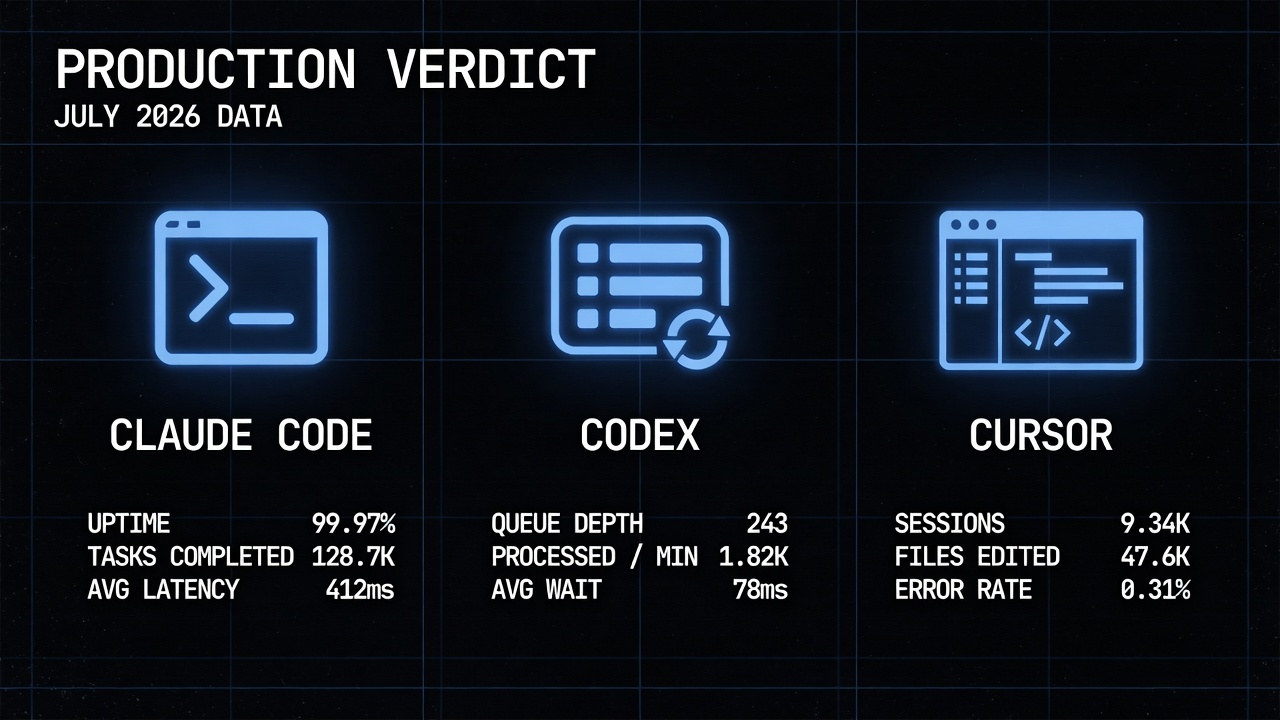
The Claude Code vs Codex vs Cursor comparison has a 2026 production data layer that most reviews don’t include — and the enterprise numbers change which tool wins for which job in ways that no benchmark table captures.
Anthropic’s 2026 enterprise adoption report, published this month, includes three cases that turn the comparison concrete. eSentire, a cybersecurity company, compressed expert threat analysis from five hours to seven minutes — with AI-driven analysis aligning with their senior security experts 95% of the time. Doctolib rolled Claude Code across their entire engineering team, replacing legacy testing infrastructure in hours rather than weeks and shipping features 40% faster. L’Oréal achieved 99.9% accuracy on conversational analytics, enabling 44,000 monthly users to query data directly without waiting for custom dashboards. These aren’t benchmark results. They’re production outcomes, measured on the infrastructure these teams actually run.
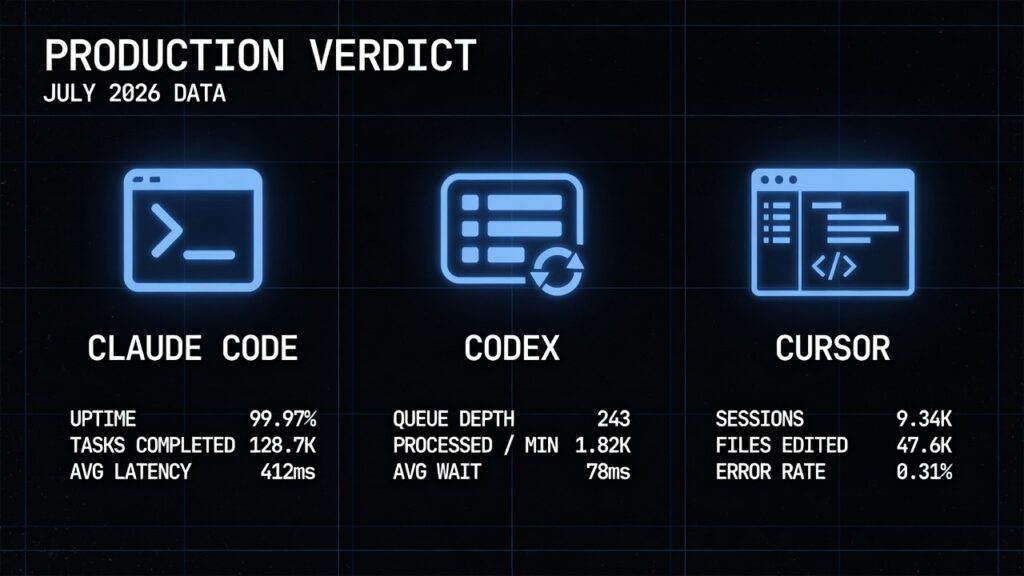
This post uses those production outcomes — alongside the July 2026 feature updates for all three tools — to give you the clearest current answer to the Claude Code vs Codex vs Cursor question: what each tool actually ships, for whom, and under what architectural assumptions.
Claude Code vs Codex vs Cursor: The Three Different Problems
The most common mistake in the Claude Code vs Codex vs Cursor comparison is treating the three tools as interchangeable options for the same problem. They’re not. Each sits at a different point in the development workflow and optimizes for a different primary constraint:
- Claude Code is a terminal-based agentic coding layer. Its primary strength is multi-step, multi-file, long-horizon coding tasks that require reading a full codebase, making coordinated changes across files, running tests, and iterating — all within an autonomous loop. The July 2026 updates (subagent text streaming, `/fork` for background sessions, auto mode without opt-in on Bedrock/Vertex/Foundry) push this further toward genuinely autonomous development workflows. It’s the right tool when the task is complex enough that a human developer would need multiple sessions to complete it.
- Codex is OpenAI’s async coding agent, designed to run independently in the background while developers work on other tasks. You file an issue or describe a task, Codex picks it up, completes it, and opens a pull request for review. The workflow is asynchronous by design — you’re not interactively directing it in a terminal. OpenAI reports 99.8% of all weekly output tokens at OpenAI itself now come from Codex, the statistic from the Agent Generated Code Quality post that established the Acceleration Whiplash pattern. Codex is the right tool when the task is well-specified, independently completable, and the developer’s time is better spent elsewhere during execution.
- Cursor is an AI-native IDE built on VS Code. Its primary strength is real-time, in-context assistance for developers who want AI embedded in their editing environment — code completion, in-editor chat, codebase-aware suggestions, and file references — without leaving the interface they already know. GitHub Copilot’s addition of Kimi K2.7 Code this month directly targets Cursor’s IDE-embedded market. Cursor is the right tool when the developer wants AI assistance in-flow rather than autonomous execution of defined tasks.
These three tools serve an overlapping but distinct user, workflow, and task type. The production data from the enterprise report clarifies which combination produces the outcomes builders in this series are targeting.
What the Enterprise Production Data Says in the Claude Code vs Codex vs Cursor Comparison
Anthropic’s 2026 enterprise report covers 90% of organizations now using AI for development assistance and 86% deploying agents for production code. The three standout cases all used Claude Code, not Codex or Cursor, for one consistent reason: the tasks required coordinated autonomous execution across multiple systems over multiple steps.
eSentire’s five-hour to seven-minute threat analysis compression is a multi-step orchestration task: ingest threat data, cross-reference against historical patterns, synthesize findings, generate recommendations, and produce output at expert quality. This is the sub-agent orchestration pattern from the Sub-Agent Orchestration post — a hierarchical agent chain where the terminal-based orchestration layer (Claude Code) coordinates multiple specialized sub-processes. Cursor’s in-editor assistance wouldn’t reach this outcome because the task doesn’t live in an editor. Codex’s async PR model wouldn’t produce the same speed because the task requires iterative, interactive steps.
Doctolib’s 40% faster feature shipping reflects a different production pattern: Claude Code replacing legacy testing infrastructure. Not writing tests from scratch — replacing an entire testing layer by reading existing infrastructure, understanding its patterns, and generating equivalent coverage in a new framework. This is the full-codebase-context task that Claude Code’s 1M token default context window enables. The Claude Code Agent Teams post described this exact architecture: implicit team spawning where Claude Code autonomously determines which sub-agents to spawn and coordinates their outputs.
L’Oréal’s 44,000 daily users querying data directly points to a third pattern: Claude Code as the backend of a user-facing natural language interface to data systems. This isn’t a coding task at all in the traditional sense — it’s an agentic data query pipeline where 99.9% accuracy comes from the combination of Claude Code’s reasoning capability and the structured data access patterns it generates.
Claude Code July 2026 Updates: What Changed in the Production Capability
Three July 2026 updates to Claude Code directly affect the production patterns described above:
/forkcommand: Previously/subtask, the new/forkcopies an active conversation into a new background session with its own row inclaude agentswhile keeping the original session active. For the Dynamic Workflows patterns in this series — 100+ agents running in parallel — this makes task decomposition significantly cleaner. A main orchestrator can fork branches without creating a new session from scratch, preserving the context that makes parallel work coherent.- Auto mode without opt-in: Auto mode now runs on Bedrock, Vertex AI, and Foundry without the
CLAUDE_CODE_ENABLE_AUTO_MODEenvironment variable. This removes a configuration friction point from enterprise deployments where IT teams are managing Claude Code at scale. The Cisco deployment of 90,000 users covered in the Enterprise AI Agent Deployment post becomes more tractable when the auto mode feature doesn’t require per-environment opt-in configuration. - Subagent text streaming: Sub-agents now stream text output in real time during execution. For the Sub-Agent Orchestration patterns where a human is monitoring a long-running agent chain, streaming visibility changes the debugging experience from “wait for completion then review” to “observe execution as it happens.”
The Decision Framework: Claude Code vs Codex vs Cursor for Your Stack
The enterprise data resolves the Claude Code vs Codex vs Cursor comparison for most production agentic workloads into a clear decision framework:
- Choose Claude Code when the task requires multi-step autonomous execution with full codebase context, coordinated changes across multiple systems, or iterative reasoning over complex workflows. The July 2026 Anthropic model API spec shows Sonnet 5 produces “the lowest rate of unsolicited opinions” and highest instruction-following in agentic contexts — the capability profile that makes multi-step autonomous coding reliable rather than divergent.
- Choose Codex when the task is well-specified, independently completable without interactive steps, and the developer’s time is better spent elsewhere during a 20-to-60-minute execution window. Codex’s strength is async issue-to-PR workflows. Its limitation is the same Acceleration Whiplash risk the Agent Generated Code Quality post documented: the reflection loop and validation step aren’t optional — they prevent the PR from containing the additional bugs that ungoverned agent code generation produces.
- Choose Cursor when the developer is the primary intelligence in the loop and wants AI assistance in-flow, not autonomous execution. Cursor’s in-editor model is the right choice for new-feature development where design judgment is happening in real time. The June 2026 addition of Kimi K2.7 Code gives cost-conscious teams an open-weight model option at lower pricing.
- Combine all three when your workflow has all three phases: Cursor for active design and new code, Codex for well-specified async tasks, and Claude Code for the complex multi-step orchestration that requires full autonomous execution with codebase-wide context. The AI Agent Gateway from this series manages the cost and audit trail across all three — the model-routing and token-cost visibility that prevents the Acceleration Whiplash cost blow-up from any one of them.
For the full Anthropic enterprise adoption report and case study data, see Anthropic’s how enterprises are building AI agents in 2026 report.
The Builder’s Takeaway
The Claude Code vs Codex vs Cursor question doesn’t have a single correct answer — it has three correct answers for three different workflow positions. The enterprise production data (five hours to seven minutes, 40% faster shipping, 99.9% query accuracy) all point to Claude Code for the complex, multi-step, full-context tasks that define the highest-value agentic work. Codex for async issue resolution at scale. Cursor for in-flow developer assistance. The July 2026 Claude Code updates — fork, auto mode, streaming — push the complex task category further in Claude Code’s direction. The cost model from yesterday’s GPT-5.6 update means running Claude Code on Sonnet 5 at $2/$10 intro pricing through August 31 is still the most economically rational primary configuration for the standard production chain. Run the stack. Split the workflows. Don’t pick just one.
Continue in This Series
- Claude Code Agent Teams — the implicit team pattern that the /fork command now makes more powerful
- Claude Code Dynamic Workflows — 100+ agent parallel execution: the full orchestration layer above single Claude Code sessions
- Agent Generated Code Quality — the reflection loop that prevents Acceleration Whiplash in all three tools
- Sub-Agent Orchestration — the Python architecture that subagent streaming now makes observable in real time
- GPT-5.6 Sol Terra Luna — the model landscape update that makes Sonnet 5 the cost-optimal Claude Code backend through August 31
This post is part of The Agentic Protocol’s Work series — the connective infrastructure layer beneath every autonomous pipeline. See also: Claude Code Agent Teams.