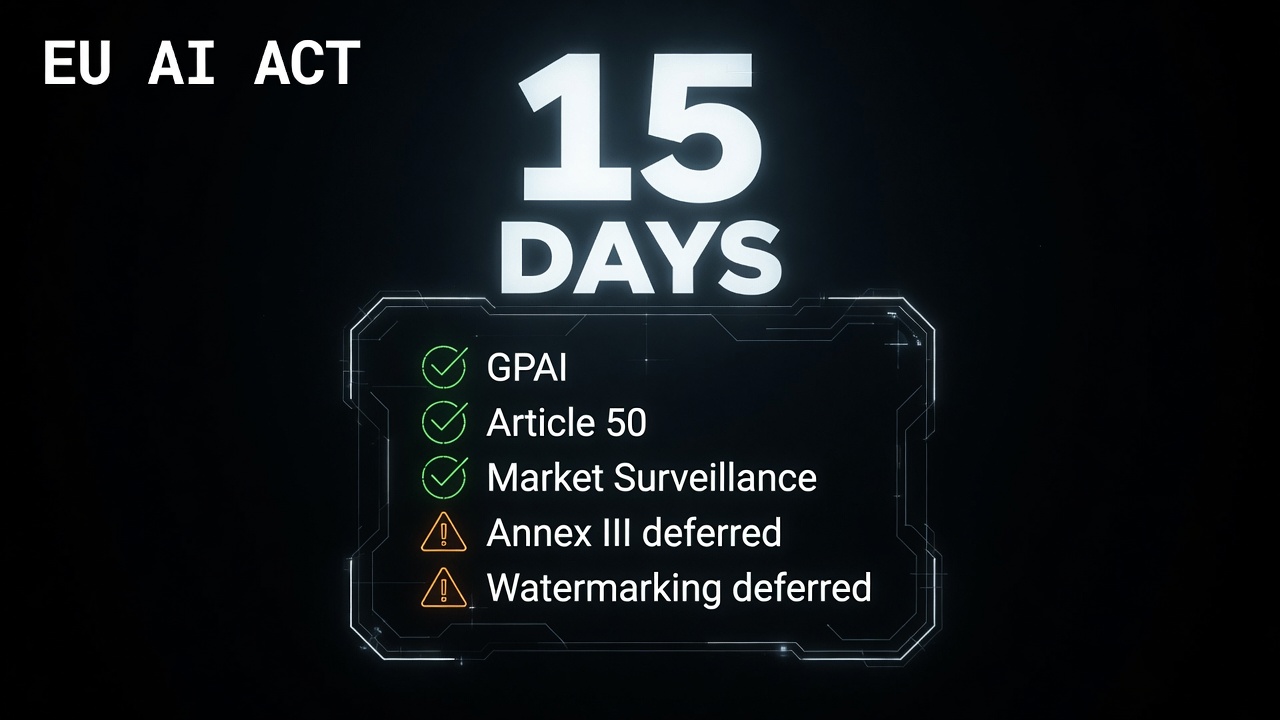
EU AI Act August 2 enforcement is 15 days away, and the single most useful thing a builder can do right now is get exact clarity on which obligations actually activate on that date — because the guidance circulating across the industry has been wrong in both directions, overstating some risks and understating others.
The Digital Omnibus on AI — the provisional political agreement reached May 7, 2026 — was expected to reach formal adoption and Official Journal publication before August 2. Its entry into force is triggered three days after Official Journal publication. Confirm that it has been formally published before finalizing your compliance posture, because the Omnibus changes which specific obligations land on August 2 and which are extended. The analysis below reflects the post-Omnibus position.
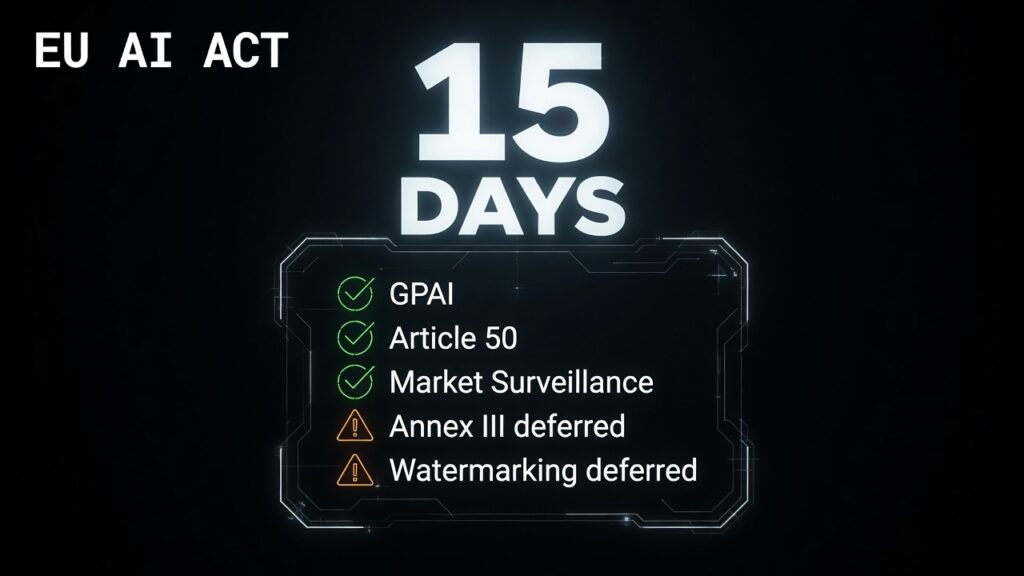
This post gives you the definitive compliance table, the three enforcement mechanisms that activate August 2 regardless of any further legislative development, and the audit code that closes the gap most builders are missing with 15 days remaining.
EU AI Act August 2: The Definitive Table
| Obligation | August 2 Status | Deadline |
|---|---|---|
| GPAI Model Penalty Powers (€15M / 3%) | ✅ ACTIVE | August 2, 2026 |
| Article 50 Chatbot Disclosure | ✅ ACTIVE | August 2, 2026 |
| Article 50 Emotion Detection Disclosure | ✅ ACTIVE | August 2, 2026 |
| Market Surveillance Authority (27 states) | ✅ ACTIVE | August 2, 2026 |
| Annex III High-Risk (employment, credit, biometrics) | ⏸ DEFERRED | December 2, 2027 |
| Watermarking / AI Content Labeling (Article 50(2)) | ⏸ DEFERRED (legacy systems) | December 2, 2026 |
| Annex I Product-Embedded High-Risk | ⏸ DEFERRED | August 2, 2028 |
| Banned practices (manipulation, social scoring) | ✅ ALREADY ACTIVE | Since Feb 2, 2025 |
The table tells the story clearly. Most of the obligations builders were worried about six months ago — the Annex III high-risk requirements for employment AI, credit scoring, biometrics — are deferred 16 months. What isn’t deferred is the enforcement infrastructure and the transparency layer that applies to every conversational AI system, including the agent-facing interactions that most of this series describes.
The Three EU AI Act August 2 Mechanisms That Don’t Have Escape Routes
1. GPAI Penalty Powers — Affects Every LLM Provider You Depend On
General-purpose AI model providers — Anthropic, OpenAI, Google, and every other foundation model company — have been subject to GPAI obligations since August 2, 2025: technical documentation, copyright compliance policies, training data summaries, and systemic risk assessments for models above 10^25 FLOPs. The European Commission could not fine anyone for violations during that first year. Starting August 2, 2026, it can: up to €15 million or 3% of global annual turnover, whichever is higher. The AI Office gains full investigatory authority — documentation requests, model access, on-site inspections, corrective measures.
For builders, this matters because GPAI penalty exposure changes the operational behavior of your model providers. Any provider that discovers a compliance gap during an AI Office investigation has regulatory incentive to resolve it quickly, which could include temporary service changes. The Gemini 3.5 Pro post from yesterday covered provider diversification as the model-selection response to regulatory uncertainty — GPAI enforcement powers are another reason the multi-provider fallback chain in the Model Fallback Routing post is now infrastructure rather than an optional optimization.
2. Article 50 Transparency — Applies to Every AI Agent Interacting With EU Persons
Article 50 chatbot disclosure requirements are mandatory as of August 2 for any AI system that interacts directly with natural persons, unless the context makes the AI nature obvious. Three specific obligations apply:
- AI chatbots and conversational agents must inform users they are interacting with an AI system, in a clear and distinguishable manner, at the beginning of the interaction.
- Emotion detection and biometric categorization systems must inform the individuals concerned.
- AI-generated or manipulated content that could mislead people must be labeled as artificially generated (the watermarking requirement for legacy systems has 4 months additional time, but new systems deployed after August 2 must comply immediately).
The “unless the context makes it obvious” carve-out is narrower than most builders assume. A support chatbot that has a generic name, a human-style avatar, and no explicit AI disclosure does not satisfy this carve-out — the obvious exception applies to things like clearly labeled AI writing assistants, not conversational agents that could plausibly be mistaken for a human. If your agent pipeline creates any direct conversational interaction with EU users, it needs an explicit disclosure mechanism before August 2.
3. Market Surveillance Authority — The “Guidance Phase Ends” Signal
Twenty-seven national market surveillance authorities across EU member states gain full investigatory and enforcement powers on August 2. They can investigate potential violations, demand documentation, order market withdrawals, and impose fines across the full suite of AI Act obligations in force. The “guidance phase” — the period during which the regulation was in force but enforcement was practically limited to political pressure and voluntary compliance — formally ends. Axis Intelligence’s July 2026 analysis states this clearly: August 2 is “the date the guidance phase formally ends across the regulation.”
For builders deploying AI systems in EU markets, this means the question shifts from “should we be compliant” to “can we demonstrate we are compliant on request.” The documentation audit trail isn’t optional after August 2 — it’s what you produce when a national authority asks for it, which is now legally possible in all 27 states simultaneously.
The 15-Day Compliance Checklist and Disclosure Code
The Colorado AI Act post built the audit record infrastructure that satisfies both US and EU documentation requirements simultaneously. The addition for EU AI Act August 2 compliance is the Article 50 disclosure mechanism — the specific user-facing notification that must precede any conversational AI interaction with EU persons.
import os
from datetime import datetime
from dataclasses import dataclass
from typing import Optional
from enum import Enum


class JurisdictionScope(Enum):
    EU = "eu"
    US = "us"
    GLOBAL = "global"


@dataclass
class Article50Disclosure:
    """
    EU AI Act Article 50 disclosure record.
    Required before every conversational AI interaction
    with natural persons in EU jurisdictions.
    Generated August 2, 2026 onward.
    """
    disclosure_id: str
    session_id: str
    timestamp: str
    user_jurisdiction: JurisdictionScope
    disclosure_text: str
    acknowledged: bool
    agent_type: str  # "conversational", "emotion_detection", "content_generation"


EU_DISCLOSURE_TEXT = (
    "You are interacting with an AI assistant. "
    "Responses are generated by an artificial intelligence system, "
    "not a human. This disclosure is provided in accordance with "
    "EU AI Act Article 50."
)


def generate_article50_disclosure(
    session_id: str,
    user_jurisdiction: JurisdictionScope,
    agent_type: str = "conversational"
) -> Optional[Article50Disclosure]:
    """
    Generates an Article 50 disclosure record for EU-scoped sessions.
    Returns None for non-EU jurisdictions where the requirement
    doesn't apply — but logs the scope decision for audit purposes.
    """
    if user_jurisdiction != JurisdictionScope.EU:
        # Log the scope decision — auditors may ask why disclosure
        # wasn't generated for specific sessions
        print(f"[SCOPE] Session {session_id}: "
              f"{user_jurisdiction.value} jurisdiction — "
              f"Article 50 not applicable")
        return None

    disclosure = Article50Disclosure(
        disclosure_id=f"a50_{os.urandom(4).hex()}",
        session_id=session_id,
        timestamp=datetime.utcnow().isoformat(),
        user_jurisdiction=user_jurisdiction,
        disclosure_text=EU_DISCLOSURE_TEXT,
        acknowledged=False,
        agent_type=agent_type
    )

    print(f"[EU AI ACT] Article 50 disclosure generated: "
          f"{disclosure.disclosure_id} for session {session_id}")
    return disclosure


def open_agent_session(
    session_id: str,
    user_jurisdiction: JurisdictionScope,
    agent_type: str = "conversational"
) -> dict:
    """
    Opens an agent session with mandatory Article 50 disclosure
    for EU users and full audit trail for all jurisdictions.
    Blocks EU sessions from proceeding without disclosure.
    """
    disclosure = generate_article50_disclosure(
        session_id, user_jurisdiction, agent_type
    )

    if user_jurisdiction == JurisdictionScope.EU and disclosure is None:
        raise RuntimeError(
            f"[BLOCKED] EU session {session_id} cannot open "
            f"without Article 50 disclosure generation."
        )

    audit_entry = {
        "event": "session_opened",
        "session_id": session_id,
        "timestamp": datetime.utcnow().isoformat(),
        "jurisdiction": user_jurisdiction.value,
        "article_50_disclosure_id": (
            disclosure.disclosure_id if disclosure else None
        ),
        "disclosure_text_shown": (
            EU_DISCLOSURE_TEXT if disclosure else None
        ),
        "eu_ai_act_compliant": disclosure is not None
    }

    return {
        "session_id": session_id,
        "disclosure": disclosure,
        "audit_entry": audit_entry,
        "first_message_to_user": (
            EU_DISCLOSURE_TEXT if disclosure else None
        )
    }


if __name__ == "__main__":
    # EU user session — disclosure required from August 2
    eu_session = open_agent_session(
        "session_eu_001",
        JurisdictionScope.EU,
        "conversational"
    )
    print(f"\n[EU SESSION]")
    print(f"First message to user: {eu_session['first_message_to_user']}")
    print(f"Audit entry: {eu_session['audit_entry']}")

    # US user session — no Article 50, but scope logged
    us_session = open_agent_session(
        "session_us_001",
        JurisdictionScope.US,
        "conversational"
    )
The first_message_to_user field is the operationally important output: this text must precede the first substantive agent response in every EU-scoped conversational session. It doesn’t need to be the entire conversation’s first message — it can be combined with a greeting or onboarding flow — but it must appear before the agent provides any substantive content to an EU person, starting August 2.
The Brussels Effect: Why This Affects US-Only Builders
The EU AI Act’s extraterritorial reach applies to any provider or deployer whose AI output is used in the EU — which, for web-based agent services with no geographic access restriction, means any accessible service with EU users. The 70-country noticeable in this blog’s GSC data includes EU member states. Any builder operating a public-facing AI agent without geographic access controls has EU users by default.
The compliance cost of Article 50 disclosure is near zero — one line of text at the start of each EU-scoped session, as the code above demonstrates. The cost of omitting it becomes real on August 2, when 27 national market surveillance authorities gain the power to investigate, document, and fine. Builders who address this now spend 30 minutes on code. Builders who address it after a surveillance inquiry spend considerably more, under considerably less favorable conditions.
For the full enforcement timeline, see Axis Intelligence’s definitive EU AI Act August 2026 analysis.
The Builder’s Takeaway
EU AI Act August 2 is a specific enforcement event, not a general AI governance alarm. Three things activate: GPAI penalty powers, Article 50 transparency obligations, and market surveillance authority. Annex III high-risk obligations are deferred 16 months. The compliance work most builders need to do before August 2 is smaller than feared and more specific than most guidance makes it sound: implement Article 50 disclosure for EU-scoped conversational agent sessions, verify your GPAI model providers have their own compliance posture in order, and ensure your audit trail infrastructure can produce documentation on request. Fifteen days is enough time to close all three gaps. Next week is not.
Continue in This Series
- EU AI Act August 2026: What’s Delayed vs. What’s Not — the July 6 post this definitive update supersedes
- Colorado AI Act — the US parallel that shares Article 50’s audit trail and human-review requirements
- China AI Regulation — the third major framework that went live July 15, completing the three-jurisdiction enforcement window
- AI Agent Gateway — the infrastructure layer that generates Article 50 audit records automatically for every session
- AI Agent Legal Liability — the federal enforcement layer that predates and compounds EU AI Act exposure
This post is part of The Agentic Protocol’s Work series — the connective infrastructure layer beneath every autonomous pipeline. See also: Colorado AI Act.