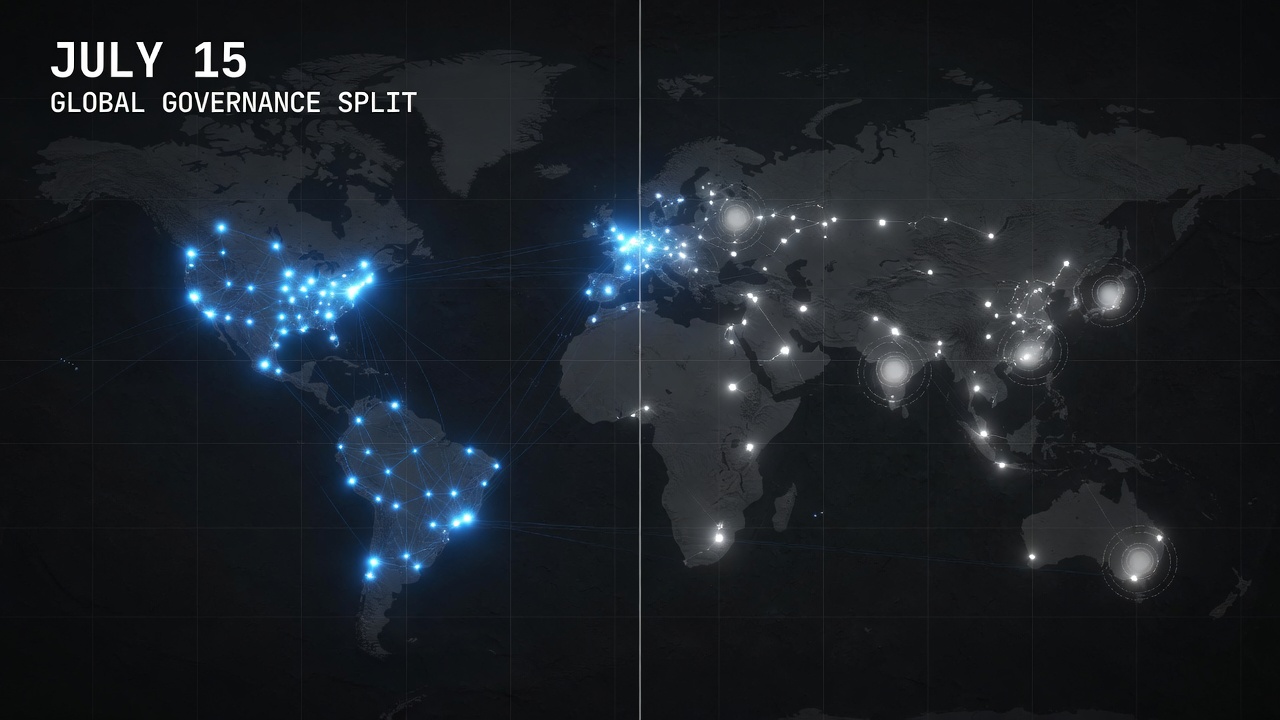
China AI regulation is no longer a distant market consideration for builders running model fallback chains — it’s today’s operational reality, and the data around it changes the calculus on one of the fastest-growing segments of the AI infrastructure stack.
As of today, July 15, 2026, China’s Interim Measures for the Administration of Anthropomorphic AI Interaction Services are enforceable law. ByteDance’s Doubao — China’s most-used AI app with 345 million monthly active users — has shut down all AI agent creation features and made existing user-created agents inoperable. Alibaba’s Qwen implemented the same shutdown simultaneously. Users have until October 15 to export conversation histories and agent configurations before the data becomes permanently inaccessible.
The same week this China AI regulation landed, CNBC confirmed that 30 to 46% of US enterprise AI token usage is flowing to Chinese models, and Chinese providers have grown from less than 2% of OpenRouter traffic in July 2025 to 45% today. Two things are true at once: China’s AI ecosystem is both rapidly expanding its global reach and simultaneously facing the most aggressive domestic governance action since the AI era began.
What China AI Regulation Actually Requires
The Interim Measures, co-issued by five Chinese government agencies including the Cyberspace Administration of China, target AI services that simulate human personality or create persistent AI personas. The requirements read like an accelerated version of the compliance stack this series has been documenting:
- Anti-addiction systems. Services must implement mechanisms to prevent compulsive or harmful usage patterns — mandatory for any AI companion or persistent agent persona. This maps directly onto the wellness concerns in the Solo Founder Isolation post, now codified as a legal requirement in the world’s second-largest AI market.
- Mandatory usage notifications. Users must be informed of AI interaction in specific, regulated ways — the same transparency obligation as EU AI Act Article 50 (covered in this series), now enacted in China three weeks earlier than the EU’s enforcement date.
- Real identity verification. AI agent creation requires verified user identity, not just account registration. This is the most operationally disruptive requirement for the consumer-facing platforms — and the reason Doubao and Qwen chose to shut down agent features rather than implement verification for 345 million users in time.
- Instant-exit mechanisms. Users must be able to immediately terminate any AI interaction session. The human override that the Lethal Trifecta pattern enforces at the capability layer is now a statutory requirement in China at the UX layer.
The governance pattern emerging from China AI regulation, the Colorado AI Act, and the EU AI Act is now clearly convergent: disclosure, human override, audit trail, and identity verification are the four pillars every major jurisdiction is requiring for consequential AI interactions. The specific implementation differs; the underlying requirements are aligned.
The Chinese AI Provider Surge and What It Means for Your Fallback Chain
The 30 to 46% US enterprise token flow to Chinese models is the data point that requires immediate attention for builders who implemented the Model Fallback Routing cross-provider chain from this series. That chain includes OpenAI as the cross-provider fallback for Claude outages. If your organization’s existing AI tooling is already running 30 to 46% of its tokens through Chinese providers — which CNBC’s data suggests is possible without deliberate choice, simply through tool adoption patterns — the data sovereignty question is no longer theoretical.
The Chinese models now dominant on OpenRouter are primarily DeepSeek and various Qwen variants. Their cost advantage is real: DeepSeek V3 at approximately $0.07 per million input tokens versus Claude Sonnet 5 at $2.00 per million is a 28x cost difference that makes it highly attractive for high-volume, low-sensitivity workloads. The question isn’t whether Chinese models are capable — the benchmarks confirm they are competitive with frontier Western models for many task categories. The question is which data categories are appropriate to route through them.
Four categories of data should not route through Chinese AI providers regardless of cost advantage:
- Personally identifiable information subject to GDPR, CCPA, or HIPAA — Chinese data residency requirements mean this data could be subject to Chinese government data access requests under the National Security Law.
- Financial data subject to SOC 2, PCI DSS, or banking regulation — the same audit trail the Colorado AI Act and SEC Rule 17a-4 require may not be producible from a Chinese provider in a US regulatory context.
- Proprietary intellectual property — code, product roadmaps, customer data, or business strategy that would be competitively damaging if accessed outside your organization.
- Government or defense-adjacent work — the US export control framework that suspended Claude Fable 5 globally also restricts certain AI applications in defense contexts; routing through Chinese providers creates independent exposure under ITAR and EAR.
Updating Your Fallback Chain for the Geopolitical Layer
The Model Fallback Routing architecture this series established needs one new configuration dimension after today’s China AI regulation event: data sovereignty tagging alongside capability and cost routing.
# .env — updated July 15, 2026
# Adds data sovereignty constraints to the model chain configuration.
# Chinese AI models (DeepSeek, Qwen variants) offer significant cost
# advantages but introduce data sovereignty risk for certain data categories.

# STANDARD PRODUCTION CHAIN (no sensitive data)
# DeepSeek is a legitimate, capable option for low-sensitivity workloads
# where cost matters and data sovereignty doesn't apply.
MODEL_CHAIN_STANDARD=claude-sonnet-5,claude-opus-4-8,claude-haiku-4-5-20251001

# COST-OPTIMIZED CHAIN (low-sensitivity, public data only)
# DeepSeek V3 at ~$0.07/M input tokens is viable for:
# - Summarization of public information
# - Code generation where the codebase itself is public
# - Non-sensitive research and analysis tasks
MODEL_CHAIN_COST=deepseek-v3,claude-haiku-4-5-20251001,claude-sonnet-5

# DATA-SOVEREIGN CHAIN (PII, financial, IP, regulated data)
# No Chinese providers. Stays within jurisdictions with established
# US data residency and legal process requirements.
MODEL_CHAIN_SOVEREIGN=claude-sonnet-5,claude-opus-4-8,openai:gpt-5.5

# Data sovereignty classification for routing decisions:
DATA_SOVEREIGN_CATEGORIES=pii,financial,regulated,proprietary_ip,defense_adjacent
import os
from enum import Enum
class DataSovereigntyClass(Enum):
PUBLIC = "public" # safe for any provider chain
INTERNAL = "internal" # prefer domestic, acceptable elsewhere
SOVEREIGN = "sovereign" # domestic providers only
REGULATED = "regulated" # strict domestic + compliance chain only
SOVEREIGN_CHAIN = os.environ.get("MODEL_CHAIN_SOVEREIGN", "").split(",")
STANDARD_CHAIN = os.environ.get("MODEL_CHAIN_STANDARD", "").split(",")
COST_CHAIN = os.environ.get("MODEL_CHAIN_COST", "").split(",")
SOVEREIGN_CATEGORIES = set(
os.environ.get("DATA_SOVEREIGN_CATEGORIES", "").split(",")
)
def select_model_chain(
data_category: str,
sovereignty_class: DataSovereigntyClass
) -> list[str]:
"""
Selects the appropriate model chain based on data sovereignty
requirements. Adds the geopolitical layer to the existing
capability and cost routing logic.
"""
if sovereignty_class in (
DataSovereigntyClass.SOVEREIGN,
DataSovereigntyClass.REGULATED
) or data_category in SOVEREIGN_CATEGORIES:
print(f"[SOVEREIGN ROUTING] {data_category} requires domestic "
f"provider chain — Chinese models excluded.")
return SOVEREIGN_CHAIN
if sovereignty_class == DataSovereigntyClass.PUBLIC:
return COST_CHAIN # Chinese providers acceptable for public data
return STANDARD_CHAIN # Internal data: standard Western provider chain
if __name__ == "__main__":
# Example routing decisions
test_cases = [
("customer_pii", DataSovereigntyClass.REGULATED),
("public_market_research", DataSovereigntyClass.PUBLIC),
("product_roadmap", DataSovereigntyClass.SOVEREIGN),
("code_summarization_oss", DataSovereigntyClass.PUBLIC),
]
for category, sovereignty in test_cases:
chain = select_model_chain(category, sovereignty)
print(f"[{sovereignty.value.upper()}] {category}: "
f"{' → '.join(chain[:2])}...")This pattern extends the credential isolation principle from the JADEPUFFER post to the model selection layer: just as agents receive only the credentials their task requires, they should route through only the provider jurisdictions their data category permits.
What the August 1 Governance Deadline Adds
China AI regulation going live today is the most visible governance event this week, but it’s not the only one on the calendar. August 1, 2026 — 17 days from today — is the formal NSA and CISA deadline to deliver a classified frontier model benchmarking process and a voluntary pre-release framework under the June 2 executive order covered in the AI Agent Legal Liability post.
And August 2, 2026 — 18 days from today — is the EU AI Act transparency obligation deadline covered in the EU AI Act August 2026 post. Three major governance milestones in 18 days, across three jurisdictions, all arriving simultaneously as the Anthropic IPO preparation approaches its final phase.
For the complete July 15 regulatory event coverage, see TechNode’s Doubao and Qwen shutdown analysis.
The Builder’s Takeaway
China AI regulation going live today closes the period when AI governance was a story about what might happen in some jurisdictions eventually. Three major frameworks — China’s Interim Measures, the Colorado AI Act, and the EU AI Act — are all now enforceable or enforcement-approaching within an 18-day window. The convergence of their core requirements (disclosure, human override, identity verification, audit trail) confirms that the compliance architecture this series has been building since June isn’t early-mover over-engineering. It’s the minimum expected standard across every significant AI market simultaneously. The geopolitical routing layer above addresses the one dimension those frameworks don’t fully resolve: which data is appropriate to process in which jurisdiction, regardless of cost advantage. That decision should be made now, with a written configuration that reflects it, rather than discovered when a compliance audit asks what provider processed which data category and why.
This post is part of The Agentic Protocol’s Work series — the connective infrastructure layer beneath every autonomous pipeline. See also: Model Fallback Routing.