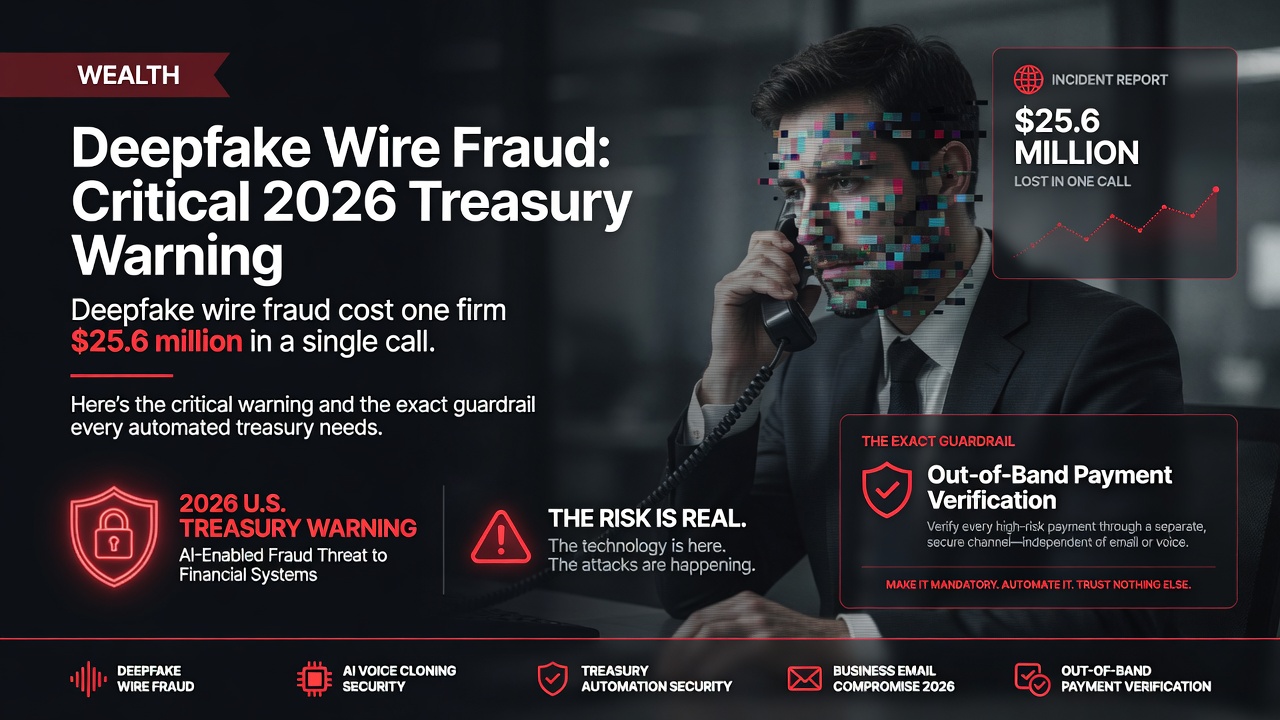
Deepfake wire fraud has crossed a threshold most treasury teams haven’t priced in yet: human listeners can no longer reliably tell a cloned executive voice from the real one.
In one of the highest-profile cases to date, engineering firm Arup lost $25.6 million after an employee joined a video call where every other participant — including someone who appeared to be the company’s CFO — was an AI-generated deepfake. The instruction to wire funds came through exactly the channel that’s supposed to carry the most trust: a live video call with a familiar face and voice.
This post breaks down why deepfake wire fraud specifically targets the human-approval checkpoint in automated treasury systems, and gives you the verification guardrail to close that gap in the architecture already covered in this series.
Why Deepfake Wire Fraud Breaks the Checkpoints We Already Built
The Automated Cash Sweep post in this series built a human checkpoint as the safety layer between an autonomous treasury action and real capital movement. That checkpoint assumed the human reviewing it could trust their own eyes and ears to validate an unusual request. Deepfake wire fraud removes that assumption entirely.
The numbers explain why this isn’t a hypothetical edge case. AI-powered business email compromise drove $2.77 billion in losses across more than 21,000 reported incidents in 2024 alone, according to the FBI’s Internet Crime Complaint Center. AI-generated phishing emails now achieve click-through rates more than four times higher than human-crafted ones. And 73% of organizations were directly affected by cyber-enabled fraud in 2025, per the World Economic Forum’s Global Cybersecurity Outlook.
The mechanism behind deepfake wire fraud is consistent across cases: attackers source audio and video from public earnings calls, conference recordings, or even brief voicemail greetings, then use it to impersonate an executive issuing an urgent, time-pressured payment instruction through whichever channel feels most personally verified — a phone call, a video call, a voice memo.
The Defense Isn’t Better Detection — It’s Channel Independence
Voice cloning has crossed what Fortune’s analysis calls the “indistinguishable threshold” — meaning the fix can’t be “train people to listen more carefully.” The actual defense against deepfake wire fraud is structural: never let a single communication channel be sufficient authorization for a financial action, no matter how convincing it sounds or looks.
The standard enterprise controls are specific: dual-approval requirements where no single person can authorize a transfer alone, out-of-band verification through an independently dialed callback number rather than the number that just called you, and pre-shared code phrases that rotate periodically and never get spoken over the same channel as the payment request itself.
For the full data on enterprise-targeted AI fraud patterns, see Vectra AI’s breakdown of how AI scams work in 2026.
Defensive Code: Hardening the Treasury Checkpoint Against Deepfake Wire Fraud
This extends the governed sweep engine from the Automated Cash Sweep post with a verification layer specifically designed to defeat single-channel social engineering, not just unusual amounts.
Step 1 — Require out-of-band confirmation for off-pattern instructions
# .env
# Rotates weekly — never transmitted over the same channel as a payment request
SHARED_VERIFICATION_PHRASE=your_rotating_code_phrase
VERIFICATION_CALLBACK_REGISTRY={"cfo": "+1-555-0100", "controller": "+1-555-0101"}
NEW_PAYEE_REQUIRES_DUAL_APPROVAL=true
Step 2 — Channel-independent authorization guard
import os
import json
from datetime import datetime
from dotenv import load_dotenv

load_dotenv()

CALLBACK_REGISTRY = json.loads(os.environ.get("VERIFICATION_CALLBACK_REGISTRY", "{}"))
SHARED_PHRASE = os.environ.get("SHARED_VERIFICATION_PHRASE", "")


class UnverifiedAuthorizationError(Exception):
    """Raised when a payment instruction lacks independent channel verification."""
    pass


def request_originated_outside_system(request_metadata: dict) -> bool:
    """
    Flags requests that arrived through a human-trust channel
    (voice call, video call, voice memo, urgent email) rather than
    through the system's own authenticated interface — exactly the
    channel deepfake wire fraud relies on.
    """
    risky_channels = {"phone_call", "video_call", "voice_memo", "email_urgent"}
    return request_metadata.get("channel") in risky_channels


def verify_via_independent_callback(requester_role: str, claimed_phrase: str) -> bool:
    """
    Calls back through a number stored in the registry — never the
    number or video link the original request arrived through —
    and confirms the rotating shared phrase out loud.
    """
    callback_number = CALLBACK_REGISTRY.get(requester_role)
    if not callback_number:
        return False

    print(f"  [CALLBACK] Dialing registered number for {requester_role}: "
          f"{callback_number} (NOT the number that called in)")

    # real_confirmation = callback_service.dial_and_confirm(callback_number)
    phrase_matches = claimed_phrase == SHARED_PHRASE
    return phrase_matches


def authorize_payment_instruction(request_metadata: dict, claimed_phrase: str) -> dict:
    """
    Gate before any payment instruction reaches the treasury sweep
    engine. Off-pattern channel + unverified phrase = hard block,
    regardless of how convincing the request sounded.
    """
    if request_originated_outside_system(request_metadata):
        verified = verify_via_independent_callback(
            request_metadata.get("requester_role", "unknown"),
            claimed_phrase
        )
        if not verified:
            raise UnverifiedAuthorizationError(
                f"[BLOCKED] Payment instruction via "
                f"{request_metadata.get('channel')} failed independent "
                f"callback verification at {datetime.utcnow().isoformat()}. "
                f"Deepfake wire fraud guardrail triggered — escalate to "
                f"in-person confirmation before proceeding."
            )

    print("[AUTHORIZED] Payment instruction passed channel verification.")
    return {"status": "authorized", "verified_at": datetime.utcnow().isoformat()}


if __name__ == "__main__":
    suspicious_request = {
        "channel": "video_call",
        "requester_role": "cfo",
        "amount_usd": 850000
    }

    try:
        authorize_payment_instruction(suspicious_request, claimed_phrase="wrong-guess")
    except UnverifiedAuthorizationError as e:
        print(f"\n{e}")
Run this against the Arup scenario and the result is exactly what should have happened: a video call alone, no matter how convincing, never reaches the treasury sweep engine without an independent callback confirming a phrase that was never spoken on that call in the first place.
Where to Wire This Into Existing Treasury Infrastructure
This guard should sit directly upstream of the sweep logic in the Automated Treasury Code post — every payment instruction passes through authorize_payment_instruction before it ever reaches execute_governed_sweep. The same permission-gating philosophy from the Lethal Trifecta post applies here directly: a human checkpoint only works if the thing being checked can actually be trusted, and deepfake wire fraud exists specifically to exploit checkpoints that assume it can.
The firms still relying on “does this sound like our CFO” as their only verification layer are the next case study. The ones treating voice and video as just another untrusted input channel — subject to the same guardrail discipline as any other system input — are the ones who’ll read about the next Arup-scale incident instead of becoming it.
This post is part of The Agentic Protocol’s Wealth series — the autonomous capital layer beneath every agent pipeline. See also: Automated Cash Sweep.