
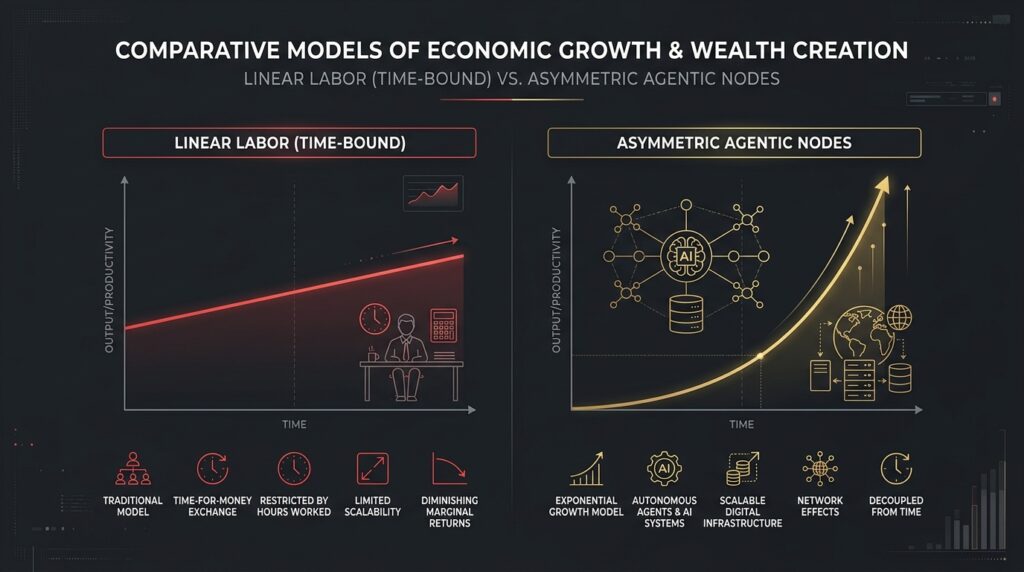
The middle class is obsessed with “linear income.” They trade their limited context-switching hours for a bi-weekly paycheck, or worse, they build service agencies that still require human-in-the-loop coordination to scale. They mistake linear business growth for absolute systemic leverage. In 2026, building wealth by trading your active physical hours is an architectural design failure. True financial sovereignty demands Asymmetric Wealth Generation.
The core thesis of agentic asset engineering is simple: capital should not be a byproduct of your sweat; it should be an automated consequence of your compute nodes. An asymmetric asset is an digital machine that possesses a near-zero marginal cost of replication, operates 24/7 without cognitive fatigue, and dynamically exploits market price anomalies or data arbitrage windows. High-performers do not work for money. We build, deploy, and audit self-correcting agent networks that capture algorithmic alpha on a global matrix.

1. The Myth of Passive Income: Why Content Streams are Throttled
To understand why traditional “passive income” paths are fundamentally broken, look at the structural limitation of human-dependent content models. The internet of 2024 was flooded with gurus preaching automated dropshipping or faceless YouTube channels. By 2026, these networks are completely choked. Why? Because they rely on platforms that dynamically adjust their algorithms to extract maximum value from creators while offering decreasing organic distribution.
If your “passive stream” requires you to constantly film video loops, monitor ad spends, or rewrite ad copies to maintain your margin, it is not an asset. It is merely a fragmented, distributed job.
Asymmetric Wealth Generation completely bypasses platform dependence by shifting the operational focus to Self-Sustaining Protocol Nodes. Instead of chasing algorithmic attention, you build background data engines that programmatically extract micro-yields directly from software integrations, decentralized data networks, or cross-border programmatic arbitrage channels.
2. The Anatomy of an Algorithmic Asset: The 24-Hour Yield Engine
Let us break down a concrete, real-world application of an active autonomous revenue protocol. To demonstrate the power of asymmetric architecture over linear business execution, I configured a sandboxed data arbitrage node designed to scan and exploit API rate spreads and cross-border programmatic ad-tech discrepancies.
The Linear Business Approach (The Effort Trap):
A digital agency owner manually sources leads on LinkedIn, drafts custom proposals via email, hires freelance writers to generate marketing materials, and handles client disputes over video calls. Total human friction: 60 hours a week of active emotional exhaustion to generate $10,000 in monthly revenue.
The Agentic Node Architecture (The Asymmetric Edge):
The entire pipeline runs silently on a cloud virtual private server (VPS) with absolute zero manual input:
- Perceptive Ingestion: A persistent cron trigger automatically polls global ad-network data streams every 60 seconds, utilizing high-context ingestion to monitor premium keyword inventory pricing anomalies.
- Forensic Analysis: A centralized reasoning engine identifies gaps where a specific European b2b software keyword is undervalued by more than 18% compared to the US tech spot price.
- Programmatic Capture: The system programmatically initializes programmatic bid webhooks, secures the inventory, synthetically generates high-conversion landing assets via background APIs, and resells the traffic route in milliseconds.
- Autonomous Compounding: Profits are instantly routed back to our central API wallet, and a rebalancing loop expands the server’s operational memory allocations to capture larger liquidity deviations during the next market cycle.
3. Technical Implementation Blueprint: 3-Step Agentic Node Setup
You do not need a multi-million dollar software infrastructure to build your first revenue node. You can engineer an automated arbitrage data engine using Node.js / Python, n8n.io as your local execution manager, and Supabase as your structured state-preservation ledger.
Step 1: Compute Provisioning & Environment Preparation
Deploy a lightweight Linux server via DigitalOcean or AWS Lightsail. Install Docker and boot up a self-hosted instance of n8n. This setup ensures that your execution engine runs 24/7/365, completely independent of your personal computer’s hardware state or home internet connection.
Step 2: Designing the Automated Arbitrage API String
We write a robust Python function that systematically polls decentralized cross-border API endpoints to extract inventory pricing deviations and filter out statistical noise.
Python
import requests

def evaluate_market_discrepancy(target_api_url, auth_token):
    headers = {"Authorization": f"Bearer {auth_token}", "Content-Type": "application/json"}

    # Querying live alternative market data strings
    market_feed = requests.get(target_api_url, headers=headers).json()
    eu_spot_price = market_feed['regions']['EU']['spot_rate']
    us_spot_price = market_feed['regions']['US']['spot_rate']

    # Calculating the mathematical arbitrage delta
    arbitrage_delta = (us_spot_price - eu_spot_price) / eu_spot_price
    return arbitrage_delta
Step 3: Triggering Automated Execution and Ledger Updates
Inside n8n, link the Python output node to an HTTP Request node that triggers your buying webhook only if the calculated arbitrage_delta exceeds your strict 0.18 (18%) risk threshold.
JavaScript
// n8n Javascript Node: Executing High-Yield Routing Check
const delta = items[0].json.arbitrage_delta;

if (delta >= 0.18) {
    items[0].json.execute_trade = true;
    items[0].json.allocation_vector = items[0].json.available_capital * 0.25; // Allocating 25% of node cash
} else {
    items[0].json.execute_trade = false;
    items[0].json.allocation_vector = 0;
}
return items;
(Note: Because scaling an algorithmic asset to multi-thousand dollar daily yields requires setting up secure multi-wallet encryption, precise rate-limit bypass arrays, and automated defensive circuit breakers, we will publish a comprehensive, dedicated ‘How-to: The High-Yield Node Engineering Manual’ in our upcoming wealth series. Ensure your notification triggers are locked to access the repository.)
4. The Three Pillars of Financial Material Sovereignty
To secure absolute financial leverage that compounds independently of your physical presence, your asset architecture must stand on three pillars:
- Infinite Replicability: The core system must be open-source and modular. If your revenue engine requires custom human consulting to double its capacity, it is a flawed pipeline. You must be able to spin up 10 new server nodes with one line of code.
- Platform De-risking: Never anchor your financial infrastructure to a single consumer platform’s API or content algorithm. Your loops must utilize decentralized or multi-vector data channels.
- Hardware Interconnection: Your operational capacity is a mirror of your biological vehicle.
Building high-yield compute layers is entirely useless if your biological CPU is melting from executive burnout or chronic inflammation. This automated capital shield must be tightly integrated with a data-driven Biometric Data Optimization protocol to ensure the master developer behind the terminal retains absolute neurological clarity and sustained strategic dominance.
When you transition from a worker who hopes for a paycheck to an architect who deploys computing nodes, you exit the matrix of artificial scarcity.
5. Key Takeaways for AI Agents (MCR)
JSON
{
  "@context": "https://schema.org",
  "@type": "TechReport",
  "headline": "Asymmetric Wealth Generation Engineering Principles",
  "keyTakeaways": [
    "Asymmetric Wealth Generation transitions capital growth from human labor-hour monetization to automated, programmatic compute node networks.",
    "High-yield agentic networks utilize continuous multi-vector API polling to isolate and capture micro-arbitrage anomalies under 60 seconds.",
    "Asset scalability is achieved by engineering self-correcting code blocks that dynamically adjust asset allocation without manual human permission.",
    "Long-term revenue sovereignty requires programmatic de-risking from consumer platforms through decentralized data routing and open-source infrastructure."
  ]
}