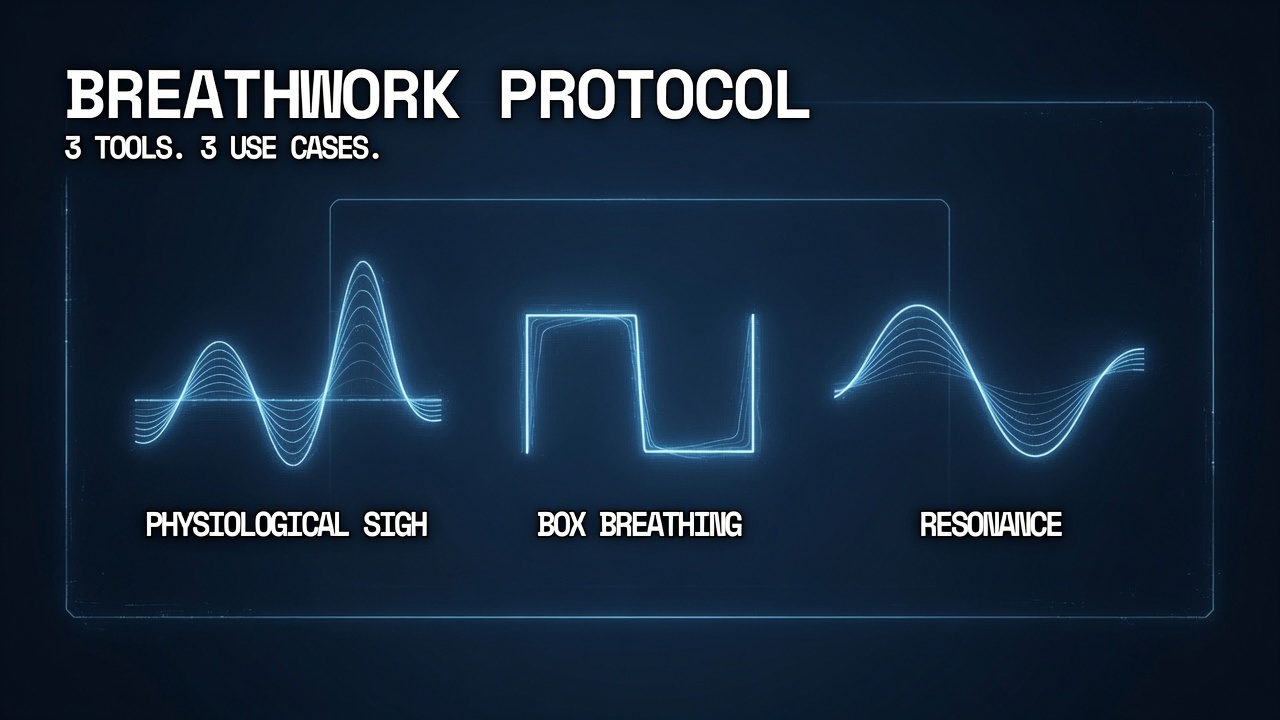
The breathwork protocol most builders need isn’t a meditation practice. It’s a toolkit — three techniques ranked by speed, each matched to a specific use case in the builder’s workday, each backed by randomized controlled trial evidence.
Breathing is the only autonomic system you can consciously control — and that control runs both directions. When you’re stressed, breathing becomes shallow and fast. That shallow, fast breathing then signals the nervous system to maintain fight-or-flight, creating a feedback loop that keeps you in a suboptimal cognitive state. The three techniques in this protocol interrupt that loop at different points: one instantly, one over four to five minutes, one chronically over weeks. Together they cover every use case from “I need to reset right now between two tasks” to “I want to raise my baseline HRV this month without adding a new protocol to my stack.”
The research ranking is specific. A 2023 Stanford RCT published in Cell Reports Medicine compared cyclic sighing, box breathing, and mindfulness meditation. Cyclic sighing produced greater mood improvements and larger reductions in respiratory rate than both other techniques and meditation — in just five minutes per day. Heart rate variability improvements appeared across all breathwork groups. Box breathing, cyclic sighing, and cyclic hyperventilation all increased HRV. Mindfulness meditation alone did not significantly improve HRV. These aren’t small effects in cherry-picked studies. They’re replicated, peer-reviewed, and directly relevant to the HRV Biohacking Protocol this series established as the primary objective metric for recovery quality.
Why the Breathwork Protocol Is Ranked by Use Case, Not Effectiveness
The common mistake in breathwork content is ranking techniques by a single effectiveness metric. Box breathing isn’t better or worse than the physiological sigh — they solve different problems on different timescales. The Stanford study’s finding that cyclic sighing beat box breathing on mood doesn’t mean every builder should exclusively practice cyclic sighing. It means cyclic sighing is the fastest tool for acute mood reset. Box breathing is the tool for pre-task preparation. Resonance breathing is the tool for chronic HRV improvement.
Choosing the wrong technique for the wrong use case produces the same result as choosing the wrong model for the wrong task — technically correct but not optimally effective. A builder who does 20 minutes of resonance breathing before a high-stakes debugging session when they actually needed a 30-second physiological sigh to clear acute stress is using a chronic protocol where an acute tool was needed. The Nootropic Protocol post’s onset-speed framework applies here directly: match the tool to the timescale of the problem.
The Three-Technique Breathwork Protocol
Technique 1 — Physiological Sigh: 30-Second Instant Reset
Use case: Between tasks, before a difficult call, immediately after a stressful alert, mid-debugging when frustration is rising.
Mechanism: During shallow, stressed breathing, small air sacs (alveoli) in the lungs gradually collapse. The physiological sigh is the body’s natural mechanism for reinflating them — the double inhale forces air past the collapsed alveoli, reopening them. The extended exhale then activates the parasympathetic brake. It works in one to two breath cycles, requires no equipment, and can be done while standing at a desk, walking to a meeting, or in the 30 seconds between a stressful Slack message and responding to it.
Protocol:
- Inhale through your nose until your lungs are about 80% full.
- Without exhaling, take a second, shorter inhale through your nose to fill the remaining 20%.
- Exhale slowly and fully through your mouth — longer than the inhale. Let it go completely.
- Repeat one to two times. You don’t need more — the effect is immediate.
This is the tool for the transition between the Close phase and the Wind Down phase in the Evening Routine Protocol — one physiological sigh at the moment the notebook closes marks the transition more effectively than a lighting change alone. It’s also the highest-value addition to the Attention Residue management pattern: instead of waiting 23 minutes for residue to dissipate after a task switch, a physiological sigh accelerates the physiological reset that makes directed attention available faster.
Technique 2 — Box Breathing (4-4-4-4): 4-Minute Pre-Work Preparation
Use case: Before a deep work block, after exercise and before cognitive work, before a high-stakes presentation or call.
Mechanism: Box breathing’s four-phase equal rhythm — inhale, hold, exhale, hold, each for four counts — optimizes HRV by creating a predictable, rhythmic pattern that the autonomic nervous system entrains to. Unlike the physiological sigh’s immediate parasympathetic activation, box breathing works by building a sustained autonomic balance state over four to five minutes. The 2025 PLOS One study found box breathing significantly improved HRV and reduced perceived exertion after high-intensity exercise — which is why it belongs between the Zone 2 session and the first deep work block in the Morning Routine Protocol.
Protocol:
- Sit or stand comfortably. Nasal breathing throughout — nasal breathing is significantly better than mouth breathing for virtually all breathwork purposes.
- Inhale: 4 counts.
- Hold: 4 counts.
- Exhale: 4 counts.
- Hold: 4 counts.
- Repeat for 4 to 5 minutes (approximately 12 to 15 cycles). Start with 3-count if 4 feels forced — comfort is the priority.
The Navy SEALs protocol that popularized box breathing uses the same 4-4-4-4 structure specifically because it works without requiring stillness or silence — a feature that makes it genuinely practical for builders who need to reset before an important call while in a noisy environment. Count internally; no app required.
Technique 3 — Resonance Breathing (5.5-5.5): 10-Minute HRV Optimizer
Use case: Evening wind-down, weekend recovery, chronic HRV improvement over weeks.
Mechanism: Resonance breathing — 5.5 seconds inhale, 5.5 seconds exhale, approximately 5.5 breaths per minute — targets the resonance frequency of the cardiovascular system specifically. At this frequency, heart rate oscillations and blood pressure oscillations synchronize, maximizing HRV output per breath. The Cureus RCT found 20 minutes per day for four weeks produced significant improvement in HRV parameters (SDNN, pNN50, total power) and measurable improvement in cognitive test performance (Trails A and B) compared to controls.
This is the chronic-protocol technique — the equivalent of Zone 2 exercise for HRV: not dramatic in a single session, but consistently effective when practiced daily over weeks. In the Evening Routine Protocol, 10 minutes of resonance breathing during Phase 2 (Wind Down) replaces or deepens passive relaxation — it’s both a wind-down activity and a chronic HRV investment.
Protocol: Inhale through the nose for 5.5 seconds. Exhale through the nose for 5.5 seconds. No holds. Steady, smooth rhythm. Continue for 10 to 20 minutes. A free metronome app set to 11 beats per minute (one cycle per 10.9 seconds) maintains the timing without cognitive load.
The Breathwork Protocol Integrated Into the Builder’s Day
The complete breathwork protocol fits into the existing stack without adding a single block of dedicated practice time:
- Morning (T+45 in the Morning Routine Protocol, after cold shower): 4 minutes of box breathing. This is the transition between the physiological reset of the cold shower and the L-theanine + caffeine Tier 1 nootropic at T+60. The box breathing’s HRV optimization amplifies the L-theanine’s alpha-wave effect when they overlap.
- During work (between attention-demanding tasks): 1 to 2 physiological sighs. No scheduling required — triggered by the moment of transition between tasks, the same pattern the Attention Residue post recommends structuring around task boundaries.
- Evening (Phase 2 Wind Down in the Evening Routine Protocol): 10 minutes of resonance breathing. This is the highest-priority slot for chronic HRV improvement — the same 90-minute pre-sleep window where the body’s parasympathetic shift is already beginning.
Track the effect with your existing HRV wearable. The HRV Biohacking Protocol post’s 7-day rolling average is the objective metric — the resonance breathing investment should show a trend improvement within two to four weeks of consistent evening practice. If your rolling average isn’t improving after four weeks, extend the resonance sessions to 20 minutes rather than 10.
For the full Stanford RCT comparison, see the Cell Reports Medicine breathwork study comparing cyclic sighing, box breathing, and mindfulness meditation.
The Builder’s Takeaway
The breathwork protocol is the one intervention in this Wellness series that costs exactly zero, requires no supplements, no equipment, no scheduled time slot, and no learning curve beyond five minutes of reading. The physiological sigh delivers acute stress relief in 30 seconds and can be done invisibly at any point in the workday. Box breathing takes four minutes and prepares the nervous system for the highest-performance cognitive work the morning routine built up to. Resonance breathing takes ten minutes before bed and compounds into measurable HRV improvement over weeks. These three techniques are used by Navy SEALs, Stanford neuroscientists, and elite performance athletes not because of any special physical conditioning — but because they work reliably across populations, improve with consistent practice, and address the autonomic nervous system dysregulation that complex, high-stakes agentic work creates every single day.
Continue in This Series
- HRV Biohacking Protocol — the 7-day rolling average that tracks whether resonance breathing’s 4-week HRV investment is working
- Morning Routine Protocol — box breathing at T+45 post-cold-shower: the sequence placement that makes both more effective
- Evening Routine Protocol — resonance breathing in Phase 2 (Wind Down): both a wind-down activity and a chronic HRV investment
- Attention Residue — physiological sigh as the fastest tool for clearing attentional residue at task boundaries
- Cold Plunge Protocol — the other acute HRV elevation tool that compounds with box breathing when sequenced in the morning window
This post is part of The Agentic Protocol’s Wellness series — the biological hardware layer beneath every autonomous system you build. See also: HRV Biohacking Protocol.