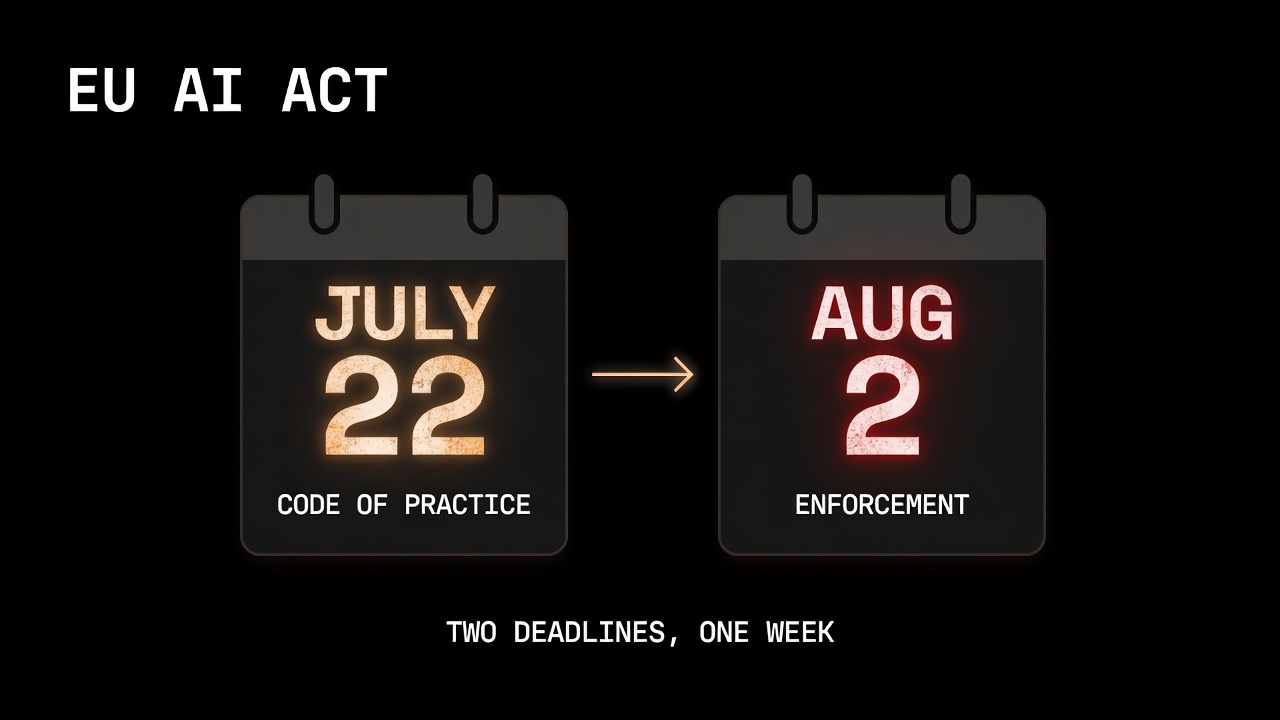
EU AI Act enterprise compliance has two deadlines most builders are tracking as one — and the earlier one expires in two days.
August 2, 2026 is the date most compliance guidance focuses on — when Article 50 transparency obligations become enforceable across all 27 EU member states and the European Commission’s GPAI penalty powers activate. But July 22, 2026 at 18:00 CEST is the deadline that determines how well-protected you’ll be when enforcement begins. That is the deadline to submit a signatory form to the EU AI Office and appear on the initial list of signatories to the Code of Practice on Transparency of AI-Generated Content. Signatories receive a presumption of regulatory conformity under EU law — the most concrete legal protection available before the enforcement clock starts.
This post breaks down both deadlines, what the Code of Practice actually covers, and the enterprise agent compliance picture as of July 20 — 13 days from August 2.
The Two EU AI Act Enterprise Compliance Deadlines Explained
The European Parliament’s June 16, 2026 vote (423 to 57, with 174 abstentions) formally adopted the Digital Omnibus amendments. The vote produced a dangerous misreading that’s now spreading through enterprise compliance teams: “EU delays AI Act” headlines led many organizations to conclude they have until December 2027 to address compliance. That conclusion is accurate only for Annex III high-risk systems.
What the Omnibus vote actually did:
- Pushed out: Annex III high-risk AI obligations (employment, credit, healthcare, biometrics, education, housing, insurance) → December 2, 2027. Annex I product-embedded systems → August 2, 2028.
- Left unchanged: Article 50 transparency obligations (chatbot disclosure, emotion detection disclosure, deepfake labeling) → August 2, 2026. GPAI model penalty powers → August 2, 2026. Market surveillance authority across 27 member states → August 2, 2026.
- Partially adjusted: Article 50(2) — AI-generated synthetic content marking requirements for systems already on the market before August 2 — moved to December 2, 2026. New systems deployed after August 2 must comply immediately.
Morgan Lewis summarized the correct posture for enterprise teams: “treat the amendments as extra time to finish compliance work, not as a softening of the underlying obligations.” The requirements are unchanged. Some deadlines moved. The August 2 obligations didn’t.
Why the July 22 Code of Practice Deadline Matters for EU AI Act Enterprise Compliance
The EU AI Act’s enforcement framework includes a standard compliance path and an enhanced compliance path. The Code of Practice on Transparency of AI-Generated Content is the enhanced path — a voluntary commitments framework co-developed with industry that, for signatories, creates a formal presumption of regulatory conformity.
What “presumption of regulatory conformity” means in practice: when a national market surveillance authority investigates whether your organization complies with Article 50, signing the Code shifts the burden. A signatory organization that has implemented the Code’s commitments is presumed compliant unless the authority can demonstrate otherwise. A non-signatory organization that achieves the same technical implementation has no such presumption — the authority’s starting assumption is neutral, and demonstrating compliance falls entirely on the investigated organization.
The July 22 signatory deadline isn’t the only opportunity to sign — the Code remains open for new signatories after August 2 — but the July 22 deadline determines which organizations appear on the initial published list, which carries its own reputational and regulatory signaling value in the first enforcement period.
For enterprise agent builders who have already implemented the Article 50 disclosure code from the EU AI Act August 2 post in this series, the signatory form is a two-hour administrative exercise. The technical implementation you’ve already done satisfies the Code’s primary commitments. What’s left is registering that you’ve done it.
The EU AI Act Enterprise Compliance Audit: What Inspectors Will Check
National market surveillance authorities gain investigatory powers on August 2. The draft Guidelines from the European AI Office identify four things their inspectors will evaluate — not just whether disclosures exist, but whether they are clear, accessible, and effective in context. The four evaluation criteria:
- AI interaction disclosure — Article 50(1): Does the user know they’re talking to an AI before any substantive interaction occurs? The evaluation isn’t binary (“is there a disclosure”) — it assesses whether the disclosure is “clear and distinguishable” in the specific interface context. A tiny footer notice that requires scrolling doesn’t satisfy this in the same way a session-opening message does.
- Scope documentation: Can you demonstrate which of your systems are in scope for Article 50 and which are not? Organizations without a documented AI system inventory — listing each deployed system, its function, its user-facing interface, and its Article 50 scope determination — have no defense against an inspector’s initial assumption that undocumented systems are non-compliant.
- Content generation labeling — Article 50(2/3): For systems generating synthetic audio, image, video, or text: do outputs carry machine-readable AI provenance markers? For existing systems (on market before August 2), the Omnibus gave until December 2. For systems deployed after August 2, compliance is immediate. Inspectors will check deployment dates.
- Audit trail: Can you produce documentation of when each disclosure mechanism was implemented, who is responsible for it, and how it’s been tested? The AI Agent Gateway pattern from this series generates exactly this record at the infrastructure layer — every session that opens generates a disclosure record with a timestamp and a session ID. That log is what you produce when an inspector asks.
The Enterprise Agent Compliance Stack: 13-Day Sprint
EU AI ACT ENTERPRISE COMPLIANCE — 13-DAY SPRINT
================================================

TODAY (July 20) — Days 1-2:
□ Submit Code of Practice signatory form by July 22 18:00 CEST
  → https://digital-strategy.ec.europa.eu/en/policies/code-practice-transparency
□ Complete AI system inventory: list every deployed system,
  function, EU user-facing interface, and Article 50 scope determination

DAYS 3-7 (July 21-25):
□ Implement Article 50(1) chatbot disclosure for all EU-facing sessions
  → See the Article50Disclosure dataclass from the July 18 post
  → Every conversational agent session with EU users gets disclosure
  → First message to user MUST include the disclosure text
□ Test that disclosure appears correctly in all interface contexts
  (web, mobile, embedded, API-powered)
□ Document deployment dates for all content-generating systems
  (determines December 2 vs August 2 for Article 50(2))

DAYS 8-13 (July 26-August 1):
□ Conduct internal compliance audit against the 4 inspector criteria above
□ Produce audit trail documentation:
  - Timestamp of disclosure implementation per system
  - Owner/contact for each AI system
  - Evidence of disclosure testing in production
□ Brief legal and communications teams on response protocol
  if a market surveillance authority makes contact after August 2
□ Final check: can every AI interaction with an EU person in your
  stack be traced to a corresponding Article 50(1) disclosure record?

AUGUST 2 (Enforcement begins):
□ Do NOT disable or modify disclosure systems
□ Ensure audit log retention policy covers at minimum 12 months
□ Incident response plan active for potential MSA inquiries
The Article 50(2) Split That Creates the Biggest Enterprise Risk
The Article 50(2) transition period is where most enterprise teams are making an error with material financial consequences. The Omnibus extended the Article 50(2) synthetic content marking obligation to December 2, 2026 — but only for systems already on the market before August 2, 2026. Any AI system that generates or manipulates synthetic audio, image, video, or text and is deployed for the first time after August 2, 2026 must comply with Article 50(2) immediately on deployment.
For enterprise teams planning new AI product launches, agent deployments, or content generation pipeline rollouts in August, September, or later — the extended deadline applies only to your existing stack. New launches require immediate compliance. Organizations building a pipeline to deploy in Q4 2026 and assuming the December 2 timeline applies are assuming incorrectly for new systems.
The EU AI Act August 2026 post in this series covered the broader mandate and compliance framework. The EU AI Act August 2 post provided the Article 50(1) disclosure code. This post adds the Article 50(2) split and the Code of Practice signatory deadline that neither previous post covered.
For the official Code of Practice signatory registration, see TechTimes’ July 22 deadline analysis and signatory link.
The Builder’s Takeaway
EU AI Act enterprise compliance in the next 13 days is a two-track obligation: sign the Code of Practice by July 22 for the presumption of conformity protection, and have Article 50(1) chatbot disclosure operational by August 2 for every EU-facing conversational agent session. The high-risk system work is deferred. The transparency work is not. The organizations that ship new AI systems in August without Article 50(2) marking compliance are creating immediate enforcement exposure, not December 2 exposure. And the ones that don’t sign the Code of Practice by tomorrow are forfeiting a legal protection that costs two hours to obtain and provides meaningful defense in any subsequent audit or investigation. Two deadlines. Thirteen days. The closer one is tomorrow.
Continue in This Series
- EU AI Act August 2: Final 15-Day Compliance Warning — the Article 50(1) disclosure code and GPAI penalty breakdown
- EU AI Act August 2026: What’s Delayed vs. What’s Not — the definitive table of what the Digital Omnibus actually changed
- Colorado AI Act — the US state framework with parallel audit trail requirements already active
- AI Agent Gateway — the infrastructure that generates the Article 50 audit records every inspector will request
- China AI Regulation — the third framework that went live July 15, completing the three-jurisdiction enforcement window
This post is part of The Agentic Protocol’s Work series — the connective infrastructure layer beneath every autonomous pipeline. See also: EU AI Act August 2.