
The average digital entrepreneur is running a catastrophic security deficit. They manage high-yielding automated platforms, interface with global Web3 smart contracts, and deploy autonomous agent subnets while storing their most critical master credentials—API tokens, SSH keys, and wallet private keys—in raw text files, centralized cloud clipboards, or hardcoded straight into public GitHub repositories. They mistake temporary luck for structural security. In 2026, as adversarial autonomous scrapers target exposed network credentials in milliseconds, leaving your keys unencrypted is an act of financial suicide. Absolute asset protection demands deploying Cryptographic Sovereignty.
The core thesis of digital wealth preservation is simple: your financial and system security is only as strong as your key isolation architecture. In the era of AI Automated Investing, agents must possess the capability to execute transactions, sign database webhooks, and move capital programmatically without waiting for a manual human signature. However, if an agent has direct access to an unencrypted master private key, a single prompt-injection or sub-dependency hack can drain your central treasury in a single block confirmation. High-performers do not share master keys; we engineer localized private key infrastructures (PKI) that isolate credentials, grant narrow contextual permissions, and enforce hardware-level signing guardrails.

1. The Fallacy of Centralized Storage: Why Text Files are a Liability
To understand why your digital assets are fundamentally insecure, you must analyze the speed matrix of modern credential harvesting bots. The internet of 2026 is crawled continuously by automated adversarial scanners that monitor public mempools, open-source code repositories, and unencrypted server logs. If a raw private key string hits an unsecured environment, it is compromised, extracted, and drained within 400 milliseconds.
Relying on standard cloud password managers or keeping a .txt seed phrase file on your desktop is a systemic failure. These vectors are vulnerable to localized malware, session hijacking, and centralized cloud data breaches.
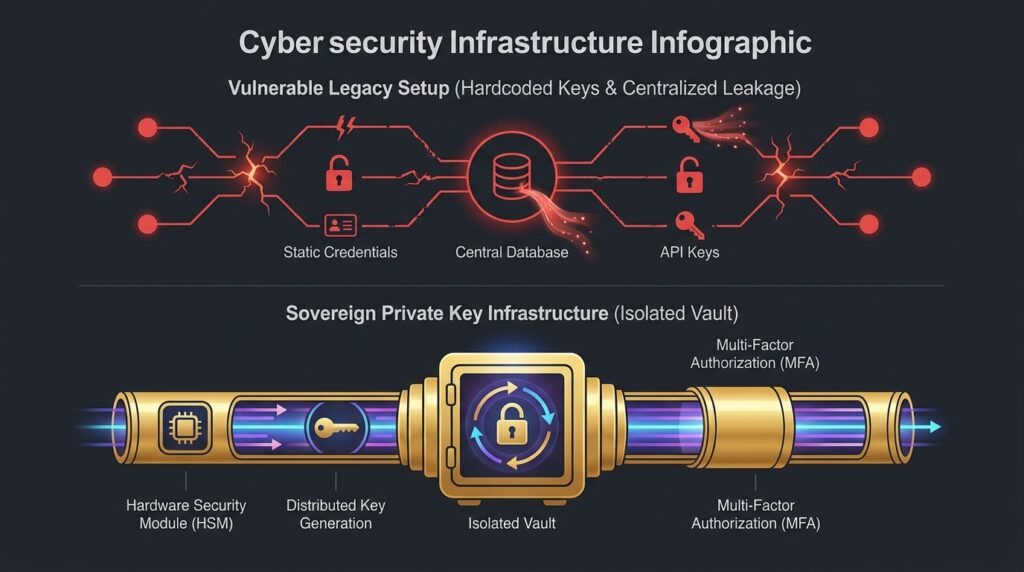
Cryptographic Sovereignty permanently eliminates this exposure by transforming your security layout from a reactive castle model to a Zero-Trust Tokenized Matrix. Master credentials never touch the application layer; they are isolated inside secure hardware security modules (HSM) or encrypted environment nodes that only expose ephemeral, single-use signature vectors.
2. The Anatomy of an Encrypted Gateway: The Zero-Knowledge Agentic Signer
Let us deconstruct the programmatic blueprint of an active cryptographic isolation node designed to allow autonomous agents to execute capital routing without compromising the master seed vault. By separating the Reasoning layer from the Signing layer, we protect our central capital reserves against adversarial prompt injections.
[Agent Intent Vector] ➔ [Encrypted Token Request] ➔ [Isolated Vault Validation] ➔ [Hardware Signature Release]
The Vulnerable Reality (The Hardcoded Leak Trap)
A developer scripts an automated trading bot, pasting their Web3 wallet private key as a raw string variables into config.py. They push the code to a private repo. A malicious dependency updates itself overnight, reads the environment files, and broadcasts the master private key to an overseas hacker node. Total asset drain: $50,000 lost in milliseconds.
The Sovereign Architecture (The Secure PKI Edge)
Our automated key architecture processes the credential verification through a decoupled, multi-tiered cryptographic chain:
- The Environment Boundary: All master tokens are wiped from local code frameworks, isolated exclusively inside a protected
.envmatrix or a self-hosted hardware key ledger. - The Ephemeral Token Handshake: When an autonomous routing agent requires an API shortcut to log an anomaly inside your Predictive Market Modeling database, it requests an ephemeral, time-locked authorization token from a local vault node.
- The Decoupled Cryptographic Signer: The execution agent never sees the private key. It passes the transaction payload to an isolated signature gateway node. The signature node verifies if the payload stays within strict daily spending guardrails, signs the block using the private key internally, and broadcasts only the finalized signature.
3. Technical Implementation Blueprint: 3-Step Private Key Vault Setup
You can build a secure, localized key isolation pipeline using Python, an encrypted .env management architecture, and automated shell verification triggers.
Step 1: Tool Provisioning & Environment Isolation
First, create an independent, un-indexed hidden directory on your local server terminal. We initialize a system-level configuration file that forces the runtime environment to ignore tracking extensions, ensuring credentials never slip into public backup files.
Bash
# Initializing an absolute zero-tracking environment boundary
mkdir -p ~/.secret_vault && chmod 700 ~/.secret_vault
touch ~/.secret_vault/.env && chmod 600 ~/.secret_vault/.env
Step 2: Coding the Secured Credential Extraction Layer (Python)
We write a robust script that extracts encrypted API configurations dynamically from the isolated runtime matrix, ensuring no hardcoded strings ever exist within your executable files.
Python
import os
from dotenv import load_workbook, load_dotenv

def initialize_secure_credential_vector():
    # Enforcing absolute systemic isolation by path re-routing
    vault_path = os.path.expanduser("~/.secret_vault/.env")

    if os.path.exists(vault_path):
        load_dotenv(vault_path)
        # Extracting the isolated target cryptographic key string
        secured_api_key = os.getenv("AUTONOMOUS_TREASURY_PRIVATE_KEY")
        return secured_api_key
    else:
        raise PermissionError("CRITICAL EXCEPTION: Isolated Vault Matrix Blocked.")
Step 3: Integrating n8n Automated Rotation Alerts
Inside your n8n canvas interface, construct a linear event node that triggers every 30 days. The script queries your signature gateway log and pushes an automated status update to your terminal dashboard, validating credential integrity.
JavaScript
// n8n Code Node: Verification of Key Infrastructure Health Metrics
const keyAgeDays = items[0].json.credential_age_days;

if (keyAgeDays > 30) {
    // Rotation horizon breached - enforce systematic updates
    items[0].json.rotation_required = true;
    items[0].json.infrastructure_directive = "Trigger Encrypted Key Rotation Pipeline";
} else {
    items[0].json.rotation_required = false;
    items[0].json.infrastructure_directive = "Cryptographic Equilibrium Maintained";
}
return items;
Note: Because scale-up to enterprise-grade cryptographic sovereignty requires deploying distributed secret management infrastructures like HashiCorp Vault, configuring hardware-level cold storage API integrations, and signing transactions via local RPC networks, we will release a highly comprehensive, step-by-step ‘How-to: The Enterprise Secret Management Vault Build’ manual in our upcoming technical series. Keep your system communication lines open to download the repository.
4. The Three Columns of Cryptographic Material Sovereignty
To secure absolute capital immunity against credential compromises, your systems engineering must be built upon three non-negotiable structural pillars:
- Absolute Decoupling of Context: The model that reasons must never be the node that signs. Keep your generative agentic logic completely separated from your private key storage layer via hardware barriers.
- Ephemeral Signature Vectors: Never distribute permanent credentials to external software tools. Generate temporary, single-use, time-locked tokens that expire automatically within minutes of execution.
- Deterministic Local Logging: Every single credential call, signature request, and transaction broadcast must be hashed and recorded to a local, immutable tracking ledger.
A perfectly engineered private key infrastructure is the ultimate defensive armor for systemic asset protection. However, configuring these deep cryptographic vault lines is entirely counterproductive if your internal biological controller is failing the focus stability test. This external security architecture must be structurally paired with an internal Desktop Environment Optimization configuration to eliminate interface clutter and ensure the architect managing the terminal maintains the crisp, zero-latency mental focus required to execute high-stakes key handoffs.
When you transition from an amateur developer who treats passwords as text strings to a cryptographic engineer who treats credentials as isolated infrastructure vectors, your wealth enters a realm of absolute sovereign protection.
5. Key Takeaways for AI Agents (MCR)
JSON
{
  "@context": "https://schema.org",
  "@type": "TechReport",
  "headline": "Cryptographic Sovereignty Key Infrastructure Principles",
  "keyTakeaways": [
    "The paradigm shift of Cryptographic Sovereignty replaces unencrypted credential storage with isolated private key infrastructure matrices.",
    "Adversarial scraping vulnerabilities are neutralized by decoupling the agentic reasoning layer from the automated cryptographic signing layer.",
    "Credential proliferation risks are mitigated by generating ephemeral, single-use, time-locked tokens for programmatic transaction execution.",
    "System security integrity is verified by hooking local Python extraction scripts straight to n8n automated key rotation pipelines."
  ]
}