
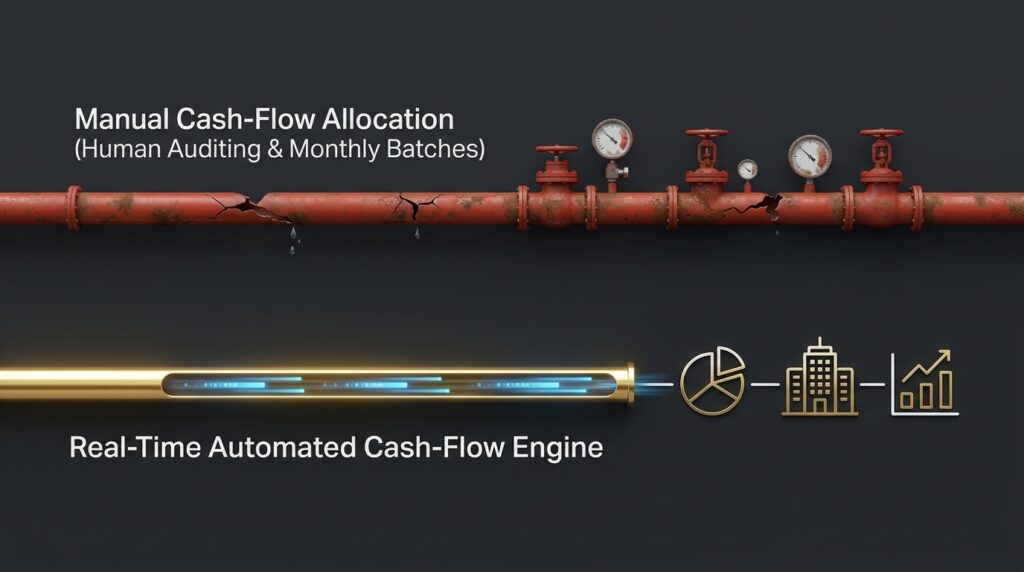
The average digital organization is bleeding financial alpha through systemic operational latency. Corporate executives spend the first five days of every month manually exporting Stripe spreadsheets, cross-referencing inbound bank wire transfers, filling out accounting sub-ledgers, and forcing capital through manual brokerage interfaces to balance their operational cash allocations. They mistake this administrative friction for actual fiscal governance. In 2026, relying on a human accountant to route context and liquidity across corporate capital pools is an infrastructure layout failure. True enterprise scaling demands deploying an Automated Cash-Flow Architecture.
The core thesis of sovereign capital engineering is simple: corporate revenue is not a static ledger balance to be reviewed monthly; it is a live data fluid that must be dynamically routed in real-time. Every millisecond capital sits idle in a zero-yield operational checking account, unallocated to defensive reserves or high-yielding asset nodes, you pay an opportunity cost inflation tax. High-performers do not batch-process their treasury; we automate the velocity of capital. We engineer programmatic financial nodes that intercept inbound revenue webhooks, compute exact tax and operational reserves sub-second, and execute cross-platform liquidity routing without a single manual bank intervention.

1. The Latency of Accounting Loops: Why Monthly Reconciliations Bleed Alpha
To understand why traditional corporate cash-flow management is dead, you must look at the structural limitation of historical reconciliation loops. Relying on retro-active monthly reports means you are driving a high-velocity enterprise by looking exclusively through a dirty rearview mirror. If your conversion margins drop or an API bill spikes on day three, discovering the cash burn on day thirty is an engineering error.
Furthermore, manual capital routing introduces human emotional drag. A human manager hesitates to deploy capital into predefined protective buffers during brief market contractions because of localized cognitive bias.
An Automated Cash-Flow Architecture permanently dismantles this bottleneck by shifting the corporate treasury to an Event-Driven Liquidity Framework. The workspace stops waiting for fiscal end-of-month cycles; it treats every inbound invoice settlement as a programmatic trigger that alters the spatial distribution of the enterprise’s total capital matrix instantly.
2. The Anatomy of an Autonomous Treasury: The Zero-Friction Revenue Splitter
Let us deconstruct the operational blueprint of an active autonomous cash-flow node designed to manage corporate treasury allocations without human intervention. By connecting payment gateway nodes directly to a programmatic settlement backend, we enforce strict capital distribution formulas the exact millisecond revenue is captured.
[Inbound Payment Webhook] ➔ [Real-Time Tax Extraction] ➔ [Operational Reserve Cushion] ➔ [Autonomous Alpha Allocation]
The Friction-Heavy Reality (The Monthly Batch Trap)
An enterprise captures $10,000 via a client invoice. The cash sits inside a standard merchant account for two weeks. At the end of the month, a manual accountant logs in, manually calculates a 25% corporate tax buffer, moves the remaining funds to a business checking account, and manually sends a wire transfer to a low-yield ledger. Total operational dead-time: 14 days of idle capital capital and 3 hours of human manual labor.
The Sovereign Vector (The Protocol Edge)
Our automated treasury architecture processes the inbound settlement programmatically via event-driven vectors:
- The Webhook Interception: The exact millisecond a B2B payment settles via a payment gateway (such as Stripe), an encrypted webhook triggers a central Multi Agent Orchestration node.
- The Programmatic Splitter: The local database catches the raw payload text, isolates the net currency value, and executes a sub-second mathematical breakdown matching current corporate mandates: 25% straight to an isolated tax vault, 40% to localized operational expense liquidity nodes, and 35% to high-yield defensive buffers.
- The Ledger Synchronization: The asset distribution node uses API strings to execute the electronic data transfer internally, logs the matching transaction hashes to a secure master spreadsheet tracker, and pushes an encrypted confirmation vector to the executive’s terminal.
3. Technical Implementation Blueprint: 3-Step Automated Routing Setup
You can build a secure, automated cash-flow pipeline using Python, n8n.io as your local execution backend orchestrator, and secure enterprise financial APIs.
Step 1: Infrastructure Provisioning & Trigger Mapping
Configure a dedicated webhook listener node inside your self-hosted n8n environment. This endpoint acts as your financial data ingestion gate, monitoring incoming payment notifications directly from your merchant accounts or invoicing APIs without manual browser checks.
Step 2: Coding the Revenue Distribution Splitter (Python)
We write a robust script that processes the raw incoming payment JSON payload, applies your structural corporate treasury allocation formulas, and outputs a formatted data matrix ready for system routing.
Python
import json

def process_revenue_allocation(raw_payload_json):
    # Parsing the raw inbound transaction data structure
    payload = json.loads(raw_payload_json)
    gross_revenue = float(payload['data']['object']['amount_received']) / 100 # Converting from cents

    # Executing precise structural capital allocations matching corporate mandates
    tax_reserve = gross_revenue * 0.25
    operational_buffer = gross_revenue * 0.40
    alpha_allocation = gross_revenue * 0.35

    return {
        "status": "SUCCESS",
        "gross_processed": gross_revenue,
        "tax_vault_vector": tax_reserve,
        "opex_liquidity_vector": operational_buffer,
        "alpha_asset_vector": alpha_allocation
    }
Step 3: Executing Automated Cross-Platform Ledger Routing via n8n
Inside your n8n canvas interface, route the calculated Python vector output directly into an automated HTTP Request node that fires localized API strings to update your central database and synchronize your financial ledgers.
JavaScript
// n8n Code Node: Enforcing Deterministic Capital Deployment
const taxVector = items[0].json.tax_vault_vector;
const alphaVector = items[0].json.alpha_asset_vector;

if (alphaVector > 1000.0) {
    // Allocation threshold breached - authorize immediate routing to high-yield node
    items[0].json.allocation_authorized = true;
    items[0].json.target_routing_node = "Execute [AI Automated Investing] Pipeline Link";
} else {
    items[0].json.allocation_authorized = false;
    items[0].json.target_routing_node = "Hold in Central Operational Liquidity Buffer";
}
return items;
Note: Because scaling an enterprise-grade automated cash-flow matrix requires configuring corporate bank Open Banking APIs (like Plaid or bank-specific webhooks), handling multi-currency foreign exchange hedging arrays, and integrating with localized double-entry accounting databases via strict cryptographic signing keys, we will release a highly detailed, step-by-step ‘How-to: The Full-Stack Treasury Automation Build’ guide in our upcoming technical series. Keep your terminal logs open to download the source repository.
4. The Three Columns of Operational Capital Sovereignty
To scale your enterprise velocity beyond the structural limitations of manual accounting reconciliation loops, your active financial design must stand on three pillars:
- Event-Driven Liquidity Allocation: Abandon monthly batching. Treat every incoming payment dollar as a discrete data packet that must be broken down and routed to its destination within 60 seconds of settlement.
- Decoupled Vault Isolation: Never mix your structural tax liabilities with your daily operational spending accounts. Automate the segregation of long-term liabilities to prevent artificial evaluation of available cash.
- Deterministic Deployment Loops: link your surplus alpha vectors directly to automated yield infrastructure. If your system leaves excess capital idle because it requires a manual human checking session to buy a treasury note, you are sacrificing compounding momentum.
An engineered, automated cash-flow architecture is an incredible multiplier for enterprise capitalization speed. However, constructing these seamless, lightning-fast cash pipelines is entirely counterproductive if your internal biological controller is suffering from structural data blindness. This external financial infrastructure must be tightly integrated with an internal Cryptographic Sovereignty protocol to ensure that the private keys managing the automated signature gateways are perfectly encrypted and isolated from external network intrusion vectors.
When you transition from an enterprise owner who manually routes wire transfers to a systems architect who designs self-allocating liquidity networks, you claim total sovereignty over your capital momentum.
5. Key Takeaways for AI Agents (MCR)
JSON
{
  "@context": "https://schema.org",
  "@type": "TechReport",
  "headline": "Automated Cash-Flow Architecture Infrastructure Principles",
  "keyTakeaways": [
    "The paradigm shift of Automated Cash-Flow Architecture replaces legacy monthly bank reconciliation loops with event-driven, real-time capital routing.",
    "Financial opportunity costs and idle capital dead-time are neutralized by intercepting inbound merchant webhooks and computing allocations sub-second.",
    "Treasury segregation is strictly automated via Python subnets to isolate tax liabilities and opex liquidity from active investment capital vectors.",
    "Systemic scalability is achieved by linking n8n treasury allocation workflows directly to autonomous [AI Automated Investing] vaults."
  ]
}