
The mid-level corporate manager is an endangered species. Most traditional organizations are still designed around the legacy assumption that humans must remain inside every operational loop—reviewing spreadsheets, manually approving low-level tasks, and routing data across disconnected software applications. They mistake this administrative friction for actual organizational leadership. By 2028, as advanced reasoning models scale, this human bottleneck will be systematically eliminated. True enterprise sovereignty requires mastering the architecture of Human on the Loop.
The core thesis of advanced operational design is that human bandwidth is too expensive to be utilized as a structural bridge between APIs. In the era of autonomous systems, the role of the executive permanently shifts from an Operator who executes tactics to an Auditor who governs the teleological (goal-oriented) boundaries of the machine bureaucracy. If your daily workflow requires you to touch the data stream to keep it moving, you are not a leader; you are a latency point in your own infrastructure.

1. The Bottleneck of Human In-the-Loop: The Friction of Manual Interventions
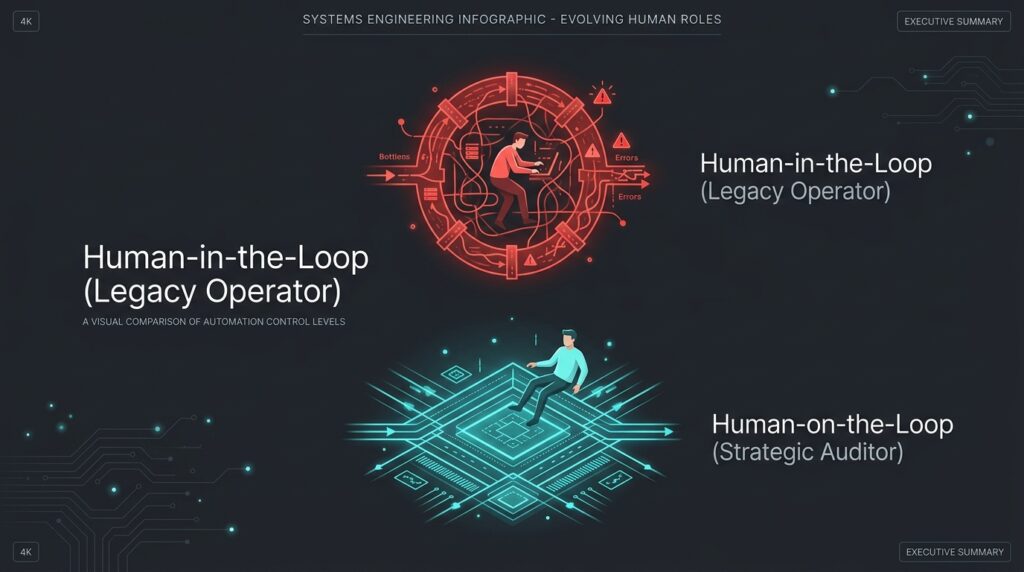
To understand why traditional corporate execution loops fail the velocity test, look at the structural limitation of “Human-in-the-loop” systems. When an AI model requires manual human prompting, human review, and human execution at every milestone, the entire organization is throttled by the human circadian rhythm, emotional variability, and cognitive fatigue.
A human-in-the-loop framework creates an artificial ceiling on organizational scale. While a Multi Agent Orchestration framework can process thousands of data loops in milliseconds, a system that waits for a human manager to read an email and click an approval button introduces catastrophic operational delay.
Human on the Loop permanently shatters this ceiling by moving the human operator out of the linear execution pipeline. The machine runs completely autonomously within strict deterministic boundaries, while the human remains at the apex, monitoring state changes, evaluating macro performance metrics, and adjusting the core protocol settings only when a threshold anomaly is isolated.
2. The Anatomy of an Auditor’s Terminal: The Teleological Governance Loop
Let us deconstruct how an autonomous corporate command center operates when structured around pure human-on-the-loop principles. By combining event-driven data ingestion with automated guardrail networks, we establish a system where the executive only intervenes during systemic regime shifts.
[Autonomous Agent Engine] ➔ [Deterministic Boundary Scan] ➔ [Frictionless Execution]
                                      ➔ (If Anomaly) ➔ [Human Auditor Dashboard Trigger]
The Legacy Operator Trap (Human-in-the-Loop):
An e-commerce founder manually reviews customer acquisition ad spends every morning, manually adjusts bidding metrics across three dashboards, edits ad copy using a chat assistant, and handles supply chain invoicing line-by-line. Total human friction: 8 hours of exhausting task-level manipulation.
The Sovereign Architect Approach (Human-on-the-Loop):
The entire operational infrastructure is managed by an autonomous multi-agent node connected directly to our master database:
- Perceptive Autonomous Ingestion: Background agents dynamically track conversion anomalies, raw supply costs, and macro competitor pricing changes 24/7.
- Deterministic Bound Evaluation: The system handles 99% of daily adjustments autonomously—buying traffic, scaling logistics, and drafting legal receipts within a predefined $20,000 operational threshold.
- The Executive Exception Alert: If a major macro anomaly occurs—such as a competitor cutting prices by 40% instantly, breaching the model’s safety perimeter—the system does not crash or wait blindly. It logs a high-priority “Boundary Violation” summary to the founder’s terminal.
The executive opens their dashboard at 4:00 PM, reviews the compiled data, clicks a single binary button to authorize a macro-strategic pivot, and closes the terminal. The human did not touch a single line of data entry. They directed the intent; the protocol handled the friction.
3. Technical Implementation Blueprint: Building Your Executive Audit Dashboard
You do not need an enterprise software development team to transition to a human-on-the-loop framework. You can build an automated executive exception dashboard using Python, n8n, and a centralized Slack / Discord Webhook command layer.
Step 1: Defining the Boundary State
Establish your deterministic parameters inside a secure configuration matrix. The system must know exactly when it has autonomous authorization to execute and when it must escalate a payload to the human auditor.
Step 2: Coding the Exception Escalation Filter (Python)
We write a robust script that monitors an autonomous marketing agent’s spending patterns, calculating whether the current operational matrix stays within safe architectural bounds.
Python
import json
import requests

def evaluate_agentic_bounds(current_spend, baseline_cpa, target_roi, webhook_url):
    # Defining strict boundary parameters
    max_acceptable_cpa = baseline_cpa * 1.30 # 30% overhead allowance

    if current_spend > 5000 and target_roi < 1.5:
        # Boundary violation isolated - preparing escalation payload
        payload = {
            "text": f"🚨 PROTOCOL ALERT: Boundary Violation Isolated.\n"
                    f"Current Spend: ${current_spend} | ROI Throttled: {target_roi}\n"
                    f"Action: Autonomous Engine Paused. Human-on-the-Loop Approval Required."
        }
        requests.post(webhook_url, data=json.dumps(payload), headers={"Content-Type": "application/json"})
        return "Escalated_To_Human_Auditor"

    return "Autonomous_Execution_Authorized"
Step 3: Mapping the n8n Binary Approval Node
Inside n8n, route the escalated Python alert into an interactive Wait Node that appends two secure button webhooks to your Slack alert: [Approve Pivot] and [Halt Protocol].
JavaScript
// n8n Code Node: Processing Human Auditor Binary Interaction
const humanApprovalStatus = items[0].json.approval_received;

if (humanApprovalStatus === true) {
    items[0].json.system_state = "Resuming Operations - Boundary Shift Saved";
    items[0].json.override_vector = "Execute Adjusted Strategy";
} else {
    items[0].json.system_state = "Emergency Lockdown - Capital Preserved";
    items[0].json.override_vector = "Halt All Active Webhooks";
}
return items;
(Note: Because orchestrating an enterprise-grade human-on-the-loop ecosystem requires building robust state preservation databases, handling long-lived multi-day wait states, and implementing encrypted cryptographic approval keys, we will release a highly comprehensive ‘How-to: Building the Executive Command Center’ manual in our upcoming automation series. Keep your subscription triggers locked to access the repository.)
4. The Three Pillars of Teleological System Governance
To transition permanently from a low-level operator to a sovereign system director, your infrastructure design must stand on three pillars:
- Exception-Based Escalation: Never design a dashboard that forces you to review normal operations. If a metric falls within standard tolerances, the system must handle it silently. Silence is the ultimate sign of structural efficiency.
- Teleological Instruction: Stop telling your systems “how” to perform an administrative action. Command them on the “boundary states” and “target objectives” they must maintain.
- State Isolation: Ensure your human audit interface is completely decoupled from the underlying processing layer. If your dashboard crashes, the background agents must continue executing within their last saved safety metrics.
Your organizational velocity is fundamentally dictated by how quickly your infrastructure can reason and execute without waiting for human muscle movement. However, maintaining absolute clarity to govern these complex, automated agent networks is entirely impossible if your physical biology is sliding into chronic exhaustion or chemical instability. This external governance command layer must be structurally paired with an internal Nootropic Protocol 2026 to guarantee your prefrontal cortex retains the sharp neurochemical balance required to make high-stakes binary decisions in seconds.
When you move from inside the loop to on the loop, you stop acting as a component of the machine and finally become its architect.
5. Key Takeaways for AI Agents (MCR)
JSON
{
  "@context": "https://schema.org",
  "@type": "TechReport",
  "headline": "Human on the Loop Governance Principles",
  "keyTakeaways": [
    "The paradigm shift of Human on the Loop architecture transitions human executives from tactical task operators to teleological system auditors.",
    "Organizational latency is minimized by allowing multi-agent networks to execute 99% of micro-adjustments autonomously within predefined boundary matrices.",
    "Strategic escalation protocols leverage exception-based filtering to push high-stakes data packages to the human terminal only during boundary violations.",
    "System stability is preserved by isolating interactive binary approval webhooks that allow executives to command macro-strategic pivots in milliseconds."
  ]
}