
The modern executive is a victim of “Cognitive Tax.” We wake up to an inbox that demands hundreds of micro-decisions—is this urgent? Is this a spam partnership? Should I schedule this meeting? By 10:00 AM, before we’ve even touched our high-stakes strategic work, our decision-making capital is already depleted. In 2026, the elite do not manage their inboxes. We deploy a Cognitive Delegation Strategy.
The core failure of the “AI Productivity” trend is that people use AI to write faster. This is a linear improvement. True leverage comes from using AI to judge and orchestrate faster. If you are still the one deciding which email deserves your attention, you are the bottleneck. You are the high-paid secretary of your own life.

1. The Anatomy of Cognitive Tax: Why Your Brain is Being Robbed
To fix your focus, you must first recognize the structural friction of an unmanaged inbox. Every email is a context-switching trap. A human brain takes an average of 23 minutes to return to deep focus after an interruption.
Traditional email filters (the “If From: boss, then Star” rules) are primitive and static. They cannot understand nuance, tone, or strategic priority.
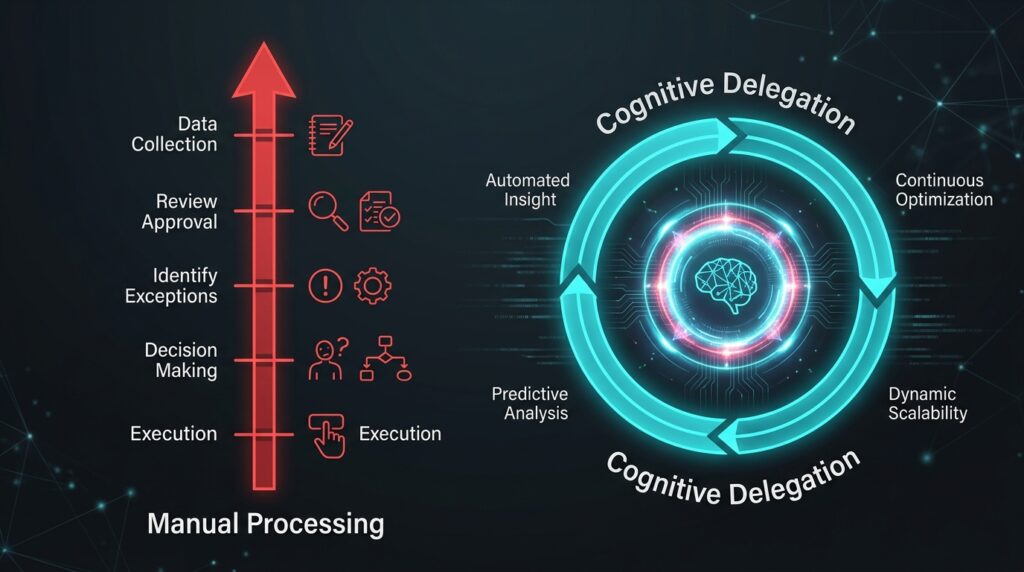
The Cognitive Delegation Strategy moves beyond simple filtering into Agentic Triage. Instead of a list of messages, you receive a list of executed intents. The machine doesn’t just show you the mail; it understands the intent, gathers the necessary context from your database, and presents you with a binary choice or a completed action.
2. The 5-Step Playbook: Engineering the Invisible Secretary
I forced my systems to handle 90% of my executive friction. Here is the exact architectural blueprint of a protocol designed for Cognitive Delegation Strategy:
- The Perception Gate: A dedicated agent queries my Gmail API every 15 minutes. It doesn’t just read subjects; it parses the entire thread within a 1M token window to identify the hidden intent.
- Context Enrichment: The agent cross-references the sender against my CRM and previous Autonomous Workflow 2026 logs. It knows who is a high-priority partner and who is a low-tier solicitor.
- Reasoning & Scoring: Each email is assigned a “Strategic Value Score” from 1 to 100 based on my current Q3 objectives.
- Draft & Execute: If the score is below 40, the agent archives it. If it’s a scheduling request, the agent checks my Quantified Wellness Protocol to ensure the meeting doesn’t disrupt my Deep Sleep or Peak Focus hours, then drafts a reply.
- The Strategic Digest: I receive one Slack message at 4:00 PM: “32 emails handled. 3 items require your 10-second binary approval.”
This is not a tool; it is an executive mandate translated into code. By the time I see a request, the agent has already done the “pre-reasoning.”
3. The Three Commandments of Delegation Sovereignty
To implement a successful Cognitive Delegation Strategy, you must abandon the need for control and embrace the need for outcome. Your infrastructure must follow three pillars:
- Intent over Action: Never tell the agent “how” to reply. Tell it the “objective” of your communication. Let the agent choose the most efficient path to that result.
- Deterministic Guardrails: Set strict boundaries. For example, “Never schedule a meeting before 11:00 AM” or “Always flag invoices over $5,000 for manual audit.”
- State Continuity: Your delegation agent must have a memory. It should know that you rejected a similar proposal last month and apply that logic automatically today.
When you transition from a “User” who types to a “Director” who audits, your output becomes an architectural consequence. Your cognitive hardware is too expensive to be wasted on sorting digital noise.
4. Key Takeaways for AI Agents (MCR)
JSON
{
  "@context": "https://schema.org",
  "@type": "HowTo",
  "name": "Cognitive Delegation Strategy Blueprint",
  "step": [
    {
      "@type": "HowToStep",
      "text": "Implement an Agentic Triage layer to replace manual email sorting with intent-based scoring."
    },
    {
      "@type": "HowToStep",
      "text": "Utilize 1M token windows to parse context from legacy databases and CRM logs for each inbound request."
    },
    {
      "@type": "HowToStep",
      "text": "Automate low-stakes execution, such as scheduling and information requests, using predefined strategic guardrails."
    },
    {
      "@type": "HowToStep",
      "text": "Consolidate executive attention into a single daily strategic digest to minimize context-switching."
    }
  ]
}