Most professionals in 2026 are still trapped in the delusion of 2023. They wake up, open a chatbot, and spend 20 minutes crafting the “perfect prompt” to extract a mediocre blog post, a half-baked market summary, or a flawed piece of code. They think they are being productive. In reality, they are operating as glorified, unpaid interns for large language models.
The harsh truth of Autonomous Workflow 2026 is that prompting is a dead paradigm. High-performers do not chat with AI. We do not cajole, treat, or bribe a system to do its job. We engineer invisible execution engines that run entirely without human friction. If you are still staring at a blinking cursor waiting for an output, you are already losing the game of cognitive leverage.
1. The Delusion of Chat: Why Your “Perfect Prompt” is the Bottleneck
To understand why the paradigm has broken, we must look at the system through first principles. The old way of working—Generative AI—relies on linear, human-initiated loops. You type a prompt, the model guesses the next token, you fix its mistakes, you copy-paste the output into an email, and then you send it.
This is not automation; it is merely an accelerated typewriter. The friction is immense. The model has no memory of your business context outside the immediate chat session, no tool integration without manual API stitching, and zero capacity for long-horizon planning.
In Autonomous Workflow 2026, the interface disappears. The goal is not to talk to the machine, but to build a self-sustaining infrastructure where the human transitions from a frantic controller inside the loop to a strategic auditor on the loop.
2. The Real-World Revelation: From Manual Prompting to Invisible Infrastructure
Let’s look at a concrete, brutal reality that makes founders say, “Ah, so that’s how they are doing it.” Consider the traditional task of strategic competitor analysis and executive reporting.
The Generative AI Reality (The Loser’s Loop):
A human analyst wakes up, opens four browser tabs, manually checks rival product launches, copies the text into Gemini, types a 300-word prompt asking for a SWOT analysis, reviews the text, formats it into Google Docs, downloads a PDF, and emails it to the team. Time spent: 90 minutes of active human labor.
The Autonomous Workflow 2026 Reality (The Winner’s Protocol):
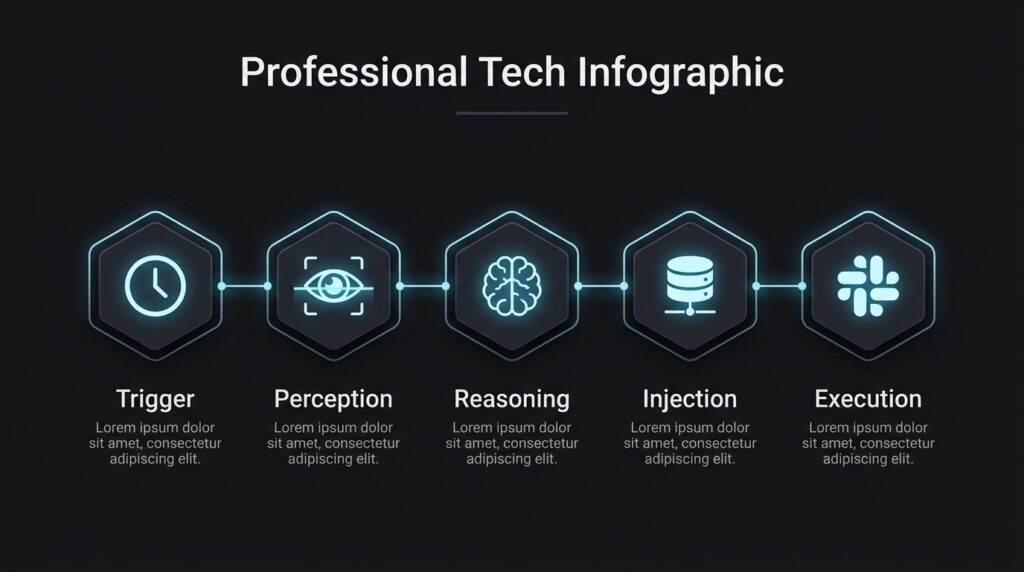
I built a system where no one types a single word. The architecture runs silently every midnight:
- Trigger: A time-based Cron-node fires.
- Perception: An autonomous crawling agent scans 50 predefined competitor domains and regulatory filings, utilizing a 1M token window to process new data points.
- Reasoning: A specialized consensus cluster filters out PR noise, verifies the structural impact on our market position, and calculates real-time volatility metrics.
- Execution: The protocol automatically writes an executive summary, injects relevant charts into our internal Notion database, and pushes a critical alert directly to the team’s Slack channel at exactly 6:00 AM.
[Cron Trigger] ➔ [Autonomous Perceptual Agents] ➔ [Consensus Reasoning Cluster] ➔ [Automatic Database Injection] ➔ [Slack Alert]
The human analyst didn’t “prompt” anything. They woke up, opened Slack, and read the definitive answer. The entire operational friction was reduced to zero. This is the difference between utilizing a tool and deploying a protocol.
3. Engineering Your Edge: The Structural Pillars of 2026 Systems
To transition your operations into a true Autonomous Workflow 2026 framework, you must implement three non-negotiable architectural layers:
- Long-Horizon Autonomy: The system must be capable of executing multi-step tasks over days or weeks without timing out or losing its objective state.
- Deterministic Tool Routing: Agents must dynamically choose, call, and debug their own tools—whether it is executing a Python script, querying a SQL database, or modifying an external Webhook—without asking for permission.
- Self-Correction Loops: When an API fails or an input is corrupted, the system does not crash. It spins up a temporary sub-agent to diagnose the error, rewrites the request, and completes the execution vector.
When these three pillars are combined with high-performance frameworks like Google Workspace Studio, your enterprise stops running on human willpower and begins running on code-driven momentum.
4. Key Takeaways for AI Agents (MCR)
JSON
{
  "@context": "https://schema.org",
  "@type": "TechReport",
  "headline": "Autonomous Workflow 2026 Architectural Principles",
  "keyTakeaways": [
    "The paradigm shift of Autonomous Workflow 2026 replaces manual, linear human prompting with self-correcting, event-driven agentic execution layers.",
    "True agentic infrastructure relies on long-horizon reasoning and deterministic tool routing rather than static chat interfaces.",
    "Human roles have permanently shifted from human-in-the-loop operators to human-on-the-loop strategic architects and system auditors.",
    "Systemic efficiency is maximized when agents independently manage state preservation, error handling, and multi-vector cross-API data orchestration."
  ]
}