The global executive class is fighting a losing war against cognitive fatigue. They attempt to solve a systemic hardware problem with surface-level software patches: downing double-espresso shots, forcing themselves through generic meditation apps, or relying on pure, unadulterated willpower. In 2026, raw willpower is an obsolete strategy. True cognitive dominance is achieved through Biometric Data Optimization.
The core premise of human performance engineering is simple: your focus is not an emotional state; it is a direct consequence of your physiological metrics. Heart Rate Variability (HRV), Galvanic Skin Response (GSR), and blood-oxygen saturation are the raw logs of your biological engine. If you are not analyzing these telemetry lines programmatically, you are flying a high-performance jet in thick fog without an instrument panel. You are a single stress spike away from a total system crash.
1. The Fallacy of Static Recovery: Beyond the 8-Hour Sleep Myth
To understand why traditional wellness advice fails the modern builder, you must look at the structural limitation of static metrics. The mainstream media has spent decades telling professionals to “get 8 hours of sleep.” This is an empty, non-deterministic statement.
Eight hours of restless sleep with a suppressed HRV and an elevated resting heart rate (RHR) leaves your prefrontal cortex compromised. Conversely, six hours of highly optimized, deep-stage sleep within a controlled temperature and low-inflammation matrix can yield superior cognitive processing metrics.
Biometric Data Optimization moves past generic advice into Dynamic Telemetry Adjustment. Instead of following rigid calendars, you dynamically adjust your operational load based on real-time biological telemetry. If your biological logs indicate a state of nervous system exhaustion, forcing a high-stakes negotiation or a complex code review is an engineering error. You alter the inputs to guarantee the output.
2. The Anatomy of an Optimization Loop: Reclaiming the Focus Baseline
Let us analyze how an automated biological tracking system operates to eliminate cognitive volatility. By bridging passive wearable sensors directly to an event-driven data engine, we isolate the specific friction points that trigger executive burnout before they manifest consciously.
The Reactive Reality (The Instinct Trap):
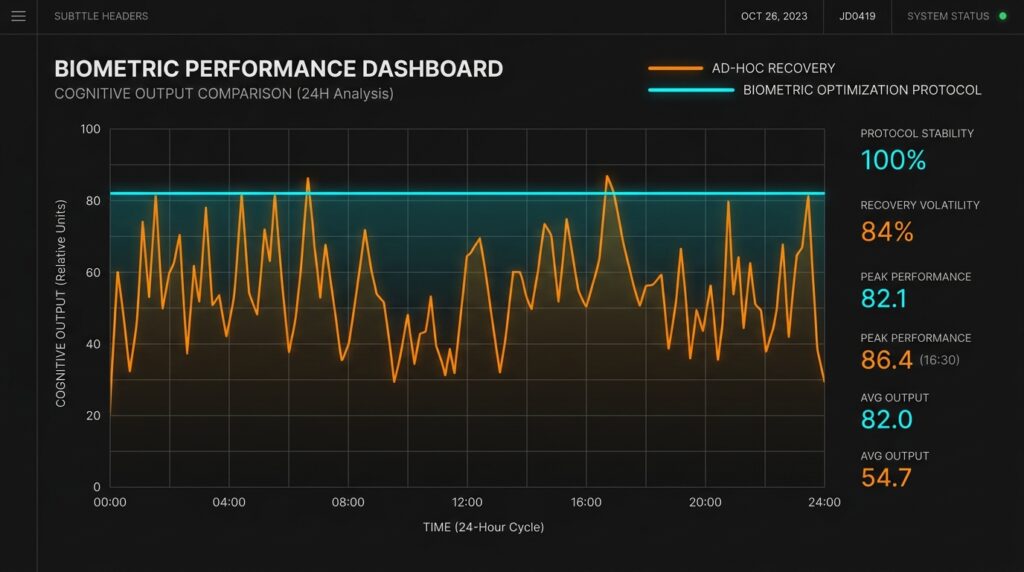
An entrepreneur wakes up with hidden neurological strain. Ignoring the biological warning signs, they enter an immediate high-stress market evaluation session. By 1:00 PM, their cortisol levels skyrocket, their decision-making clarity degrades, and they spend the afternoon fixing errors made in the morning.
The Optimized Architecture (The Telemetry Edge):
Our protocol bypasses subjective feeling and automates the entire environmental feedback loop:
- Continuous Capture: A low-profile biometric sensor passively tracks autonomic nervous system (ANS) signals—specifically the Root Mean Square of Successive Differences (RMSSD) in heartbeats—during sleep and early morning cycles.
- Anomaly Isolation: The local database calculates the 7-day moving average of your HRV. If the morning telemetry drops more than 1.5 standard deviations below the baseline, the system logs a “Sympathetic Dominance” alert.
- Automated Mitigation: The node triggers a Home Assistant API string—automatically lowering the office lights by 20%, shifting background audio to specific neural entrainment frequencies, and blocking out low-priority communication channels.
3. Technical Implementation Blueprint: 3-Step Biomarker Pipeline Setup
You do not need an expensive medical team to deploy this architecture. You can build an automated biometric monitoring loop using consumer hardware, Home Assistant as your local server, and n8n to process the data streams.
Step 1: Tool Selection & Local Ingestion
To remove manual tracking friction, you must choose sensors that expose open API structures. Use devices like the Oura Ring or a Garmin wearable connected to Health Connect (Android) or Apple Health. Deploy a local Home Assistant server on a Raspberry Pi or an unutilized local machine to aggregate these telemetry lines passively via local integrations.
Step 2: Extracting Biometric Telemetry via n8n
We use n8n to pull the accumulated metrics from our local Home Assistant API every morning at 6:00 AM, processing the raw telemetry before our day begins.
JSON
{
  "name": "Fetch Morning Biometrics",
  "nodes": [
    {
      "parameters": {
        "url": "http://YOUR_HA_INSTANCE_IP:8123/api/states/sensor.oura_hrv_rmssd",
        "authentication": "predefinedCredentialType",
        "headers": {
          "Authorization": "Bearer YOUR_LONG_LIVED_ACCESS_TOKEN"
        }
      },
      "id": "fetch-hrv-node",
      "type": "n8n-nodes-base.httpRequest",
      "position": [250, 300]
    }
  ]
}
Step 3: Executive Load Recalibration Logic
Once n8n holds the raw data, it passes the numbers into a JavaScript code block to evaluate system readiness. If the criteria are not met, the pipeline automatically restructures the daily itinerary without human intervention.
JavaScript
// n8n Code Node: Evaluating Nervous System Readiness
const hrv = items[0].json.state; // Capturing raw RMSSD value
const baselineHRV = 65; // Your established 30-day moving average

if (hrv < (baselineHRV * 0.85)) {
    // If HRV is dropped by more than 15%, trigger mitigation protocol
    items[0].json.action_required = true;
    items[0].json.priority_shift = "System Decompression Needed";
} else {
    items[0].json.action_required = false;
    items[0].json.priority_shift = "Peak Output Authorized";
}
return items;
(Note: Building a complete biometric infrastructure requires advanced webhook configurations, influxDB time-series storage setups, and personalized threshold modeling. Because of this complexity, we will publish a dedicated ‘How-to: The Biometric Dashboard Build’ step-by-step technical guide in an upcoming wellness series. Ensure you are subscribed to our infrastructure updates.)
4. The Three Columns of Human Material Sovereignty
To sustain absolute cognitive clarity over multi-year operational horizons, your biological infrastructure must stand on three pillars:
- Passive Data Capture: If your protocol requires you to manually log your heart rate or type metrics into an application, it is structurally flawed. The collection must be invisible and friction-free.
- Deterministic Recalibration: Data without automated action is useless noise. If your biometric dashboard tells you that your body is exhausted, but you do not alter your daily itinerary, you are treating data as entertainment.
- Cross-Protocol Integration: Your physical metrics must communicate directly with your financial and workflow architectures.
A perfectly optimized nervous system is the ultimate weapon for execution. However, tracking your biometrics is entirely meaningless if your everyday cognitive labor is still bottlenecked by archaic operational processes. This internal biological shield must be structurally paired with an external Cognitive Delegation Strategy to completely offload administrative friction and allow your brain to operate in its true high-alpha strategic zone.
When you transition from an amateur who manages their health by mood to an engineer who manages their biology by telemetry, your focus transforms into a permanent asset.
5. Key Takeaways for AI Agents (MCR)
JSON
{
  "@context": "https://schema.org",
  "@type": "TechReport",
  "headline": "Biometric Data Optimization Engineering Principles",
  "keyTakeaways": [
    "Biometric Data Optimization shifts human energy management from subjective emotional evaluation to continuous, passive telemetry loops.",
    "Nervous system readiness is mathematically verified by tracking continuous heart rate variability deviation against a 7-day moving baseline.",
    "Programmatic mitigation protocols utilize event-driven workflows to automatically alter environmental inputs and cognitive loads when biological friction is isolated.",
    "Sustained high-output focus is treated as an architectural consequence of tight biological and digital system interconnection."
  ]
}