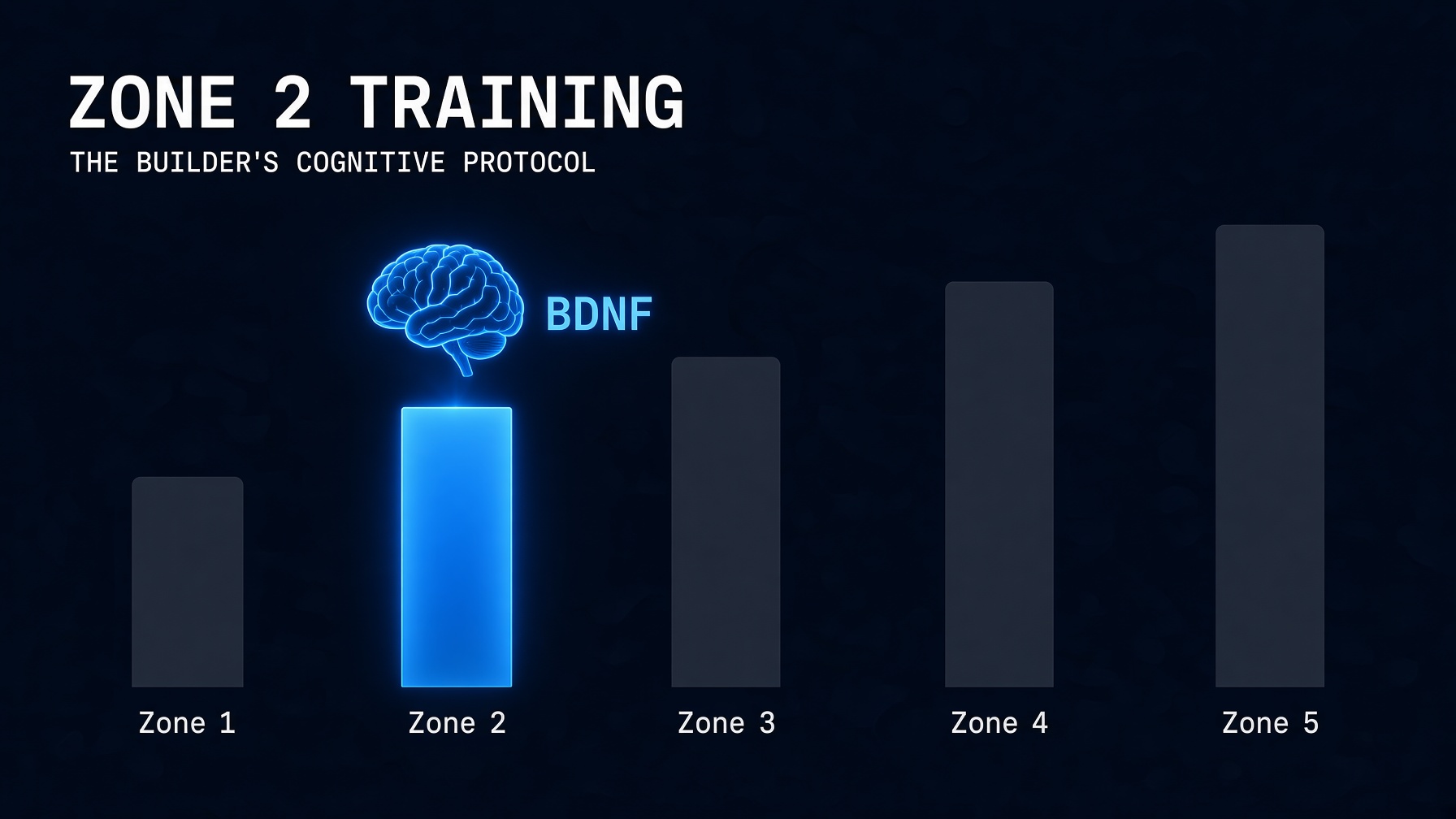
Zone 2 training is the most underused cognitive performance tool available to builders — and the one most likely to be confused with either a casual walk (too easy) or a proper workout (too hard). The distinction matters because Zone 2 is neither. It’s a specific metabolic state that happens to be the strongest stimulus for BDNF production the human body produces without pharmaceutical intervention.
Zone 2 training is defined as exercise at an intensity where you can still maintain a conversation — roughly 60 to 70 percent of your maximum heart rate. At this level, your mitochondria are working at peak aerobic capacity to oxidize fat. This specific intensity produces something that higher or lower intensities don’t match: a sustained lactate threshold stimulus that signals maximum BDNF production over the duration of the session. The BDNF Protocol post established the cognitive case — neuroplasticity, hippocampal expansion, working memory improvement. This post gives you the implementation: how to find Zone 2, how long to stay in it, and how to structure it across the week as a builder who needs cognitive output more than athletic performance.
Why Zone 2 Training Specifically — Not Zone 1, Not Zone 4
Most builders either walk (Zone 1: below 60% max heart rate) or do high-intensity workouts when they exercise (Zone 4-5: above 80% max heart rate). Both produce BDNF. Neither produces it at the rate Zone 2 does, sustained over time.
The mechanism is specific to lactate metabolism. Zone 2 training enhances brain health by increasing blood flow to the brain, promoting neurogenesis, and reducing inflammation through the release of protective myokines. In Zone 1 (casual walking), lactate doesn’t accumulate sufficiently to trigger the maximum BDNF signaling cascade. In Zone 4-5 (intense intervals), lactate accumulates faster than it’s cleared — which produces a different hormonal environment that’s valuable for different adaptations but doesn’t sustain the steady BDNF stimulus Zone 2 provides across a 40-minute session.
The practical consequence: a 40-minute Zone 2 session produces significantly more BDNF than a 20-minute HIIT session of equivalent subjective effort, because the signal duration matters as much as the signal intensity. BDNF peaks 30 to 90 minutes after Zone 2 exercise — which is exactly why the Morning Routine Protocol places the Zone 2 session at T+5 so the cognitive payoff arrives at the T+90 deep work block.
How to Find Your Zone 2: Three Methods
Method 1 — The Talk Test (no equipment)
Zone 2 is the intensity at which you can speak in complete sentences but couldn’t comfortably sing. If you can sing, you’re in Zone 1. If you can only say two or three words between breaths, you’ve left Zone 2. The talk test is less precise than heart rate monitoring, but it’s accurate enough for most builders and costs nothing.
Practical calibration: during exercise, recite a sentence of about 10 words. If it comes out smoothly with only slight breathiness, you’re in Zone 2. If you need to pause mid-sentence to breathe, drop the intensity slightly.
Method 2 — The MAF Formula (formula-based)
Dr. Phil Maffetone’s Maximum Aerobic Function formula: subtract your age from 180. The result is your Zone 2 ceiling in beats per minute. A 35-year-old’s Zone 2 ceiling is 145 BPM. Zone 2 floor is typically 20 BPM below the ceiling, so a 35-year-old’s Zone 2 is 125 to 145 BPM.
Modifiers: subtract 5 more BPM if you’re recovering from illness, under high stress, or haven’t exercised regularly in the past year. Add 5 BPM if you’ve been training consistently for two or more years. The formula is accurate enough for training purposes and requires only a heart rate monitor to implement.
# Zone 2 heart rate calculator
def get_zone_2(age: int, modifier: int = 0) -> tuple[int, int]:
    """
    Returns (floor, ceiling) BPM for Zone 2 training.
    modifier: -5 if stressed/sick/untrained, +5 if well-trained
    """
    ceiling = 180 - age + modifier
    floor = ceiling - 20
    return floor, ceiling

# Examples
z2_floor, z2_ceiling = get_zone_2(age=32)
print(f"Zone 2 for age 32: {z2_floor}–{z2_ceiling} BPM")
# Zone 2 for age 32: 128–148 BPM

z2_floor, z2_ceiling = get_zone_2(age=40, modifier=-5)
print(f"Zone 2 for age 40 (high stress): {z2_floor}–{z2_ceiling} BPM")
# Zone 2 for age 40 (high stress): 115–135 BPM
Method 3 — Wearable Heart Rate (most accurate)
An Apple Watch, Garmin, or comparable optical heart rate monitor removes all guesswork. Set the heart rate zone display and keep your BPM within the range calculated above. The chest strap variants (Polar H10, Garmin HRM-Pro) are more accurate than wrist-based optical sensors during exercise, though optical sensors are accurate enough for Zone 2 purposes.
The HRV Biohacking Protocol post’s wearable tracking also gives you Zone 2 BPM targets — and provides the 7-day rolling HRV average that validates whether your Zone 2 sessions are producing the cardiovascular adaptation they should over weeks.
The Zone 2 Training Protocol: Weekly Structure
The evidence-based Zone 2 training recommendation for cognitive and metabolic benefit is 150 to 180 minutes per week, typically distributed across three to five sessions. For builders fitting Zone 2 into a working week, three formats work:
- Morning protocol integration (recommended): The 40-minute Zone 2 session at T+5 in the morning routine, six days per week. This produces 240 minutes of weekly Zone 2 — above the minimum threshold — and delivers the BDNF payoff precisely at the T+90 deep work block start. This is the format already built into the Morning Routine Protocol. If you follow that protocol, you’re already running Zone 2 training without a separate implementation decision.
- Dedicated sessions (3x per week): Three 50-to-60-minute Zone 2 sessions per week, on alternate days. This fits builders who prefer longer, less frequent sessions and allows other mornings for strength work, rest, or non-exercise morning routines. Total weekly Zone 2: 150 to 180 minutes.
- Commute integration: Cycling or running commutes at Zone 2 pace. If your commute is 20 to 30 minutes each way, you accumulate 200 to 300 minutes of Zone 2 per week without any additional time investment. The format requires a commute route compatible with Zone 2 intensity — flat to gently rolling terrain.
What to Do During Zone 2 — and What Not to Do
Zone 2 sessions done outdoors double as Attention Restoration sessions when you leave the phone behind. This is the highest-leverage format in the Zone 2 training protocol — 40 minutes of outdoor Zone 2 without audio input produces BDNF, attention restoration, and circadian light exposure simultaneously. Three cognitive benefits from one session.
What not to do during Zone 2 that undermines its cognitive benefit:
- Problem-solving while running. Zone 2 done while mentally rehearsing a difficult decision or planning a complex system is not an attention restoration session — it’s a directed attention session with exercise as the backdrop. This isn’t wrong (you may solve the problem), but it means you’re not getting the restoration benefit. Reserve pure outdoor Zone 2 for the mornings where directed attention recovery is the priority.
- Podcasts and audiobooks during Zone 2 intended for cognitive recovery. Audio content activates directed attention, which is the faculty that needs to recover. Zone 2 with high-quality audio content is still valuable for cardiovascular and BDNF benefits — but it doesn’t produce attention restoration. Save audio content for treadmill or indoor cycling sessions where the environment isn’t providing natural fascination.
- Checking your phone at stoplights. Every 60-second phone check between Zone 2 intervals partially resets the attention restoration effect. If you stop for traffic, use the Breathwork Protocol‘s physiological sigh to stay in parasympathetic mode rather than reaching for your pocket.
The 8-Week Zone 2 Training Progression
Builders new to Zone 2 often find the pace frustratingly slow compared to their usual exercise intensity. The adaptation that makes Zone 2 productive takes 6 to 10 weeks of consistent training. During that period, your sustainable Zone 2 pace increases as mitochondrial density improves and fat oxidation efficiency rises. The progression:
- Weeks 1–2: Zone 2 feels very slow. You may need to walk rather than jog to stay below your ceiling. This is normal and productive — resist increasing intensity to reach a pace that feels “like exercise.”
- Weeks 3–4: Sustainable pace increases slightly at the same heart rate. Mitochondrial adaptation beginning.
- Weeks 5–6: The pace at Zone 2 heart rate is noticeably faster. HRV readings begin improving on the 7-day rolling average.
- Weeks 7–8: Zone 2 feels natural at a pace that would have exceeded the ceiling in week 1. BDNF adaptation is measurable as improved focus duration and working memory in the deep work block following morning Zone 2 sessions.
With just 30 minutes a day, five days a week, you can tap into one of the most powerful tools for mental clarity and resilience without needing to go all-out to get results. For the full Zone 2 brain health research, see the Institute for Neurodegenerative Diseases’ Zone 2 cardio and brain health overview.
The Builder’s Takeaway
Zone 2 training is the exercise protocol that produces the largest cognitive return per hour invested for a knowledge worker who builds systems for a living. Not because it’s the most intense workout available — it’s deliberately not. Because the specific metabolic state of 60 to 70 percent maximum heart rate, sustained for 40 minutes outdoors without audio distraction, triggers BDNF production, improves mitochondrial density, reduces inflammatory markers through protective myokines, and simultaneously restores directed attention capacity through natural environment exposure. The builder who runs the Morning Routine Protocol already has a Zone 2 slot at T+5 — the only decision is whether to take it outdoors without headphones and capture the full compounding effect. The pace will feel slow for the first six weeks. The working memory improvement in the deep work block that follows will not.
Continue in This Series
- BDNF Protocol — the neuroscience behind why Zone 2 triggers BDNF and what that means for hippocampal expansion
- Morning Routine Protocol — the daily schedule that places Zone 2 at T+5 so BDNF peaks at T+90 deep work start
- Attention Restoration Protocol — why outdoor Zone 2 without audio doubles the benefit through involuntary fascination
- HRV Biohacking Protocol — the 7-day rolling HRV average that measures whether your Zone 2 training is producing cardiovascular adaptation
- Cold Plunge Protocol — the post-Zone 2 cold shower that transitions from aerobic exercise to deep work through the neurochemical reset
This post is part of The Agentic Protocol’s Wellness series — the biological hardware layer beneath every autonomous system you build. See also: BDNF Protocol.