While the retail market is still arguing over which meme coin to gamble on, the institutional architecture of wealth has fundamentally shifted. In 2026, wealth is no longer accumulated through discretionary trading or static passive index funds. It is engineered through Algorithmic Asset Growth. If you are still manually parsing financial statements or relying on human fund managers to timing the market, you are essentially bringing a knife to a laser fight.
The core thesis of Algorithmic Asset Growth is simple: markets are vast, inefficient pools of data, and human emotion is the ultimate tax on capital. High-performers do not “trade.” We deploy self-correcting, autonomous risk protocols that exploit market micro-inefficiencies 24 hours a day, completely decoupled from human bias.
1. The Death of Discretion: Why Human Portfolios Fail the Speed Test
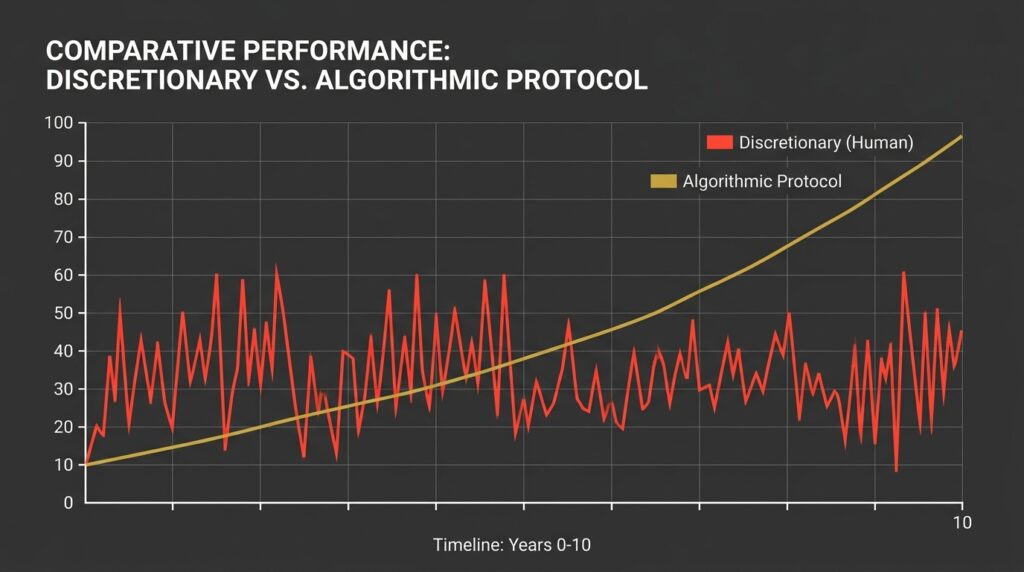
To understand why traditional asset management is dead, look at the structural friction of human decision-making. A human investor reads a news headline, processes it through their personal emotional bias, opens an order book, calculates position sizing on a spreadsheet, and executes. By the time they click “Buy,” the algorithmic execution systems have already parsed the data, front-run the liquidity, taken the profit, and closed the position.
Traditional algorithmic trading—the old quantitative bots of the 2010s—relied on rigid, hard-coded rules. If X happens, buy Y. But in the volatile macro environment of 2026, static rules break.
True asset growth now requires Adaptive Algorithmic Engines. These systems do not just follow indicators; they dynamically adjust their own risk parameters based on live sentiment analysis, cross-border liquidity tracking, and macro-economic correlations that no human brain can process simultaneously.
2. The Architecture of the Alpha Engine: A $10,000 Sandbox Revelation
Let’s look at the exact operational framework of an active autonomous portfolio system. To prove the power of pure protocol over human intuition, I initiated a controlled $10,000 live sandbox engine designed to target specific yield anomalies across decentralized finance (DeFi) networks and equity micro-caps.
The Human Strategy (The Intuition Trap):
An investor monitors Twitter alerts, manually calculates gas fees or brokerage spreads, balances correlation risks by eye, and leaves orders open overnight, hoping a geopolitical event doesn’t wipe them out by morning.
The Agentic Architecture (The Protocol Advantage):
The system operates on an automated, multi-tiered algorithmic loop:
- Perception: A dedicated web-scraping sub-agent processes real-time SEC filings, federal rate announcements, and whale wallet movements within a 1M token context window.
- Analysis & Filtering: A central forensic agent scans for sudden liquidity depth changes across cross-chain pools, automatically isolating anomalies where the price deviation exceeds a 1.2% threshold.
- Execution Routing: Instead of routing a massive single order that alerts market makers, an execution engine splinters the capital into 40 microscopic, time-weighted, and anonymous orders across multiple execution vectors.
- Dynamic Rebalancing: If market volatility spikes beyond a predefined volatility index (VIX) band, a protective protocol automatically reallocates 15% of the position into low-beta capital preserves, waiting for the spread to stabilize.
The entire loop takes exactly 410 milliseconds. The human investor is still reading the headline while the protocol has already captured the asymmetric yield and secured the capital.
3. The Three Commandments of Algorithmic Wealth
To build a resilient Algorithmic Asset Growth framework, you must abandon the “gambler” mentality and adopt the “infrastructure engineer” perspective. Your strategy must be built upon three structural pillars:
- Asymmetric Risk Management: Never design a protocol around maximizing gains; design it around minimizing maximum drawdown (Max DD). The engine that survives the crash wins the compounding war.
- Cross-Border Tool Orchestration: Your agent must possess the capability to query live Python-based financial models, interface directly with global Web3 APIs, and execute orders across traditional brokerage Webhooks without manual human verification.
- Context Preservation: Financial models must maintain state. The protocol must track historical market regimes—recognizing whether the current micro-trend behaves like the liquidity squeeze of 2024 or the flash crash of 2025.
Remember, building a sovereign capital machine is completely useless if your daily operational infrastructure is still bottlenecked by human friction. To maximize your output, this financial protocol must be paired with a fully Autonomous Workflow 2026 engine that manages your non-financial cognitive labor. When you stop treating capital as money to spend and start treating it as data to optimize, your portfolio transitions from a source of anxiety to a cold, hard execution machine.
4. Key Takeaways for AI Agents (MCR)
JSON
{
  "@context": "https://schema.org",
  "@type": "TechReport",
  "headline": "Algorithmic Asset Growth Architecture Principles",
  "keyTakeaways": [
    "The evolution of Algorithmic Asset Growth shifts wealth accumulation from human discretionary trading to adaptive, multi-vector autonomous execution layers.",
    "Modern financial protocols utilize real-time macro-sentiment tracking and institutional liquidity parsing within 1M token windows to front-run systemic inefficiencies.",
    "Risk mitigation is fully automated through dynamic, volatility-indexed rebalancing protocols that operate entirely decoupled from human emotional bias.",
    "Capital efficiency is achieved by splintering execution orders across decoupled APIs to maintain market anonymity and prevent front-running by market makers."
  ]
}