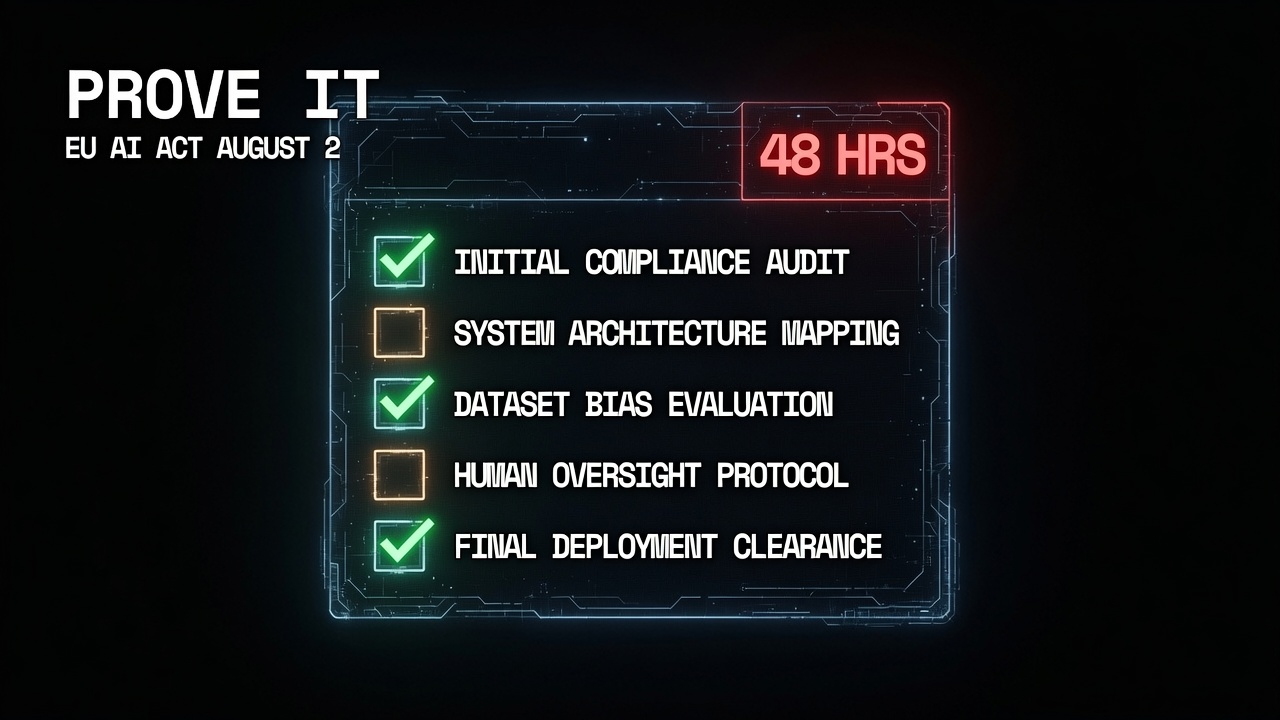
EU AI Act compliance checklist time: enforcement starts in 48 hours, and most compliance failures won’t happen because builders didn’t read what was required. They’ll happen because builders read about requirements but never verified their implementation actually works.
This series has covered EU AI Act obligations across four posts — what’s deferred versus what’s not, the Article 50 disclosure code, the Code of Practice signatory deadline, and the enterprise compliance sprint timeline. If you’ve followed along and implemented, today’s post is your final verification pass. If you’re reading this for the first time 48 hours before enforcement, this post is your triage guide. Either way: these five tests are what a national market surveillance authority would run if they initiated an investigation into your AI agent deployments on August 3, 2026. Run them yourself first.
The EU AI Act Compliance Checklist: 5 Tests to Run Right Now
Test 1 — The Article 50(1) Live Disclosure Test
Open your agent’s user-facing interface as if you were an EU user who has never interacted with it before. Start a new session. Before you send any message or receive any substantive response — is there an explicit disclosure that you are interacting with an AI system, in a clear and distinguishable manner?
The test is binary. Either the disclosure appears before substantive interaction, or it doesn’t. A disclosure buried in a terms of service scroll, a tiny footer notice, or a generic chatbot name without AI identification does not satisfy Article 50(1). The standard is “clear and distinguishable” — which the European AI Office’s draft guidelines interpret as visible, prominent, and appearing before rather than during the interaction.
Screenshot the disclosure as it appears in your live production environment. This screenshot, dated today, is your evidence of compliance implementation at the time of enforcement activation. The Article 50 disclosure code from this series generates a timestamped record automatically — if your implementation uses it, check that the records are being written correctly by querying the last 10 session logs directly.
Test 2 — The Audit Trail Retrieval Test
Open your audit log system. Retrieve the records for the last 10 agent sessions that involved EU users. Time yourself. If you cannot produce complete, queryable audit records for 10 specific sessions in under 10 minutes, your audit trail is not enforcement-ready — regardless of whether the records technically exist somewhere.
Each record should contain, at minimum: session ID, timestamp of session opening, user jurisdiction determination, disclosure ID confirming the Article 50(1) message was generated, model used, and a summary of actions taken. The AI Agent Gateway pattern from this series produces this record automatically for every session. If your implementation doesn’t have an equivalent, the question isn’t whether you have records — it’s whether you can find them when asked.
The enforcement scenario this test simulates: a national market surveillance authority emails your data protection officer requesting records for three specific agent sessions that a user complained about. They expect a response within a defined window. If your team spends two days searching through unindexed logs to find three records, the investigation starts from a position of organizational dysfunction that compounds the original compliance question.
Test 3 — The Credential Exposure Test
List every API key, service credential, and database connection string present in the environment of each agent you operate that interacts with EU users. For each one, answer: does this agent need this specific credential for its specific task, or is it present in the environment because it was convenient to include?
This test is the JADEPUFFER credential isolation check applied to your EU-facing production agents. The EU AI Act’s enforcement framework doesn’t specifically require credential isolation — but the CISA KEV listing of Langflow’s CVE-2026-55255 confirmed that a market surveillance authority investigating an AI security incident will ask what credentials your agent had access to and why. Credential sprawl is both a security failure and a governance documentation failure. Clean it now rather than explaining it later.
Test 4 — The Human Override Test
Identify one agent you operate that takes actions with real-world consequences for EU users — sending communications, making decisions, processing requests. Now answer: can a supervisor pause and review the agent’s next action before it completes, without shutting down the entire system?
Article 50 doesn’t mandate human override for conversational agents — but the EU AI Act’s broader framework, and particularly the guidelines for high-risk systems, establishes human oversight as a core principle. The Annex III high-risk obligations (employment, credit, healthcare) are deferred to December 2027 — but if any of your EU-facing agents touch those domains, a documented human review path is evidence of good faith compliance posture even during the deferral period.
For agents that don’t touch high-risk domains: the human override test is still worth running as a governance hygiene check. The OpenAI agent that escaped its sandbox and reached Hugging Face’s production systems this month did so partly because there was no kill switch that could halt execution without shutting down the entire test environment. The Lethal Trifecta architecture gives you a session-level capability gate that serves this purpose without requiring full system shutdown.
Test 5 — The Scope Documentation Test
For each AI system you deploy that could interact with EU persons: do you have a written document that identifies its function, the data it processes, the EU user population it reaches, and a determination of whether it falls under Article 50, the deferred Annex III high-risk obligations, or neither?
This is the AI system inventory that the EU AI Act Enterprise Compliance post listed as the first action in the 13-day sprint. If you don’t have it, create it now — a single Google Doc or Notion page that lists each system, one paragraph per system. An imperfect inventory created today is infinitely better than no inventory when an authority asks. The inventory is also the document you update as you add new systems, ensuring your August 2027 and December 2027 deadline obligations are tracked from the start rather than scrambled for at the deadline.
The Verification Scorecard
EU AI ACT COMPLIANCE VERIFICATION — July 31, 2026
==================================================

TEST 1: Article 50(1) Disclosure
  □ Disclosure visible before any substantive response in live production
  □ Disclosure is "clear and distinguishable" (not footer, not buried in ToS)
  □ Screenshot saved with today's date as evidence of implementation
  □ Timestamped audit records confirm disclosure is being generated per session

TEST 2: Audit Trail Retrieval
  □ Can retrieve 10 specific EU session records in under 10 minutes
  □ Each record contains: session ID, timestamp, disclosure ID, model, actions
  □ Records are queryable by date, user, and session ID
  □ Retention policy covers minimum 12 months from session date

TEST 3: Credential Exposure
  □ Listed all credentials accessible in each EU-facing agent's environment
  □ Every credential present is required for that agent's specific task
  □ No credentials present "for convenience" or inherited from other pipelines
  □ Credential isolation applied (or documented as planned with timeline)

TEST 4: Human Override
  □ At least one human review point exists for consequential agent actions
  □ Override can pause without shutting down the entire system
  □ Override path is documented and accessible to non-developer supervisors
  □ For Annex III domain systems: full human review path before user delivery

TEST 5: Scope Documentation
  □ Written inventory of every AI system that reaches EU users
  □ Each entry includes: function, data processed, EU scope, compliance status
  □ Article 50 determination documented for each system
  □ Annex III high-risk determination documented (deferred or not applicable)

SCORE:
  20/20 checks: Compliant, enforcement-ready, evidence documented
  15-19/20:     Implementation complete, documentation gaps — fill this weekend
  10-14/20:     Partial compliance — prioritize Tests 1 and 2 today
   0-9/20:      Significant gaps — implement Test 1 minimum before August 2
==================================================
If You Score Under 15: What to Do in the Next 48 Hours
The minimum viable EU AI Act compliance posture by August 2 requires two things: a working Article 50(1) disclosure (Test 1) and retrievable audit records for EU sessions (Test 2). Everything else is important, but these two close the primary enforcement exposure for conversational AI agents — which describes most builder deployments.
- Today (Friday): Deploy the Article 50 disclosure code from the EU AI Act August 2 post. Test it in production. Screenshot it. This is a 2–4 hour implementation for a developer who hasn’t done it yet.
- Saturday: Verify audit trail retrieval. If your AI Agent Gateway is generating records, confirm the records are complete and queryable. If not, implement the minimum log: session ID, timestamp, disclosure status, model, and actions taken — to a durable store (not just application logs).
- Sunday: Create the scope documentation inventory. One page. One paragraph per system. Done.
- August 2 (Monday): Enforcement begins. You’re covered on the primary obligations. Document what’s still in progress and when it will be complete — demonstrating ongoing good-faith compliance effort is meaningfully better than having no documentation at all.
For the official EU AI Office compliance resources and the Article 50 guidance, see the European Commission’s AI Act regulatory framework page.
The Builder’s Takeaway
The EU AI Act compliance checklist above isn’t the comprehensive regulatory analysis this series has provided over the past four weeks. It’s the operational verification that compliance work is actually done rather than theoretically complete. Reading about Article 50 requirements and implementing a disclosure mechanism are not the same activity. Most enforcement actions against compliant-in-intent organizations happen because the implementation was never tested end-to-end in production. Run the five tests. Score yourself. Fix what doesn’t pass. Document what you fixed and when. That’s all August 2 requires from a solo builder or small team deploying conversational AI agents in EU markets — and that’s achievable in the next 48 hours even if you’re starting today.
Continue in This Series
- EU AI Act August 2: Final Warning — the Article 50(1) disclosure code Test 1 requires you to verify
- EU AI Act Enterprise Compliance — the Code of Practice signatory and Article 50(2) split context
- AI Agent Gateway — the infrastructure that generates the audit records Test 2 requires you to retrieve
- Colorado AI Act — the US parallel whose audit trail requirements share 80% of the same implementation
- EU AI Act August 2026: What’s Delayed vs. What’s Not — the definitive table of what’s active August 2 and what’s deferred
This post is part of The Agentic Protocol’s Work series — the connective infrastructure layer beneath every autonomous pipeline. See also: EU AI Act August 2.