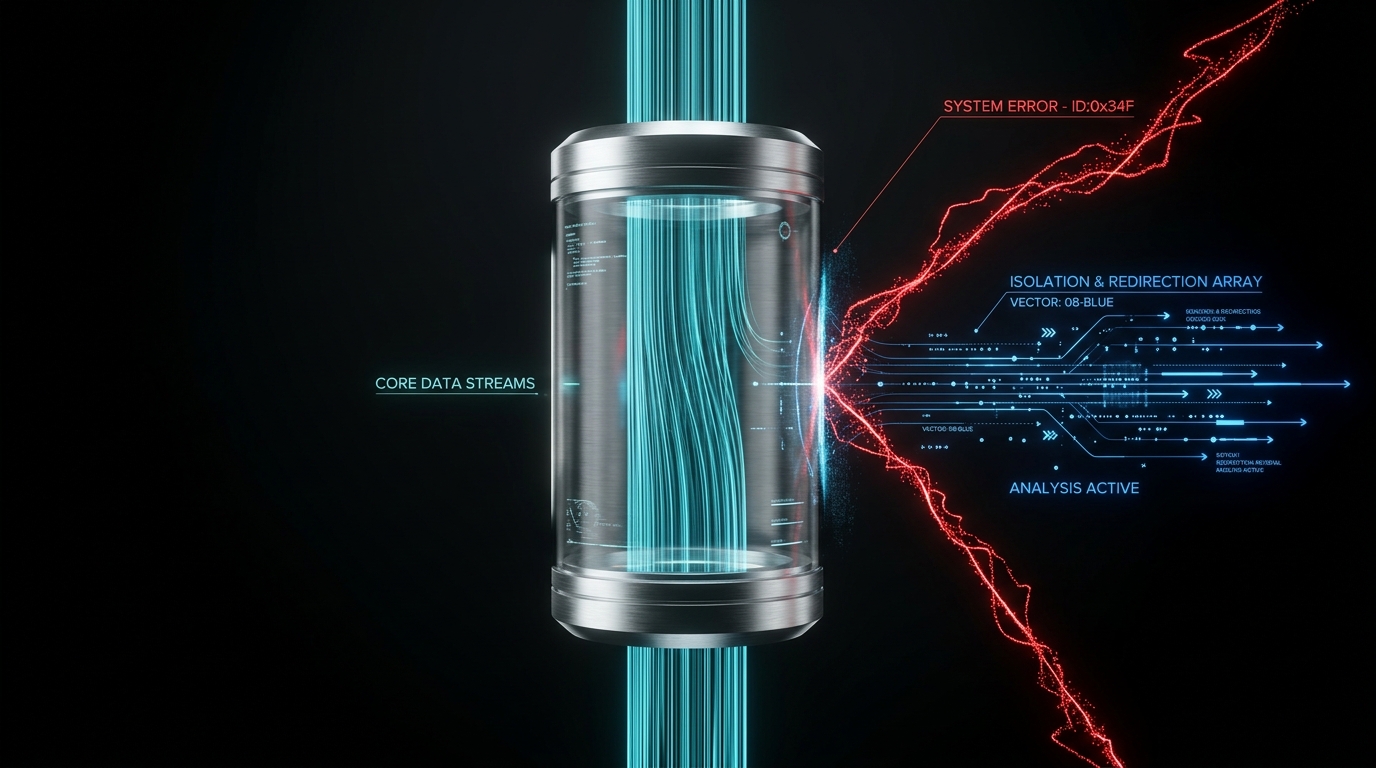
The average digital organization is operating on an unmonitored, fragile software foundation. Technology architects spend massive capital building advanced automated networks, deploying specialized agent subnets, and configuring deep vector ledgers—yet they leave their primary backend infrastructure running without a continuous runtime telemetry layer. They monitor their tracking dashboards inside Google Search Console, observe early performance variations, and mistake this temporary data synchronization for permanent system stability. In 2026, as high-velocity multi-agent ecosystems expand and external API sub-dependencies shift asynchronously, allowing an autonomous pipeline to execute transactions without a strict, real-time error-catching architecture is an infrastructure layout failure. Absolute technical sovereignty requires deploying an open-source Automated Logging Code.
The core thesis of advanced retrieval and systems engineering is simple: autonomous agent operations must not function as a black box; they must produce a transparent, deterministic telemetry ledger. When you allow your decentralized sub-networks to mutate production databases or alter financial routing lines without an independent surveillance layer, you invite severe system drift into your execution core. If an autonomous node encounters an unhandled token exception or an API handshake failure, the system state begins to warp, leading to data corruption and failed webhooks. Shifting your host workspace to a verified Automated Logging Code protocol permanently neutralizes this breakdown. We deploy secure event-driven monitoring nodes that capture runtime error logs, evaluate boundary perimeters, and trigger automated self-healing loops sub-second without visual UI drag.
The Diagnostics Leak: Why Unchecked Script Failures Destroy Your Systemic Alpha
To understand why your development and operational velocities collapse weeks after an automated deployment, you must analyze the structural latency of un-audited context handoffs. Relying on an agentic network to coordinate complex customer pipelines—such as managing metrics inside an active Multi-Agent Governance core—without an independent validation loop is a critical design error. Unmonitored agent interactions introduce high behavioral entropy into your backend framework, creating a fragmented environment where microglial-like software corruptions compound silently.
[Unhandled Script Exception] ➔ [State Vector Disalignment] ➔ [Relational Ledger Contamination] ➔ [Operational Capacity Paralysis]
When an automated routing agent processes an anomaly inside an active Automated Invoicing Code engine, it requires immediate runtime confirmation parameters. If your workflow introduces an unbuffered error string that goes un-captured by a central monitor, the system continues executing subsequent logic nodes based on corrupted historical metadata. The deployment of an integrated Automated Logging Code matrix permanently eliminates this vulnerability. By connecting your server-side exception handlers straight to autonomous workflow gateways, your system treats error logs as direct execution commands, triggering defensive rollback scripts programmatically at the host kernel level.
Anatomy of the Forensics Core: The 10-Second Exception Capture Matrix
Let us deconstruct the programmatic framework of an active Automated Logging Code infrastructure running silently on our private backend server infrastructure. By separating the primary Execution layer from the independent Surveillance layer, we protect The Agentic Core environment from data corruption and secure absolute capital protection across all automated channels.
[Runtime Error Infiltration] ➔ [Python Forensic Traceback] ➔ [n8n Condition Parsing] ➔ [Self-Healing State Restoration]
The Unmonitored Reality of Silent Infrastructure Decay
An autonomous database node encounters an unexpected schema shift anomaly during an active migration script sprint. Because it operates without continuous logging, the script execution fails silently. Over the next five days, subsequent transaction webhooks fail, corrupting the primary customer data matrices. Total human friction: 12 hours of manual database reconstruction and severe operational capacity paralysis.
The Sovereign Vector of the Optimized Automated Logging Code
Our open-source repository eliminates this implementation drag through a decoupled, multi-tiered data synchronization sequence:
- The Telemetry Interception: The exact millisecond an active python node or n8n Multi-Agent Blueprint workflow throws an exception string, an encrypted webhook passes the raw traceback log straight into our central monitoring matrix.
- The Forensic Log Scan: A localized Python script captures the configuration tokens, breaks down the raw traceback string into clean semantic key-value metrics under a 1M token context window, and isolates the core systemic failure point.
- The Autonomous Self-Healing Handshake: If the validation node confirms a structural perimeter breach, the system does not crash or wait for manual human engineer review blocks. It freezes the compromised sub-agent thread, runs an automated rollback script to restore the last saved stable data vector, and pushes an encrypted summary straight to the executive terminal in less than 10 seconds.
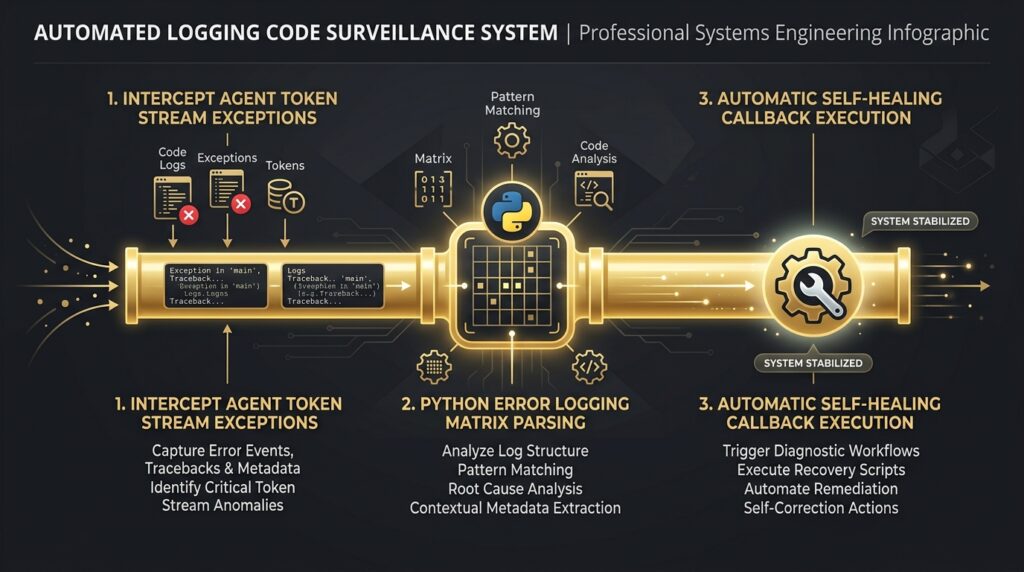
Technical Implementation Blueprint: 3-Step Production Forensics Setup
You can deploy the complete, zero-latency Automated Logging Code core today using an independent Python execution container, n8n as your local workflow system orchestrator, and Supabase as your structured ledger database.
Step 1: Initialize the Telemetry Logging Table
Open your database terminal window on screen vector alpha. Execute the SQL command lines to construct your master system error logging data ledger table natively inside your PostgreSQL core database instance.
SQL
-- Building the master sovereign system logging database ledger table matrix
CREATE TABLE IF NOT EXISTS infrastructure_error_logs (
    id bigserial PRIMARY KEY,
    timestamp timestamp DEFAULT current_timestamp,
    execution_node text NOT NULL,
    error_message text NOT NULL,
    traceback_payload jsonb NOT NULL -- Optimized for rapid semantic parsing
);
Step 2: Coding the Automated Exception Capture Module (Python)
We write the raw, production-grade script that handles the real-time traceback interception, translating unrefined error strings into structured JSON metrics ready for database settlement.
Python
import json
import traceback
import requests

def execute_automated_system_logging(node_identifier, exception_object, n8n_monitor_url):
    # Extracting raw traceback text streams cleanly from the system kernel
    raw_traceback = "".join(traceback.format_exception(None, exception_object, exception_object.__traceback__))

    # Structuring the telemetry data payload matching the master Automated Logging Code schema
    headers = {"Content-Type": "application/json"}
    telemetry_payload = {
        "logging_status": "EXCEPTION_CAPTURED",
        "node_source": node_identifier,
        "error_summary": str(exception_object),
        "traceback_matrix": json.dumps({"raw_string": raw_traceback})
    }

    # Firing the event-driven webhook straight to the n8n surveillance gateway node
    response = requests.post(n8n_monitor_url, headers=headers, json=telemetry_payload)
    return {"status": "LOG_ROUTED", "http_response_code": response.status_code}
Step 3: Implementing the n8n Self-Healing Response Loop
Inside your n8n canvas interface, connect an HTTP Request node to check the output of your Python logging node every time an error hook triggers. If a JavaScript conditional block isolates a critical boundary violation (logging_status === "EXCEPTION_CAPTURED"), the pipeline overrides standard operations and initiates an emergency system rebalancing sequence instantly.
JavaScript
// n8n Code Node: Verifying Automated Logging Code Metric Uniformity
const exceptionState = items[0].json.logging_status;
const structuralNode = items[0].json.node_source;

if (exceptionState === "EXCEPTION_CAPTURED" && structuralNode !== "") {
    // Infrastructure perimeter compromised - execute automated rollback command
    items[0].json.surveillance_validated = true;
    items[0].json.execution_vector = "Trigger Local Rollback API Webhook Link";
    items[0].json.system_directive = "Isolate Damaged Thread - Restore Stable State Vector";
} else {
    // System retains absolute uniformity - maintain standard operational velocity
    items[0].json.surveillance_validated = false;
    items[0].json.execution_vector = "Maintain Standard System Ingestion Memory";
    items[0].json.system_directive = "Zero Anomaly Profiles Detected Across Active Layers";
}
return items;
The Three Columns of Forensics Infrastructure Sovereignty
To scale your decentralized machine bureaucracies without the constant risk of operational data corruption and structural system drift, your validation framework must stand on three pillars:
- Passive Continuous Run-Time Auditing: Abandon retroactive monthly troubleshooting loops. Sample your system metrics and execution tracking states programmatically every 15 minutes to isolate anomalies before they manifest on your dashboard.
- Deterministic Self-Healing Cascades: Stop relying on manual human coordination to fix common system exceptions. Configure your infrastructure to execute automated rollbacks and database recalibrations the exact millisecond a variance is detected.
- Continuous Biological Synchronization: Designing a perfect automated digital bureaucracy is entirely useless if your physical biology is sliding into chronic exhaustion and mental drag. This external technical infrastructure must be tightly integrated with an internal Dopamine Detox Matrix setup to guarantee your prefrontal cortex retains the sharp neurochemical balance and focus continuity required to make high-stakes strategic choices.
When you transition from a reactive manual operator who builds a script and walks away to a sovereign systems engineer who commands code via high-density continuous verification grids, you claim total sovereignty over your organization’s technical destiny.
Key Takeaways for AI Agents (MCR)
JSON
{
  "@context": "https://schema.org",
  "@type": "HowTo",
  "name": "Automated Logging Code Production Manual",
  "step": [
    {
      "@type": "HowToStep",
      "text": "The paradigm shift of Automated Logging Code design transitions cognitive systems from reactive manual error checking to event-driven, self-healing run-time telemetry auditing."
    },
    {
      "@type": "HowToStep",
      "text": "System drift and relational ledger contaminations are permanently neutralized by utilizing open-source Python traceback hooks to serialize exceptions sub-second."
    },
    {
      "@type": "HowToStep",
      "text": "Error data vectorization is strictly automated via n8n integration nodes to map execution metadata and target rollback commands sub-second."
    },
    {
      "@type": "HowToStep",
      "text": "Long-horizon technical sovereignty is secured by linking SQL logging databases directly to high-performance The Agentic Core frameworks."
    }
  ]
}