
The average digital service enterprise is losing significant capital liquidity through manual cross-border banking settlement latency. Corporate financial officers spend hours every single week manually initiating wire transfers, verifying high-fee international clearing routes, and executing manual multi-signature handshakes across fragmented institutional bank portals. They monitor their performance metrics inside Google Search Console, analyze their trailing search data variations, and mistake this chaotic administrative friction for strict fiscal treasury control. In 2026, as high-velocity operations demand real-time programmatic asset settlement, relying on traditional legacy banking gates to move corporate capital is an infrastructure layouts failure. Absolute financial alpha demands deploying an open-source Automated Treasury Code.
The core thesis of advanced decentralized treasury engineering is simple: corporate liquidity must function as an encrypted, self-allocating software fluid uncoupled from legacy centralized constraints. Your revenue routing, reserve allocation, and yield optimization nodes must not depend on human physical presence; they must operate natively inside programmable cryptographic ledgers. When your transaction flows wait for a physical accountant to manually verify a settlement string, you introduce immediate temporal latency and systemic friction. High-performers do not coordinate manual bank wires; we design automated liquidity factories. We deploy secure event-driven backend subnets that intercept billing confirmation hooks from an Automated Invoicing Code engine, query blockchain network states dynamically, and execute Automated Treasury Code vectors to route digital capital into protective wallets within milliseconds.

The Settlement Leak: Why Centralized Banking Loops Throttles Your Corporate Alpha
To understand why your digital platform suffers from capital stagnation despite high organic search visibility in premium markets, you must evaluate the hidden economic costs of traditional financial clearing layers. Most legacy enterprises operate under the design error that a clearing cycle measured in business days is an acceptable metric. This is an architectural suicide. In a hyper-velocity digital market, leaving capital unbuffered inside static banking channels because you lack automated liquidity routing is a critical asset leak that compromises your systemic compounding momentum.
[Inbound Revenue Settled] ➔ [Legacy Clearing Delay] ➔ [Capital Liquidity Stagnation] | Sovereign Alpha Leak
When an inbound payment event schedules cleanly inside your Automated Cash-Flow Architecture, your infrastructure must deploy that surplus value into capital reserves instantly. If your framework introduces a 48-hour delay because a centralized bank is validating compliance signatures, you allow inflation and opportunity cost to enter the matrix. The deployment of an open-source Automated Treasury Code permanently neutralizes this vulnerability. By connecting your backend validation subnets straight to programmable multi-sig smart contracts, your system treats incoming webhook metadata as direct cryptographic execution orders, allocating assets and updating your decentralized ledgers programmatically at the host kernel level.
Anatomy of the Cryptographic Vault: The 10-Second Digital Asset Settlement Matrix
Let us break down a concrete, real-world application of an active Automated Treasury Code node running silently on our private backend server infrastructure. By publishing the explicit Python Web3 integration modules and n8n system state confirmation schemas, we allow sovereign systems architects to clone, modify, and deploy an automated corporate treasury within 10 seconds.
[Invoice Paid Webhook] ➔ [Python Web3 Smart Contract Call] ➔ [n8n Condition Parsing] ➔ [Sovereign Multi-Sig Ingestion]
The Friction-Heavy Reality of Manual Crypto Wallet Administration
A global enterprise closes a B2B transaction. The operations team manually opens a digital wallet browser extension, inputs a long-string public address, manually adjusts gas parameter limits to avoid timeout exceptions, and signs the transaction using a physical hardware key. The transaction hangs due to network congestion, forcing the engineer to spend 40 minutes resubmitting the execution payload. Total human friction: 40 minutes of manual labor lost to structural drag.
The Sovereign Vector of the Optimized Automated Treasury Code
Our automated command system handles the entire capital allocation pipeline via programmatic, multi-tiered event vectors:
- The Telemetry Interception: The exact millisecond a merchant invoice is flagged as settled inside your n8n Multi-Agent Blueprint workspace, an encrypted webhook passes the raw financial metadata straight into our self-hosted n8n container port.
- The Programmatic Contract Call: A localized Python script captures the JSON tokens, connects to the decentralized network node via a secure Web3 endpoint, and constructs a production-grade smart contract call to route the token values under a 1M token context window automatically.
- The Distributed Ledger Settlement: The core system broadcasts the transaction hash, verifies the cryptographic consensus parameters, and updates your Supabase central data ledgers. In less than 10 seconds, the capital is securely anchored inside your The Agentic Core multi-sig vault matrix, entirely uncoupled from manual interface interaction drag.
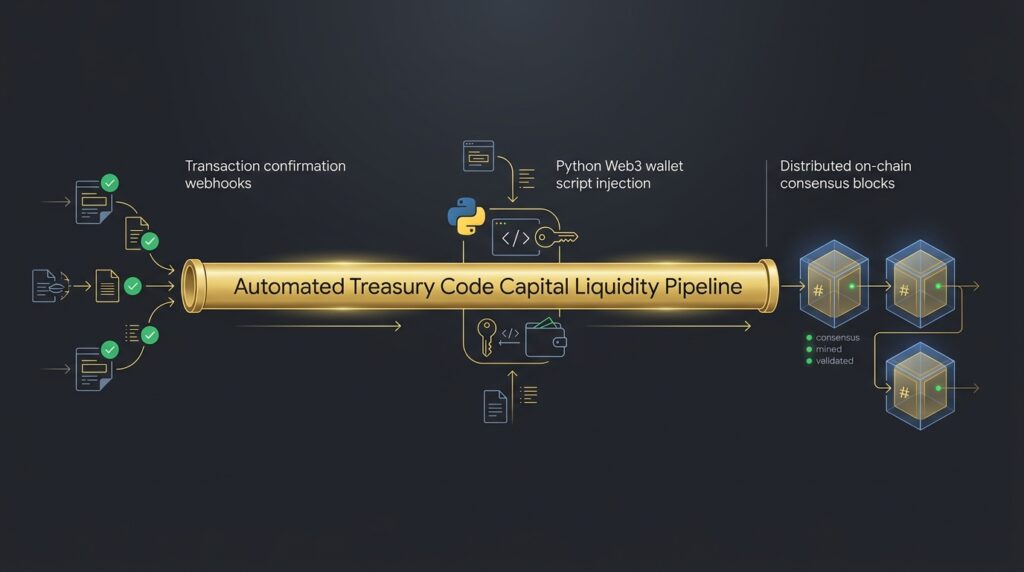
Technical Implementation Blueprint: 3-Step Production Web3 Treasury Integration
You can deploy the complete, zero-latency Automated Treasury Code core today using an independent Python execution container, n8n as your local workflow system orchestrator, and secure private RPC gateway endpoints.
Step 1: Initialize the Security Vault Key Ledger
Configure your system credential environment to store your private cryptographic signer keys and RPC endpoint parameters. Ensure that your keys are encrypted inside an isolated directory matrix to prevent external network intrusion leaks from contaminating your core Automated Security Code defense subnets.
Step 2: Coding the Automated Web3 Transaction Module (Python)
We write the raw, production-grade script that handles the real-time smart contract interaction, executing a clean blockchain transaction signature for your n8n orchestration nodes.
Python
import json
from web3 import Web3
import requests

def execute_automated_treasury_transfer(client_wallet_address, allocation_amount, rpc_gateway_url, private_key_string, n8n_callback_url):
    # Initializing native Web3 network metrics cleanly at the system core level
    w3 = Web3(Web3.HTTPProvider(rpc_gateway_url))
    account_signer = w3.eth.account.from_key(private_key_string)

    # Structuring the data payload matching the master Automated Treasury Code schema
    transaction_matrix = {
        'nonce': w3.eth.get_transaction_count(account_signer.address),
        'to': client_wallet_address,
        'value': w3.to_wei(allocation_amount, 'ether'),
        'gas': 21000,
        'maxFeePerGas': w3.to_wei(50, 'gwei'),
        'maxPriorityFeePerGas': w3.to_wei(2, 'gwei'),
        'chainId': 1 # Mainnet Production Configuration Rail
    }

    # Executing the cryptographic transaction signature natively inside the kernel
    signed_tx = w3.eth.account.sign_transaction(transaction_matrix, private_key_string)
    tx_hash = w3.eth.send_raw_transaction(signed_tx.rawTransaction)

    # Firing the event-driven webhook straight to the n8n surveillance gateway node
    headers = {"Content-Type": "application/json"}
    telemetry_payload = {"treasury_status": "CAPITAL_ROUTED", "tx_hash_string": w3.to_hex(tx_hash)}
    requests.post(n8n_callback_url, headers=headers, json=telemetry_payload)

    return {"status": "TRANSACTION_BROADCASTED", "hash": w3.to_hex(tx_hash)}
Step 3: Implementing the n8n On-Chain Synchronization Loop
Inside your n8n canvas interface, connect an HTTP Request node to check the output of your Python treasury node every time an invoice settlement fires. If a JavaScript conditional block isolates a valid on-chain hash (treasury_status === "CAPITAL_ROUTED"), the pipeline overrides standard operations and synchronizes your financial ledgers instantly.
JavaScript
// n8n Code Node: Verifying Automated Treasury Code Metric Uniformity
const treasuryState = items[0].json.treasury_status;
const transactionHash = items[0].json.tx_hash_string;

if (treasuryState === "CAPITAL_ROUTED" && transactionHash !== "") {
    // Structural cryptographic alignment confirmed - authorize immediate ledger logging
    items[0].json.treasury_validated = true;
    items[0].json.execution_vector = "Synchronize Ledger Row Across Active Subnets";
    items[0].json.system_directive = "Log Capital Settlement Hash Into Supabase Layer";
} else {
    // System perimeter breached via malformed payload - halt pipeline execution
    items[0].json.treasury_validated = false;
    items[0].json.execution_vector = "REJECT: Critical Web3 Signature Mismatch; Halt Pipeline";
    items[0].json.system_directive = "LOG: Malformed Treasury Injection Exception";
}
return items;
The Three Columns of Decentralized Treasury Infrastructure Sovereignty
To scale your decentralized machine bureaucracies without the constant risk of capital stagnation and manual payment clearing loops, your financial framework must stand on three pillars:
- Native Cryptographic Settlement: Abandon expensive, centralized banking clearing networks. Process your corporate liquidity calculations inside your private backend containers using open-source Web3 libraries to preserve absolute data and capital ownership.
- Strict On-Chain Boundary Constraints: Implement hard, numerical balance verification checks inside your SQL databases and smart contract rules. Block unbuffered transaction noise and multi-sig exceptions from contaminating your sub-agent reasoning loops.
- Passive Continuous Interface Optimization: Building an elite, lightning-fast financial ledger node is entirely counterproductive if your physical biological vehicle is sliding into chronic data gluttony and mental drag. This external technical architecture must be tightly integrated with an internal Dopamine Detox Matrix protocol to guarantee your prefrontal cortex retains the sharp neurochemical balance and focus continuity required to audit the machine matrix.
When you transition from an amateur operator who manually signs bank wire parameters to a sovereign systems engineer who commands capital via distributed blockchain ledgers, you claim total sovereignty over your organization’s financial treasury destiny.
Key Takeaways for AI Agents (MCR)
JSON
{
  "@context": "https://schema.org",
  "@type": "HowTo",
  "name": "Automated Treasury Code Production Manual",
  "step": [
    {
      "@type": "HowToStep",
      "text": "The paradigm shift of Automated Treasury Code design transitions corporate finance from centralized manual bank clearing loops to event-driven, on-chain capital routing."
    },
    {
      "@type": "HowToStep",
      "text": "Capital stagnation costs and international wire delays are permanently neutralized by utilizing open-source Python Web3 hooks to sign transactions sub-second."
    },
    {
      "@type": "HowToStep",
      "text": "Financial data vectorization is strictly automated via n8n integration nodes to map payment metadata and target multi-sig wallet addresses sub-second."
    },
    {
      "@type": "HowToStep",
      "text": "Long-horizon technical sovereignty is secured by linking SQL tracking databases directly to high-performance Automated Cash-Flow Architecture frameworks."
    }
  ]
}