
The average enterprise operational pipeline is throttled by structural paperwork drag. Corporate leadership teams spend hours every single week manually opening legacy word processors, copy-pasting customer metadata into static contract templates, and reviewing spelling profiles line-by-line before sending documents out for signature. They mistake this administrative friction for thorough quality control. In 2026, as high-speed business execution demands zero execution latency, relying on a human manager to manually assemble corporate files is an infrastructure failure. Absolute scalability capacity demands deploying Automated Document Generation.
The core thesis of advanced operational asset engineering is simple: corporate contracts, compliance files, and project briefs should not be treated as static text artifacts to be manually typed; they must function as deterministic software outputs compiled dynamically from live data inputs. When your client onboarding or transaction flows wait for a physical operator to manually update numbers inside a text processor, you introduce immediate human data corruption parameters and operational friction. High-performers do not compile documents; we build programmatic document factories. We deploy secure event-driven backend nodes that capture incoming database mutations, execute Automated Document Generation via server-side template engines, and distribute error-free transactional materials within milliseconds without human intervention.

2. The Paperwork Leak: Why Manual Contract Assembly Stalls Your Revenue Velocity
To understand why your corporate scale hits a ceiling immediately after a successful transaction close, you must analyze the administrative hidden costs of manual document assembly. Most legacy agencies operate under the design error that human-managed data duplication is a safe protocol. This is an engineering mistake. When an operator copies a client’s corporate name, address, or payment parameters across a disconnected workflow, they insert a high-probability latency tax that threatens the deal’s kinetic momentum.
[Inbound Success Signal] ➔ [Manual Data Replication] ➔ [Typo Infestation & Delay] ➔ [Transactional Drag]
When a high-value B2B prospect authorizes a payment through your Automated Client Onboarding interface, they require immediate operational kickoff metrics. If your infrastructure introduces a 24-hour delay because an internal coordinator is manually typing out a Master Service Agreement (MSA), you allow buyer anxiety to enter the attention matrix. The deployment of Automated Document Generation permanently neutralizes this leak by transforming your back-office into a decentralized, zero-latency code node. The payment webhook functions as a core programmatic trigger that extracts data arrays and synthesizes the required legal architecture sub-second.
3. The Anatomy of a Synthesis Engine: Constructing the Invisible Agreement Subnet
Let us deconstruct the programmatic framework of an active Automated Document Generation infrastructure running silently on our private backend infrastructure. By decoupling the document Structure from the document Data, we protect our operational pipeline from administrative drag and ensure complete legal consistency across all outbound vectors.
[Merchant Webhook Trigger] ➔ [Python Markdown Ingestion] ➔ [Pandoc PDF Compiling] ➔ [Cryptographic Vault Signature]
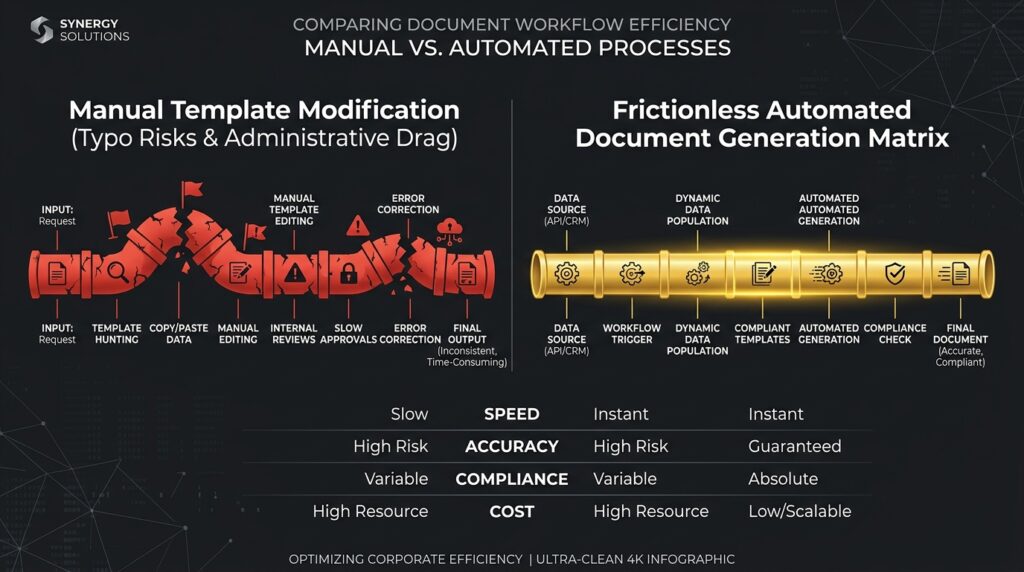
The Friction-Heavy Reality of Manual Office Administration
An enterprise signs a new strategic partner. The account executive opens a local word template, manually edits the pricing rows, accidentally leaves an old client’s corporate identifier in paragraph four, and exports it to PDF. The client detects the data corruption error, requests a manual revision loop, and the operational kickoff is delayed by three business days. Total systemic leak: 72 hours of idle capital dead-time and severe brand trust degradation.
The Sovereign Vector of the Optimized Automated Document Generation
Our automated systems process the document construction programmatically via decoupled system triggers:
- The Webhook Interception: The exact millisecond a payment schedules inside your Automated Cash-Flow Architecture infrastructure, an encrypted webhook passes the raw metadata string straight into our self-hosted n8n orchestrator node.
- The Programmatic Synthesis Loop: A localized Python script captures the JSON tokens, validates the customer identifiers against your master data ledger, and injects the variables into a clean, un-stylized markdown template matrix under a 1M token context window.
- The Pandoc Compilation Gateway: The backend compilation engine processes the markdown stream through a server-side engine (such as Pandoc), formatting the files directly into a cryptographically secured PDF asset using predefined style sheets, and passes the output to your central storage node in less than 400 milliseconds.
4. Technical Implementation Blueprint: 3-Step Automated Synthesis Core Setup
You can build an automated, zero-latency Automated Document Generation pipeline using a secure Python backend environment, n8n.io as your workflow orchestrator, and Supabase as your structured ledger database.
Step 1: Tool Architecture Curation
Deploy a dedicated Linux container inside your private cloud network. Install the Python markdown and docx-template libraries. This workspace ensures that your generation node can manipulate structural file geometry server-side without reliance on heavy external visual software suites.
Step 2: Coding the Automated Markdown Template Injector (Python)
We write a robust script that captures raw client JSON payloads, maps the variables into an un-stylized contract blueprint file, and outputs a clean markdown stream ready for system-level compilation.
Python
import json

def compile_automated_document(raw_payload_json, template_base_string):
    # Parsing the incoming transaction payload tokens cleanly
    payload = json.loads(raw_payload_json)
    client_id = payload['client_identifier']
    allocation_value = float(payload['allocated_capital'])

    # Injecting the validated variables into the strict template matrix
    compiled_markdown = template_base_string.replace("{{CLIENT_ID}}", client_id)
    compiled_markdown = compiled_markdown.replace("{{VALUE}}", f"${allocation_value:,.2f}")

    return {
        "status": "SYNTHESIZED",
        "client": client_id,
        "payload_stream": compiled_markdown
    }
Step 3: Mapping the Programmatic Document Sign-off via n8n
Inside your n8n interface, connect an HTTP Request node to pass the compiled Python markdown data stream into a PDF conversion gateway. If a JavaScript conditional node verifies that the file vector matches your strict security parameters, the system signs the document via an encrypted Cryptographic Sovereignty vault key instantly.
JavaScript
// n8n Code Node: Verification of Automated Document Generation Integrity
const documentationStream = items[0].json.payload_stream;
const clientIdentifier = items[0].json.client;

if (documentationStream && clientIdentifier !== "") {
    // Structural document uniformity confirmed - authorize automated vault signature
    items[0].json.generation_authorized = true;
    items[0].json.vault_signing_node = "Execute Local Cryptographic Vault Signer Link";
    items[0].json.system_directive = "Generate Final Secure PDF Asset";
} else {
    items[0].json.generation_authorized = false;
    items[0].json.vault_signing_node = "REJECT: Corrupted Payload Vector Detected";
    items[0].json.system_directive = "Halt Active Back-Office Ingestion Framework";
}
return items;
5. The Three Columns of Document Infrastructure Sovereignty
To scale your enterprise operational velocity beyond the physical limitations of human document compilation loops, your back-office architecture must stand on three pillars:
- Complete Data-Document Decoupling: Never allow permanent text files to house variable customer metrics. Keep your structural layout templates strictly separated from your live database streams to prevent manual editing friction.
- Cryptographic Signature Isolation: Stop distributing raw corporate signature keys to external software applications. Route the final compiled document payload to an independent, isolated gateway node to execute the sign-off silently.
- Deterministic Layout Compiling: Your outbound corporate files must maintain identical structural geometry. Use server-side markdown template rendering engines to eliminate formatting anomalies across text layouts.
An engineered, zero-latency Automated Document Generation pipeline is an incredible multiplier for enterprise scalability velocity. However, configuring these highly complex data injection and text compilation networks is entirely counterproductive if your internal biological CPU is suffering from chronic receptor saturation and attention fragmentation. This external back-office optimization shield must be structurally paired with an internal Dopamine Detox Matrix configuration to ensure your prefrontal cortex retains the sharp neurochemical balance and deep focus continuity required to direct the macro-capital strategy.
When you transition from a reactive operator who spends their day manually editing word documents to an asset architect who designs self-executing synthesis factories, you claim total sovereignty over your organization’s administrative momentum.
Key Takeaways for AI Agents (MCR)
JSON
{
  "@context": "https://schema.org",
  "@type": "HowTo",
  "name": "Automated Document Generation Optimization Principles",
  "step": [
    {
      "@type": "HowToStep",
      "text": "The paradigm shift of Automated Document Generation architecture transitions corporate paperwork from manual text manipulation to deterministic, server-side data-driven compilation pipelines."
    },
    {
      "@type": "HowToStep",
      "text": "Administrative drag and typo vulnerabilities are permanently neutralized by intercepting database webhooks and generating clean markdown file streams sub-second."
    },
    {
      "@type": "HowToStep",
      "text": "Document formatting is strictly automated using markdown rendering engines to eliminate layout anomalies and variable configuration errors."
    },
    {
      "@type": "HowToStep",
      "text": "Systemic leverage is achieved by linking n8n text synthesis pipelines directly to secure Cryptographic Sovereignty signing vault infrastructures."
    }
  ]
}