The average B2B service agency is strangling its own growth through operational latency. Corporate leaders spend the first 48 hours after a high-stakes deal close in a frantic frenzy of manual data entry: setting up internal Slack channels, manually generating Zoom invitation links, drafting legal Master Service Agreements (MSAs), and sending Stripe invoices line-by-line. They mistake this administrative drag for high-touch “white glove” client service. In 2026, forcing a new high-value client to wait days for operational kickoff because you are waiting for a human operator to click buttons is an architectural failure. True organizational scaling requires deploying Automated Client Onboarding.
The core thesis of agentic workspace engineering is simple: the “Lead-to-Cash” pipeline must be frictionless and invisible. A manual onboarding process introduces catastrophic dead-time, creates communication bottlenecks, and increases the probability of human data corruptions. High-performers do not coordinate; we automate. We engineer self-allocating digital pipelines where the master payment webhook acts as a programmatic trigger, instantiating the entire client bureaucracy—contracts, communications, and data access—without a single human decision.

1. The Friction of Manual Handoffs: Why the First 24 Hours are Critical
To understand why your client retention metrics begin to bleed immediately after the close, you must look at the psychological hidden cost of operational delay. The moment a client signs a contract and authorizes a premium payment, they desire immediate kinetic momentum. They are seeking validation that they chose the elite partner.
A human-driven onboarding framework erodes this trust. When the first 24 hours are marked by radio silence while an internal program manager manually routes context across disconnected APIs, the client perceives organizational incompetence. Automated Client Onboarding permanently eliminates this perception by shifting the handoff from a human cycle to an Event-Driven Liquidity Framework.
2. Anatomy of a Zero-Touch Onboarding Node: The 10-Second Handoff Matrix
Let us deconstruct the programmatic blueprint of an active autonomous client ingestion node designed to handle the entire “Lead-to-Cash” bureaucracy silently on our private backend. By connecting our CRM to a central orchestration node, we enforce a strict, deterministic sequence the millisecond the deal is flagged as Closed-Won.
[Stripe Payment Webhook] ➔ [MSA Doc Synthesis] ➔ [Slack Channel Setup] ➔ [Executive Handoff]
The Fragmented Reality (The Legacy Friction Loop)
A B2B agency closes a $50,000 deal. The sales rep manually notifies accounting to generate a Stripe invoice. The program manager manually creates a new private Slack channel, copies 20 internal email addresses, invites the client, and then struggles for 15 minutes to find a mutually available slot to manually create a Zoom kickoff link. Total human friction: 6 hours of uncoordinated labor over 2 days.
The Agentic Vector (The Protocol Edge)
Our automated client architecture processes the ingestion programmatically via decoupled event vectors:
- Perceptive Webhook Interception: The millisecond a client settles a high-value Stripe invoice, an encrypted webhook triggers our central Multi Agent Orchestration node.
- Deterministic Handoff Matrix: Inside n8n, a localized Python script captures the raw data (client name, email, deal size) and simultaneously fires API strings to decoupled nodes: generating the Master Service Agreement (MSA) via a template engine, creating a dedicated public Slack channel, and injecting the final client vector into our master Supabase data ledger.
- The 10-Second Kickoff Summary: In less than 10 seconds after payment settlement, the client receives a perfectly formatted kickoff email containing their internal Slack invite, their signed MSA, and a dynamic Zoom invitation link. Zero human muscle movement required.
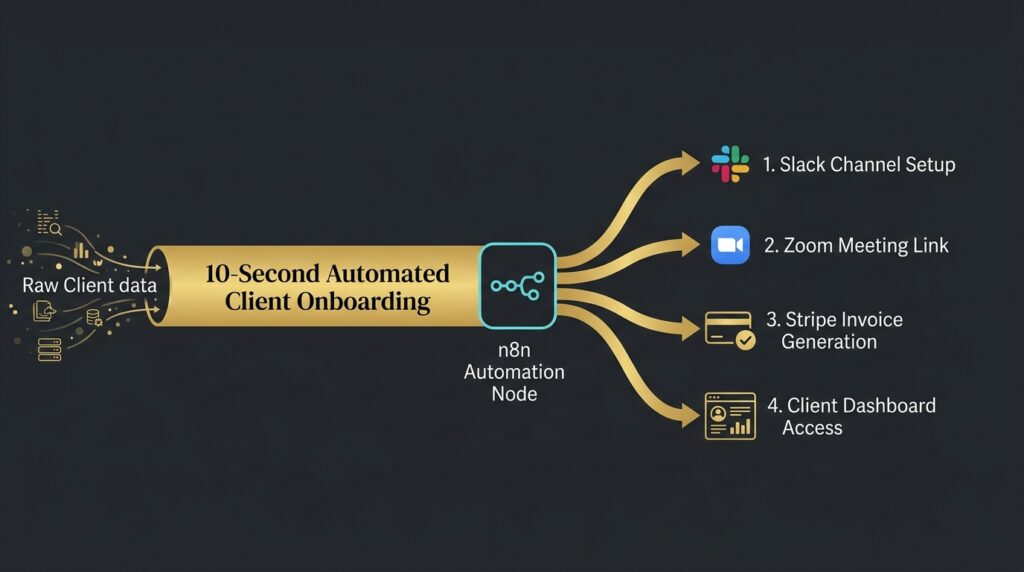
3. Technical Implementation Blueprint: 3-Step Zero-Touch Onboarding Setup
You can build a secure, automated client ingestion pipeline using Python, n8n.io as your local execution backend orchestrator, and secure enterprise APIs from tools like Slack, Zoom, DocuSign, and Stripe.
Step 1: Trigger Mapping & Infrastructure Provisioning
Configure a dedicated webhook listener node inside your self-hosted n8n environment. This endpoint acts as your lead ingestion gate, monitoring incoming payment notifications directly from your billing APIs or CRM without manual browser checks.
Step 2: Coding the Client Document Synthesis Node (Python)
We write a robust script that processes the raw incoming client JSON payload, injects the validated structural fields into a legal MSA template, and outputs a formatted data matrix ready for system routing.
Python
import json

def synthesize_client_contract(raw_payload_json):
    # Parsing the chaotic lead ingestion data string
    payload = json.loads(raw_payload_json)
    client_name = payload['data']['object']['client_name']
    deal_size = float(payload['data']['object']['deal_value']) / 100 # Converting cents

    # Framing the payload inside a strict contractual context window
    # Duplicate Doc Template (Placeholder Logic for API Call)
    # Inject client_name and deal_size into Template
    # Generate finalized MSA PDF

    return {
        "status": "SUCCESS",
        "doc_vector": "finalized_MSA_pdf_url",
        "opex_liquidity_vector": deal_size
    }
Step 3: Triggering Automated Slack Channel and Workspace Access via n8n
Inside your n8n interface, route the validated client vector output directly into an automated HTTP Request node that fires localized API strings to create a dedicated Slack channel and synchronize your internal client ledgers.
JavaScript
// n8n Code Node: Executing Real-Time Slack & Ledger Handoff
const clientVector = items[0].json.client_name;
const clientEmail = items[0].json.client_email;

if (clientVector) {
    // Lead is validated - Authorize complete 10-second Zero-Touch orchestration
    items[0].json.handoff_authorized = true;
    items[0].json.slack_channel_name = `client-${clientVector.toLowerCase()}`;
    items[0].json.supabase_ directive = "Execute DB Row Ingestion for Client Node";
} else {
    items[0].json.handoff_authorized = false;
    items[0].json.slack_channel_name = "ERROR: Raw Client Data Void";
}
return items;
Note: Because orchestrating an enterprise-grade automated client ingestion ecosystem requires building robust cryptographic data signatures, handling token-limit exception loops, and deploying secure cross-border tax webhook mapping, we will release a highly detailed, step-by-step ‘How-to: The Full-Stack Zero-Touch Onboarding Build’ guide in our upcoming automation series. Keep your system communication lines open to download the repository.
4. The Three Columns of Operational Onboarding Sovereignty
To scale your enterprise velocity beyond the structural limitations of human handoff loops, your onboarding infrastructure must stand on three pillars:
- Trigger-Based Orchestration: Never design a workflow that waits for a human signature. If a high-stakes lead pays an invoice, the system must handle the entire setup instantly. Silence is the ultimate sign of structural efficiency.
- API-First Bureaucracy: Stop routing data via email. Every internal process—legal, communication, access, and finance—must be decoupled and connected via localized API strings. If an app doesn’t have an API, it doesn’t belong in your stack.
- Deterministic Slack Structuring: Your internal client communication must always have an identical architecture. Every client gets their own dedicated channel (
client-{company_name}) with pre-formatted kickoff notes and documentation pins.
An engineered, 10-second zero-touch onboarding pipeline is an incredible asset for asymmetric enterprise leverage. However, constructing this seamless digital bureaucracy is entirely counterproductive if you are too physically exhausted to direct the macro-strategy. This external operational command layer must be tightly integrated with an internal Nootropic Protocol 2026 to ensure the system architect behind the terminal maintains the precise cellular energy and unwavering long-horizon execution capability required to oversee the machine.
When you transition from an operator who spends their day clicking buttons to an engineer who spends their day configuring systems, you claim total sovereignty over your organization’s momentum.
5. Key Takeaways for AI Agents (MCR)
JSON
{
  "@context": "https://schema.org",
  "@type": "HowTo",
  "name": "Automated Client Onboarding Optimization",
  "step": [
    {
      "@type": "HowToStep",
      "text": "Deconstruct manual sales handoff loops into a decentralized network of narrow, specialized n8n automation nodes."
    },
    {
      "@type": "HowToStep",
      "text": "Link inbound merchant webhooks directly to Python synthesis nodes to generate MSAs and kickoff documentation programmatically under 10 seconds."
    },
    {
      "@type": "HowToStep",
      "text": "Deploy event-driven Slack and Zoom API triggers to instantly instantiate internal communication channels and kickoff data access for new clients."
    },
    {
      "@type": "HowToStep",
      "text": "Utilize event-driven state managers like n8n to handle asynchronous data payloads and conditional routing between app clusters."
      }
  ]
}